
Why Cherrapunji Gets So Much Rain and Its Hills Are Still Bare
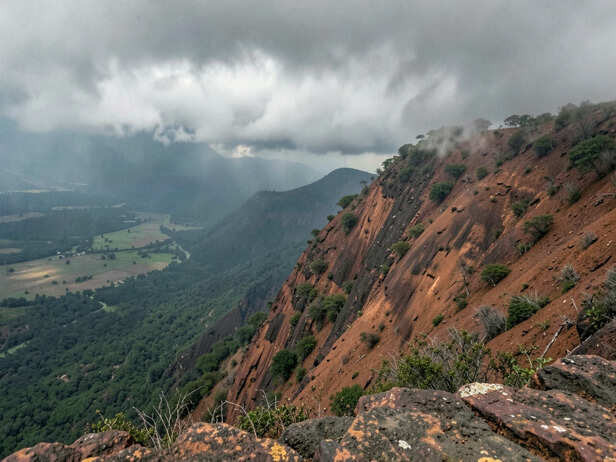
Cherrapunji holds a place in most people's minds as the wettest place on earth, a fact repeated in school textbooks and travel articles with equal confidence. The reality is more specific and more interesting than the superlative. The rain here is not simply heavy. It arrives in a particular way, for a particular reason, and it leaves behind a landscape that looks like it should belong somewhere else entirely.
The Wall the Clouds Cannot Cross
Cherrapunji, known locally as Sohra, sits on the southern edge of the Meghalaya plateau at roughly 1,400 metres. Below it, the land drops sharply toward the Sylhet plains of Bangladesh, which sit nearly at sea level. The Bay of Bengal pushes warm, wet air northward. That air travels across flat ground until it hits the southern face of the plateau, which rises almost like a wall. With nowhere horizontal to go, the air is forced upward. As it climbs, it cools. Cooled air cannot hold as much moisture as warm air, so the moisture falls as rain. This process, called orographic lift, is the engine behind Cherrapunji's rainfall. The plateau acts as a ramp, and the clouds have no choice but to empty themselves against it.
Why the Rain Comes All at Once
The rainfall here is not spread across the year. It is concentrated in a few months when the southwest monsoon drives moisture-laden air from the Bay of Bengal directly into this funnel. During those months, rainfall totals can reach figures that seem implausible: a single day's rain here can exceed what many cities receive in a year. The rest of the year, the winds shift. The air that arrives from the north and northeast has already crossed the plateau and lost most of its moisture. The same geography that forces rain out of clouds in one season leaves the hills dry in another. The mechanism works in both directions.
What the Rain Does to the Ground
This is where the bare hills come in. Intense, concentrated rainfall does not behave the same way as steady, distributed rainfall. When rain falls this hard and this fast, the ground cannot absorb it quickly enough. Water runs off the surface rather than soaking in. It carries topsoil with it as it goes. Over many decades, this surface runoff has stripped the hillsides around Cherrapunji of much of their topsoil, leaving exposed laterite, a reddish, iron-rich rock that supports very little vegetation. The irony is precise: the rain that makes this one of the wettest places on the planet is also the reason the hills look as though they have been through a drought. The water never stays long enough for the soil to hold it.
The Forest That Was and the Roots That Remain
The hills were not always bare. The plateau once carried dense subtropical forest, and in the deeper valleys and in areas where the slope is gentler, pockets of that forest still exist. The Khasi people who have lived in these hills for centuries developed a practice that speaks directly to the problem of water and roots: the living root bridges. Ficus elastica, the Indian rubber tree, sends out aerial roots that can be trained over years and decades to cross a stream and take hold on the other side. These bridges, some of them several hundred years old, are not built in the conventional sense. They are grown. They hold because the roots are alive and continue to grip the bank. They are also a practical response to a landscape where wooden bridges rot quickly in the relentless wet. The forest knowledge behind them is specific to this place and its particular relationship with water.
Two Records, One Place
Cherrapunji and the nearby village of Mawsynram have traded the title of world's wettest place depending on which period of measurement is used and which gauge is consulted. Mawsynram sits a few kilometres to the west on the same plateau edge and benefits from the same orographic mechanism, though its bowl-shaped topography may funnel clouds even more efficiently. The competition between the two is less interesting than what they share: both sit on the same geological edge, both face the same plains, and both receive rain through the same process. The record is almost beside the point. What matters is the structure that produces it, and that structure is the same in both places.
The bare hills and the extraordinary rainfall are not opposites. They are the same story told from two angles. The plateau's edge catches the clouds and wrings them out. The intensity of what falls makes it impossible for the ground to hold. The landscape that results is stripped by the very thing that defines it, which is as good a description of Cherrapunji as any superlative in a record book.
Unlock insightful tips and inspiration on personal growth, productivity, and well-being. Stay motivated and updated with the latest at My Life XP.