
How to Pack for a Mountain Week and a Coastal Week in One Bag
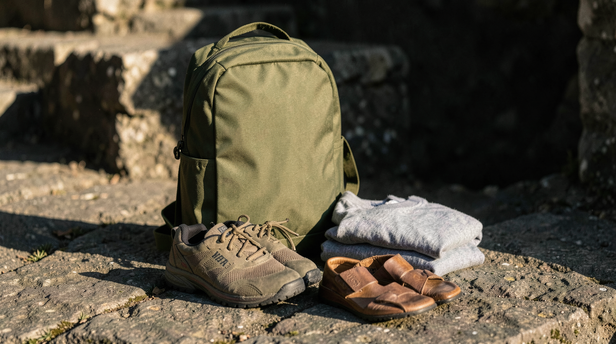
The problem with packing for two climates in one bag is not the bag. It is the assumption that each place needs its own wardrobe. Mountains ask for warmth and layers. Coasts ask for lightness and quick drying. The overlap between those two demands is larger than it first appears, and building a bag around that overlap is the whole exercise.
Start With What the Environments Share, Not What Separates Them
Both a mountain trail and a beach town involve physical activity, variable light, and the need to look presentable at dinner. Both expose your skin and your clothing to sun. Both involve uneven ground at some point. The clothing that handles all of that, a mid-weight merino layer, a pair of dark quick-dry trousers that read as casual, a structured waterproof shell that compresses small, works in both settings without looking like it is trying to. The mistake most people make is packing for the extreme version of each place: the coldest possible mountain night and the hottest possible beach afternoon. Pack for the middle of each, and carry one item for each extreme.
The Layer Logic That Replaces the Separate Wardrobe
A mountain week is built on a base, a mid-layer, and a shell. A coastal week is built on the base alone, with the shell available if an evening turns cool or a ferry crossing gets wet. This means the mid-layer is the only piece doing single-environment work. Choose it carefully: a lightweight down gilet or a thin fleece that compresses to the size of a water bottle. It earns its weight on the mountain and disappears into the bag at the coast. The base layers, two or three merino or synthetic T-shirts, travel through both weeks without comment. Merino in particular handles temperature range and odour in a way that synthetic fibres in cheaper options do not, which matters when the bag has to last the full run without a laundry stop in between.
Footwear Is Where the Bag Gets Heavy or Stays Light
Three pairs of shoes for two weeks is how a bag doubles in weight. The answer is two pairs with one doing double duty. A low-cut trail shoe with a grippy sole handles most mountain day walks and reads as a casual sneaker at a coastal café. A pair of flat sandals with a strap across the instep covers beach, town, and dinner. The only scenario that breaks this is a technical mountain route that genuinely requires ankle support and a stiff sole, in which case the trail shoe becomes a proper hiking boot and the sandal still covers the coast. What does not make the cut is a dedicated pair of flip-flops that cannot do dinner and a pair of gym shoes that cannot do a path.
The Coastal Items That Do Not Belong on a Mountain
A swimsuit, a sarong, and reef-safe sunscreen are the only pieces that are purely coastal. They are also small. A sarong folds to the size of a paperback. A swimsuit folds smaller. These three items take up less combined space than one extra pair of jeans. The temptation is to pack more beach-specific clothing, cover-ups, linen shirts, wide-brim hats, and this is where the bag fills before the mountain gear goes in. A linen shirt that crushes without creasing works at the coast. A wide-brim hat that collapses into the bag works. A structured straw hat does not.
Toiletries and the Weight That Accumulates Without Notice
The difference between a mountain and a coastal environment is humidity. High humidity at the coast means hair behaves differently, skin holds moisture differently, and the sunscreen that sits fine in dry hill air may feel heavy by the sea. One moisturiser with SPF built in covers both. A light facial mist that doubles as a setting spray handles the coast's humidity and the mountain's dry air equally. Decant everything into containers that are the same size, it makes the toiletry bag pack flat rather than lumpy, and a flat toiletry bag slides into a gap where a lumpy one does not.
How to Actually Fit It All
The bag that works for this trip is a 40-litre pack or a medium duffel with a structured base, large enough to carry a week's worth of clothing with room for the shell, small enough to go into overhead storage without negotiating. Pack the heaviest items, boots if you have them, the shell, the toiletry bag, against the back panel or the base. Roll soft items rather than folding them; a rolled merino T-shirt takes up roughly half the space of a folded one. The sandals go at the top, because they come out first at the coast. The mid-layer goes in last, because it comes out first on the mountain.
The bag that covers two weeks in two climates is not a compromise. It is a more honest version of what you actually wear, the pieces that do real work in more than one setting, chosen over the pieces that feel right at the packing stage and sit untouched at the bottom for a fortnight.
Unlock insightful tips and inspiration on personal growth, productivity, and well-being. Stay motivated and updated with the latest at My Life XP.