
Why Cappadocia's Cave Rooms Were Cut Into Rock, Not Built From It
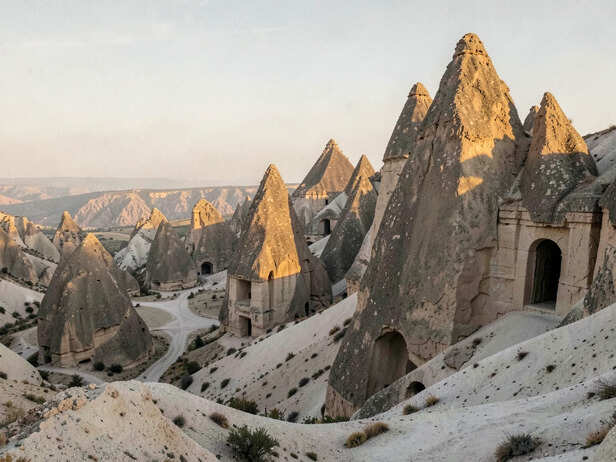
The first thing that surprises most people about Cappadocia's cave rooms is not how many there are, but how precise they look. Arched doorways, smooth interior walls, niches cut at consistent heights, these are not rough shelters hacked into a cliff face in desperation. They are rooms, built with intention, and the material they are cut from is the reason they could be made that way.
The Rock Beneath the Landscape Has a Name and a Story
The material is tuff, sometimes written tufa in older texts, though the two are technically different things. Tuff is consolidated volcanic ash, the compressed debris left after eruptions from the Erciyes, Hasan, and Güllü Dağ volcanoes blanketed the region over millions of years. The ash settled in deep layers, compacted under its own weight, and slowly cemented into a pale, porous stone that looks solid but behaves more like firm clay than like granite or limestone.
The key property is what geologists call differential hardness. Freshly cut tuff, where the interior of the rock has not yet been exposed to open air for long, can be worked with iron tools, historically, with wooden and bone implements, without great effort. A person can carve a niche into a tuff wall in the time it would take to lay a few courses of dressed stone. Once the cut surface is exposed to air and moisture cycles, the outer layer gradually hardens through a process of recrystallisation. The room firms up around its inhabitants.
Why People Chose to Cut Rather Than Build
In a landscape with abundant tuff and scarce timber, cutting down into the rock made more practical sense than stacking material upward. Building a stone room requires quarrying, transport, and mortar. Cutting a room into tuff requires tools, time, and the knowledge of where to start. The rock provides the walls, the ceiling, and the floor simultaneously. It also provides insulation that a thin-walled surface structure cannot match, tuff's porosity and mass keep interior temperatures remarkably stable across seasons, cool in summer and holding warmth in winter.
The earliest carved spaces in the region predate the more famous Byzantine-era churches and the underground cities. Neolithic communities used natural cavities and extended them. Later inhabitants, Phrygians, early Christians, communities sheltering from raids across several centuries, recognised that the same material that could be shaped quickly could also be deepened, extended, and connected. Underground complexes at Derinkuyu and Kaymaklı were not dug in a single period of construction. They grew incrementally, each generation cutting further down as need required.
The Fairy Chimneys Are Part of the Same Process
The tall, pointed formations that have become the region's most recognisable image are called peri bacaları in Turkish, fairy chimneys, and they are a product of the same volcanic sequence, shaped by erosion rather than by human hands. A harder caprock of basalt or denser tuff sits on top of a softer tuff column. Rain and wind erode the softer material around the column faster than they erode the cap, leaving a pillar with a darker stone hat balanced on top. When the cap eventually falls, the column erodes quickly and disappears.
The same differential hardness that made the fairy chimneys possible made them habitable. A chimney with a thick enough column could have rooms cut into it from the side, with the cap acting as a natural roof. Some of the most photographed dwellings in the region are exactly this: a window or doorway cut into the side of a tuff pillar, with a basalt cap overhead that has been there since before anyone thought to move in beneath it.
What the Churches Tell You About the Material
The rock-cut churches of the Göreme valley, several dozen of them, some with painted interiors that have survived because the tuff kept humidity and temperature consistent, show what becomes possible when a material is both easy to shape and structurally stable once shaped. Barrel vaults, apses, columns, and iconostases were all carved from the living rock rather than assembled. A column in a rock-cut church is not load-bearing in the conventional sense; it is the rock itself, left standing while the space around it was removed.
The painted surfaces survived partly because of the rock's chemistry. Tuff is alkaline, which resisted the mould and bacterial growth that destroyed frescoes in more humid, organic environments. The painters who worked in these spaces were, without knowing the mineralogy, working with a material that would preserve their work across centuries.
The Rock Is Still Being Cut
Tuff's workability did not stop being useful when the Byzantine period ended. Houses, storage rooms, and pigeon houses, the latter cut in their thousands to collect droppings for fertiliser, continued to be carved through the Ottoman period and into the twentieth century. Some families in the region lived in carved rooms until a few decades ago, and a number of the cave hotels that now occupy the landscape are extensions of spaces that were in domestic use within living memory.
The same softness that made tuff easy to cut also makes it vulnerable to water infiltration, to the freeze-thaw cycles of winter, and to the vibration of heavy vehicles on roads that were not designed for them. Conservation work in the region involves stabilising cut surfaces that have begun to spall, and monitoring the underground complexes for structural shifts. The rock that was so easy to open is, in places, proving harder to hold together.
Cappadocia's landscape reads like something designed, the chimneys, the valleys, the carved interiors, but the design was a long collaboration between volcanic geology, erosion, and the practical decisions of people who understood what the rock around them would and would not do. The rooms were cut into tuff because tuff invited cutting, and because the people who first put a tool to it discovered that the mountain would hold the shape they gave it.
Unlock insightful tips and inspiration on personal growth, productivity, and well-being. Stay motivated and updated with the latest at My Life XP.