
How the 80-Tonne Capstone of Thanjavur's Brihadeeswarar Temple Was Lifted in 1010
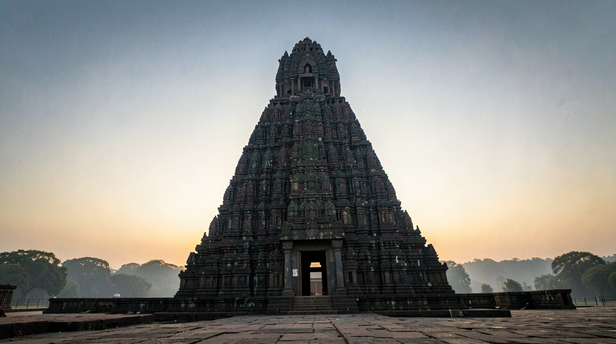
The Brihadeeswarar temple in Thanjavur has stood for just over a thousand years, and the question that stops visitors mid-stride is not about its age. It is about the stone at the very top. A single piece of granite, roughly 80 tonnes, rests at the apex of a tower that rises more than 60 metres from the ground. It was placed there in 1010 CE, when the tallest structure most people in the world had ever seen was a tree.
What the Stone Actually Is
The capstone is called the kumbam, the pot-shaped finial that crowns the vimana, the main tower above the sanctum. At Brihadeeswarar, this kumbam is not a decorative element added later. It was part of Raja Raja Chola I's original commission, completed in the same year the temple was consecrated. The stone is a single piece of dark granite, and its weight has been estimated at between 70 and 80 tonnes depending on the measuring method. It sits on a circular drum called the griva, itself sitting on the top of a tower built from interlocking granite blocks with no mortar holding them together, the weight of each course locks the one below it.
The Inclined Plane Theory, and Why the Landscape Supports It
The most widely accepted explanation among historians and engineers is that the builders used an earthen ramp, an inclined plane long enough to give the stone a gradual enough angle to be hauled upward. The mathematics are straightforward: a shallower ramp reduces the force needed to move a given weight, at the cost of distance. To raise an 80-tonne block 60 metres at a workable angle, the ramp would have needed to begin several kilometres away from the base of the tower.
What makes this more than speculation is the terrain around Thanjavur. A village called Sarapallam sits roughly six kilometres from the temple site. The name translates loosely as the hollow or depression left after earth was removed. Local tradition holds that this is where the fill for the ramp was excavated. The depression is real, the distance is consistent with the geometry, and the name has been associated with the construction since at least the medieval period. No document from 1010 confirms it. The land itself does.
What the Chola Records Say, and What They Leave Out
Raja Raja Chola I was a meticulous administrator. The temple walls carry inscriptions that record donations of gold, land, cattle, and dancers, thousands of individual entries detailing the temple's endowment. These inscriptions are among the most detailed administrative records surviving from medieval India. They say almost nothing about how the building was built.
This is not unusual. Construction methods were guild knowledge, passed between craftsmen rather than written down. The Vishwakarma communities who built temples across South India held their techniques as professional inheritance, not public record. What the inscriptions do confirm is the date of consecration, the identity of the patron, and the scale of the project, which itself implies a workforce and a logistics operation of considerable size, even if the method is unrecorded.
The Engineering That Makes the Ramp Theory Credible
The Chola builders were not improvising. The Brihadeeswarar vimana is built with a precision that still puzzles structural engineers: the tower has stood through earthquakes and centuries of monsoon without mortar, relying entirely on the geometry of its interlocking stones. Builders who could achieve that level of dimensional accuracy across a 60-metre structure were capable of planning a multi-kilometre earthen ramp.
The ramp would have been built in stages as the tower rose, with the capstone hauled on sledges or rollers, guided by ropes, and managed by a large coordinated team. Experimental archaeology on comparable ancient construction, the pyramids at Giza, the temples at Angkor, consistently finds that human labour, rope, and a well-designed inclined surface can move weights that seem impossible until the geometry is worked out. The Chola builders had access to all three, and they had already demonstrated, in the lower courses of the same tower, that they understood how stone behaves under load.
What Remains Genuinely Unknown
The ramp theory is the most plausible explanation available, but it is still a theory. No ramp survives, earthen ramps are dismantled and the fill reused once a building is complete, which is part of why they leave so little evidence. The connection between Sarapallam and the temple construction is traditional rather than documented. And the exact technique for the final placement of the kumbam, how it was seated precisely on the griva at the summit without cracking either stone, is not explained by the ramp alone. That last step required a level of control at height that the theory does not fully account for.
The honest answer is that we know the stone is there, we know roughly when it was placed, and we have one strong candidate for the method. The rest is inference from a landscape and a building that have outlasted the people who made them.
The kumbam has not moved in a thousand years. The tower has not settled. Whatever the method was, it worked well enough that the structure it produced has become the benchmark against which every subsequent Chola temple was measured, and none of them, in the century that followed, reached the same height.
Unlock insightful tips and inspiration on personal growth, productivity, and well-being. Stay motivated and updated with the latest at My Life XP.