
What the Tiered Roof of Key Monastery in Spiti Is Actually Telling You
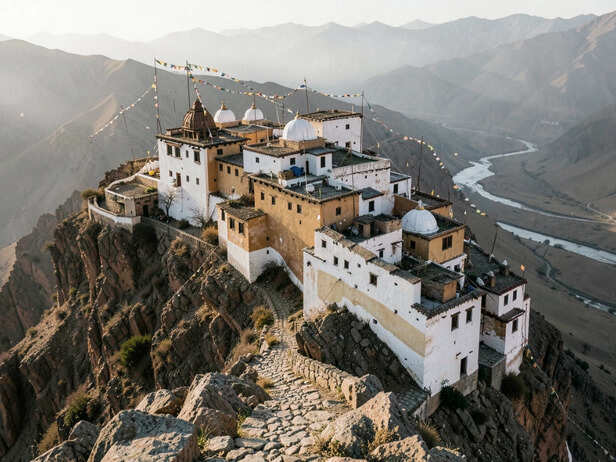
The first thing most visitors do when they reach Key Monastery is photograph it from the road below. From there the building reads as a single white mass, stacked improbably on a cone of brown rock above the Spiti River. It is only when you climb closer, past the mani walls, past the prayer flags snapping in the cold dry air, that the building separates into its actual layers, and the roof begins to make sense as a document rather than a decoration.
The Hill Chose the Building's Shape
The rocky spur on which Key sits is not flat. It rises in a rough pyramid, and the monastery was built to follow it rather than to level it. Each successive tier of rooms steps back as the hill narrows, which is why the profile from below reads as a ziggurat. This was not a stylistic choice in the way a modern architect might choose a form. It was the most stable way to build in stone and mud brick on unstable high-altitude ground, where the freeze-thaw cycle cracks foundations every winter. The tiers distribute weight laterally rather than concentrating it at a base, and they give each level its own flat roof that doubles as the courtyard or walkway for the level above. The building climbs because the ground climbs, and the roof is where that logic becomes visible: a series of flat terraces, each slightly smaller than the one below, all the way to the assembly hall and the gonkhang at the top.
What the Painted Parapet Bands Mean
Look at the outer walls just below the roofline on any of the main tiers. You will see a horizontal band, usually dark red or maroon, running around the building like a belt. This is a traditional Tibetan Buddhist architectural marker called a frieze of brushwood, in practice, it is a compressed layer of tamarisk twigs or similar scrub packed between the mud-brick courses and left slightly proud of the wall surface, then painted. It signals that this is a sacred building, not a domestic one. The same band appears on monasteries across Ladakh, Kinnaur, and the Tibetan plateau. At Key it is most visible on the upper levels, where the walls are better preserved and the light falls cleanly on the south-facing face in the morning. The band also has a practical function: the compressed brushwood layer acts as a flexible joint in the wall, absorbing the small movements that temperature extremes cause in mud brick. Sacred marker and seismic buffer in one stripe.
The Chortens on the Roof and What They Guard
Scattered across the upper terraces are small whitewashed chortens, the dome-shaped reliquary structures that in Tibetan Buddhism mark a sacred presence or consecrate a space. At Key, several of these sit directly on the roof of the main assembly hall. They are not decorative. A chorten on a roof signals that the room below holds something of ritual importance: a relic, a consecrated object, or the remains of a significant lama. The chorten's form is itself a cosmological diagram, its square base represents earth, the dome water, the spire fire and air, and the parasol above the spire the space element, so placing one on a roof is a way of extending that diagram upward into the sky rather than containing it within a room. When you look at the roof from the upper path that circles the monastery, count the chortens and their positions relative to the building's axis. They are not scattered randomly. They mark the sacred hierarchy of the rooms below.
Prayer Flags, Wind Direction, and the Valley Below
The strings of prayer flags that run from the roof poles down to the surrounding walls are a feature of almost every Tibetan Buddhist monastery, but at Key their placement is worth reading carefully. The flags are strung so that the wind, which in the Spiti valley runs reliably up the gorge from the south in the afternoon, carries the prayers printed on them outward and downward toward the river and the villages below. This is intentional. The monastery sits above its community in the literal sense, and the flags are oriented to carry merit and protection downward toward the people who live in the valley. The poles themselves, rising from the flat roof of the assembly hall, are the highest fixed points on the building and the first things to catch the morning light. On clear mornings, before the valley fills with shadow, the flags are already moving while the building below them is still in shade.
The Roof as a Working Space
Key is a living monastery, not a heritage site managed at a distance. The flat roofs of the lower tiers are used. Firewood is stacked there in autumn. Grain and dried vegetables are spread to dry on the terraces that catch the most sun. Monks cross between buildings by walking across rooftops rather than through internal corridors. This working quality of the roof is part of what the tiered plan was designed to enable: each flat terrace is accessible from the level above and the level below, so the building functions as a connected vertical village rather than a sealed tower. When you climb through the monastery rather than photographing it from below, the roof stops being a skyline and becomes a series of thresholds, each one opening onto a slightly different angle of the valley and the river far beneath.
Key Monastery is most often described in terms of its age and its altitude, both of which are real. But the building's intelligence is in its tiers. The hill shaped them, the climate reinforced them, and the ritual life of the community filled them in from the top down. The roof is where all three of those forces are still visible at once, if you climb high enough to read it.
Unlock insightful tips and inspiration on personal growth, productivity, and well-being. Stay motivated and updated with the latest at My Life XP.