
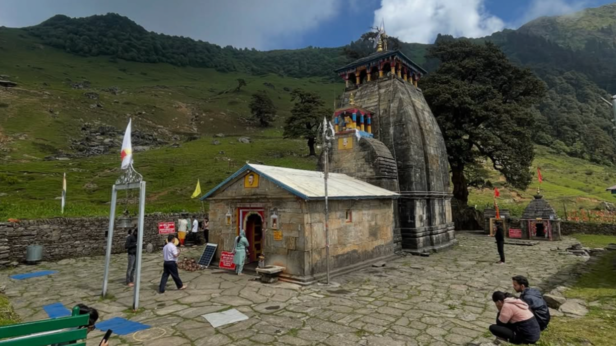
For most people, Tungnath is introduced with a single line- the highest Shiva temple in the world. It is a title that immediately captures attention, but it barely scratches the surface of what this place truly is. Because Tungnath is not just about altitude. It is about atmosphere, history, silence and a kind of experience that unfolds slowly, often without warning. Those who visit expecting just a temple often return with something far more difficult to describe- a quiet shift in the way they feel, think and see the world around them.
A Temple That Feels Alive
To reduce Tungnath to its height is to miss its essence. Yes, it stands at over 12,000 feet, but what truly defines it is not how high it is, but how it feels. Unlike many famous pilgrimage sites that are crowded, loud and fast-moving, Tungnath carries a rare stillness. The stone structure, believed to be over a thousand years old, does not dominate the landscape- it blends into it. It feels as though the temple has grown out of the mountains rather than being built on them.
According to Hindu tradition, Tungnath is one of the Panch Kedar temples, associated with the legend of the Pandavas seeking Lord Shiva after the Kurukshetra war. It is believed that Shiva’s arms appeared here when he took the form of a bull. But even beyond mythology, there is something undeniably powerful about the space. It does not demand devotion- it invites it quietly. And that is what makes it different.
Where is Tugnath Located
Tungnath is located in the Rudraprayag district of Uttarakhand, nestled deep within the Garhwal Himalayas. The journey to reach it takes you through Chopta, a region often described as one of the most beautiful in India. But its location is not just about scenic beauty- it shapes the entire experience.
Being so high and so removed from urban life, Tungnath exists in a kind of natural isolation. There are no chaotic roads leading directly to it, no overwhelming commercialisation surrounding it. The mountains act as a barrier- not just physically, but mentally. By the time you reach, you are already different from when you started. The altitude, the quiet and the vastness of the landscape create a sense of detachment from everyday life.
This is why the location matters. Tungnath is not just placed in the Himalayas- it is protected by them. And in that protection, it retains something rare: authenticity.
How to Reach Tungnath: A Journey That Prepares You
Reaching Tungnath is not difficult, but it is not instant either- and that is part of its power. The nearest road access is Chopta, which can be reached from major towns like Rishikesh, Haridwar or Dehradun by road. From Chopta, the journey continues on foot.
The trek to Tungnath is about 3.5 kilometres, well-paved and manageable even for beginners. But calling it just a “trek” feels incomplete. It is more like a gradual transition. As you walk, the environment begins to change. The air becomes thinner and cooler. The sounds of vehicles and conversations disappear, replaced by wind, birds and long stretches of silence.
With every step, something within begins to slow down. The mind, which is often restless, starts settling without effort. By the time you reach the temple, the journey has already begun to shape your experience. It prepares you- not just physically, but mentally.
Chandrashila: The Extension That Changes Everything
For those who choose to go a little further, Tungnath is not the end- it is a midpoint. About 1.5 kilometres above the temple lies Chandrashila, a summit that completely transforms the experience.
The climb from Tungnath to Chandrashila is steeper, but what awaits at the top is something extraordinary. At sunrise, the Himalayan peaks- Nanda Devi, Trishul, Chaukhamba- glow in shades of gold and orange. The sky opens up in a way that feels almost unreal. Standing there, above the temple, above the clouds, there is a sense of vastness that is difficult to put into words.
Chandrashila is not just a viewpoint. It is a moment of perspective. Many visitors describe it as the point where the journey becomes deeply personal. The silence feels deeper, the space feels larger and the mind feels clearer. If Tungnath is about stillness, Chandrashila is about expansion.
Best Time to Visit: When the Experience Feels Just Right
Tungnath is not open throughout the year. Due to heavy snowfall, the temple remains closed during winter, usually from November to April, and the deity is moved to a lower altitude for worship. This makes timing an important part of the experience.
The best months to visit are from May to June and September to October. During summer, the weather is pleasant, the skies are clear and the path is accessible. The greenery of Chopta is at its peak, making the journey visually stunning. Post-monsoon months, especially September and October, offer perhaps the most breathtaking views, with crisp air and clear mountain ranges.
The monsoon season, while beautiful in its own way, can make the trek slippery and unpredictable. Winter, on the other hand, transforms the region into a snow-covered landscape, but reaching the temple becomes extremely challenging.
Explore the latest trends and tips in Health & Fitness, Spiritual, Travel, Life Hacks, Trending, Fashion & Beauty, and Relationships at Times Life!