
Why Does Meghalaya Have Bridges Made From Living Tree Roots?
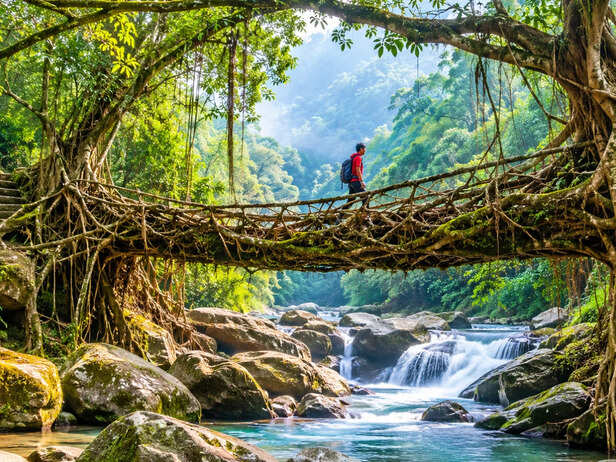
Imagine walking through a thick green forest and reaching a bridge that looks as though it has grown directly out of the trees around it. Its floor is made of tangled roots, its sides are formed by living branches, and it stretches across a flowing stream.This is not a scene from a fantasy film. It is a real part of life in Meghalaya, a state in northeast India.Known as living root bridges, these remarkable structures are created by guiding the aerial roots of rubber fig trees (Ficus elastica) across rivers, streams and deep valleys. Over time, the roots grow, strengthen and form a natural pathway that people can walk across.Unlike ordinary bridges, which are constructed within a fixed period, living root bridges take years, sometimes decades, to develop. Their strength comes from the continued growth of the trees themselves.
How Do People Make Bridges From Tree Roots?
The process requires patience, planning and a close understanding of the local environment.Communities traditionally use the aerial roots of rubber fig trees because they are flexible when young and can grow over long distances. Local people guide these roots towards the opposite side of a river or stream.
Here is how the process generally works:
- Choosing the right tree: A rubber fig tree is selected near the riverbank or valley where a crossing is needed.
- Guiding the roots: Young aerial roots are directed across the water using temporary supports, often made from bamboo or areca palm trunks.
- Connecting the roots: Once the roots reach the other side, they are guided into the soil or around a supporting tree.
- Allowing them to strengthen: As the roots continue growing, they become thicker and gradually form a connected structure.
- Maintaining the bridge: Local communities continue guiding, weaving and caring for the roots to improve the pathway over time.
The remarkable part is that the bridge remains alive. Its roots continue growing even after people begin using it.
Why Are Living Root Bridges Found in Meghalaya?
Meghalaya receives heavy rainfall, and many of its villages are surrounded by hills, dense forests, streams and deep valleys. During the monsoon, rivers and streams can swell, making it difficult for people to cross them safely.In such conditions, conventional wooden bridges may deteriorate, while other structures can require materials and construction methods that are difficult to access in remote areas.
Living root bridges developed as a practical response to this environment. They allow communities to create crossings using resources already available in their surroundings.The tradition is particularly associated with the Khasi and Jaintia communities. It reflects generations of knowledge about local trees, weather patterns and the landscape.These bridges are not simply tourist attractions. They have served as important routes connecting villages, farmland and neighbouring communities.
What Makes These Bridges Stronger Over Time?
The secret lies in the way the roots naturally grow and join together.As the aerial roots become thicker, they can connect with one another and form a stable network. This natural joining process is known as inosculation. It helps the roots develop into a structure capable of carrying the weight of people.Unlike dead wood, living roots continue to grow and adapt. With regular care, the bridge can become stronger as the tree matures. Some structures are believed to have survived for centuries, although their condition depends on the health of the trees and continued maintenance.This is what makes the bridges so unusual. They are not completed once and left untouched. They remain part of the natural environment and require attention from the people who use them.
The Famous Double-Decker Living Root Bridge
One of Meghalaya's most famous examples is the Double-Decker Living Root Bridge in Nongriat village, near Cherrapunji.As its name suggests, the bridge has two levels, one above the other. Its unusual structure makes it one of the most recognisable examples of traditional root engineering.Reaching Nongriat is an experience in itself. Visitors generally travel towards Tyrna village and then descend a long series of steps through forested hills to reach the bridge. The route involves steep sections, so comfortable walking shoes, drinking water and a reasonable level of fitness are important.The bridge is not just a place for photographs. It demonstrates how local communities developed practical ways to cross difficult terrain using the natural growth of trees.
Are Living Root Bridges a Sustainable Form of Architecture?
Living root bridges are often discussed as an example of sustainable architecture because they use locally available natural resources instead of relying entirely on manufactured construction materials.
Their environmental value goes beyond the bridge itself:
- Less dependence on manufactured materials: The structure develops through the growth of tree roots.
- Long-term use: A well-maintained bridge can remain useful for generations.
- Connection with forests: The bridges depend on healthy trees and surrounding ecosystems.
- Community participation: Their development and upkeep involve local knowledge and cooperation.
UNESCO has included the Living Root Bridge Cultural Landscapes of Meghalaya on its Tentative List for World Heritage recognition. The proposal highlights their importance as examples of traditional knowledge, community cooperation and human interaction with nature. This does not mean they have already been inscribed as a UNESCO World Heritage Site.
Where Can You See Living Root Bridges in Meghalaya?
Travellers interested in seeing these natural structures can explore different parts of the Khasi and Jaintia Hills.
Some well-known locations include:
- Nongriat: Famous for its Double-Decker Living Root Bridge.
- Riwai: Home to a popular living root bridge near Mawlynnong.
- Mawkyrnot: Known for its remarkable root bridge structures, including a particularly long example.
- Nongbareh: Another area associated with the traditional practice of growing root bridges.
Each location offers a different experience, from forest walks and village visits to views of rivers and green valleys.
What Should Travellers Know Before Visiting?
A visit to a living root bridge is different from visiting a roadside viewpoint. Many require walking along forest paths, crossing uneven ground or climbing a significant number of steps.
Keep these points in mind:
- Wear comfortable shoes: Trails can be steep, slippery and muddy, especially after rain.
- Carry drinking water: Some routes involve long walks with limited facilities.
- Respect local customs: These bridges are part of community life, not simply tourist attractions.
- Avoid littering: Carry your waste back rather than leaving plastic or food packaging behind.
- Follow local guidance: Use designated paths and follow instructions from local guides and residents.
- Check weather conditions: Heavy rainfall can affect trekking routes and stream crossings.
Travellers should also avoid damaging roots, carving names into trees or placing unnecessary weight on fragile sections.
A Tradition That Connects People With Nature
Meghalaya's living root bridges are more than unusual structures built from trees. They represent a relationship between people, forests and the environment that has developed over generations.At a time when modern construction often focuses on speed and manufactured materials, these bridges offer a different lesson. They show what can happen when people understand their surroundings and use nature's own growth to solve everyday problems.The most remarkable part is that the work does not end when the bridge becomes usable. Each generation has a role in caring for it so that the next one can continue to use it.For travellers, walking across one of these bridges is an opportunity to experience a living tradition that cannot be understood through photographs alone.
Unlock insightful tips and inspiration on personal growth, productivity, and well-being. Stay motivated and updated with the latest at My Life XP.