Most people who know a little about Vedic astrology know their rashi, the moon sign the tradition assigns at birth. Fewer know their janma nakshatra, the lunar mansion the moon was moving through at the exact moment of birth. In Jyotish, that nakshatra is often treated as the more precise of the two, because it narrows the moon's position to a span of roughly thirteen degrees rather than a full thirty-degree sign.
What a Nakshatra Actually Is
The word nakshatra comes from Sanskrit and is most commonly translated as lunar mansion or lunar house. The system works by dividing the full 360-degree circle of the sky into 27 equal sections, each spanning exactly 13 degrees and 20 minutes. The moon takes roughly one day to move through each section, completing the full circuit in about 27 days, which is why the number 27 is not arbitrary. It maps directly onto the moon's orbital rhythm.
Each nakshatra is associated with a fixed star or a small cluster of stars that ancient Vedic astronomers used as a reference point. Rohini, for instance, is anchored to Aldebaran in the constellation Taurus. Jyeshtha aligns with Antares in Scorpius. The stars themselves do not move perceptibly on a human timescale, which makes them reliable markers in a system built around a moving moon.
The 27 Nakshatras and How They Are Grouped
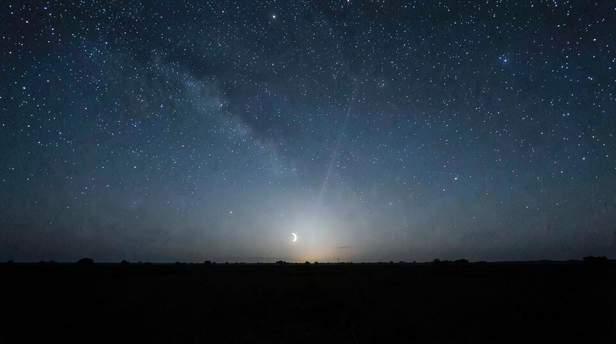
![Vast Celestial Canvas Unfolds]()
Vast Celestial Canvas Unfolds
Image credit : AI
Vedic astrology lists the nakshatras in a fixed sequence beginning with Ashwini and ending with Revati. They are grouped in several ways depending on what a reading is examining. One grouping divides them by the three gunas: sattva, rajas, and tamas. Another assigns each nakshatra to one of four aims of life, dharma, artha, kama, and moksha. A third groups them by the quality of their energy: fixed, moveable, sharp, soft, mixed, fierce, or dreadful.
Each nakshatra also has a ruling planet under the Vimshottari dasha system, which is the planetary period system most widely used in Jyotish. This rulership is separate from the rashi lord and adds a third layer of planetary influence to the chart. Ashwini is ruled by Ketu, Bharani by Venus, Krittika by the Sun, the sequence continues through all 27 before cycling back.
The Janma Nakshatra and What the Tradition Says About It
The nakshatra the moon occupied at the moment of birth is called the janma nakshatra. In Jyotish, it is used to determine the starting point of the Vimshottari dasha, the sequence of planetary periods that the tradition uses to time events across a lifetime. Before any other calculation begins, a practitioner identifies the janma nakshatra, because it sets the clock for the entire dasha sequence.
Beyond timing, the janma nakshatra is described in classical Jyotish texts as shaping temperament, instinctive responses, and the quality of the mind. Each nakshatra has a presiding deity, called an adhidevata, and a symbol. Hasta, for example, is symbolised by a hand and is associated with Savitar, a solar deity connected to skill and craftsmanship. The tradition describes people born under Hasta as dexterous and quick-thinking. Magha is symbolised by a throne and presided over by the Pitrs, the ancestral spirits; the tradition associates it with a strong sense of lineage and pride in heritage.
These descriptions are the tradition's own framework. They are not psychological diagnoses. A person born under any nakshatra carries the full complexity of a human life; the nakshatra offers one lens, not a verdict.
How the Nakshatra Sits Inside the Birth Chart
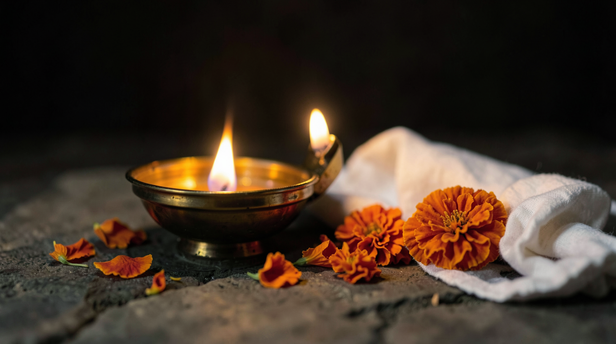
![Brass Diya's Gentle Glow]()
Brass Diya's Gentle Glow
Image credit : AI
A Vedic birth chart, called a kundali, places the moon in a rashi. The nakshatra refines that placement considerably. Two people can share the same moon sign, say, Vrishchika, Scorpio, while the moon falls in different nakshatras within that sign. Anuradha and Jyeshtha both occupy Scorpio. A practitioner reading the chart treats them as meaningfully different placements, because the nakshatra's deity, symbol, and dasha lord differ between them.
The pada system refines the position further. Each nakshatra is divided into four padas of 3 degrees and 20 minutes each, and each pada corresponds to one sign of the zodiac in sequence. This means a single nakshatra spans across a navamsha chart, a divisional chart used in Jyotish, in a way that adds yet another layer of detail to the reading. Classical texts like the Brihat Parashara Hora Shastra describe the pada placements in considerable detail, though the nakshatra itself remains the primary reference point.
Nakshatras Beyond the Moon
While the janma nakshatra, the moon's position, is the most commonly referenced, every planet in a Vedic chart occupies a nakshatra. The sun's nakshatra at birth, the lagna nakshatra (the nakshatra rising on the eastern horizon), and the nakshatra positions of Mars, Jupiter, and the rest all carry meaning in a full reading.
The lagna nakshatra, in particular, is considered important for understanding the body and outward manner. The sun's nakshatra is associated with the soul's purpose in some classical readings. Practitioners who work with the full system examine the nakshatra positions of every planet rather than the moon alone, though the janma nakshatra remains the entry point for most readings and the one most people learn first.
Why the Nakshatra System Has Stayed Central to Jyotish
The nakshatra system predates the rashi system in Indian astronomical history. References to the 27 lunar mansions appear in the Vedas and in texts like the Atharva Veda and the Taittiriya Brahmana, making it one of the oldest continuously used frameworks in Indian thought. The rashi system, which divides the zodiac into 12 signs, arrived later and shows the influence of Hellenistic astronomy. Jyotish absorbed both and built a synthesis, but the nakshatra system remained the foundation beneath it.
That historical depth is part of why practitioners continue to treat the nakshatra as the more intimate of the two placements. The rashi places the moon in a broad sign shared by everyone born across a month. The nakshatra places it in a span the moon crosses in a single day, anchored to specific stars that ancient observers named and watched for centuries before the system was written down.
The 27 lunar mansions do not predict what will happen. In Jyotish, they describe the quality of the ground a person stands on, the instincts, the inherited patterns, the rhythm of the mind at its most unguarded. What a person does with that ground is a different question, and one the nakshatras leave open.
Facing repeated career and financial challenges? Your name energy may be influencing it. Check here.Unlock insightful tips and inspiration on personal growth, productivity, and well-being. Stay motivated and updated with the latest at
My Life XP.