Have you ever wondered how ordinary stones could float on the sea while building Ram Setu? According to a popular story associated with the Ramayana, the secret was not in the stones themselves but in the name of Lord Rama. Hanuman Ji and the Vanara army were devoted to completing the bridge so that Lord Rama could reach Lanka and rescue Mata Sita. But there is a beautiful lesson behind writing Rama's name on every stone that goes far beyond the construction of a bridge.
The Challenge of Building Ram Setu
![Hanuman after Lord Ram returned to his divine abode]()
Hanuman after Lord Ram returned to his divine abode
Image credit : chatgpt(ai)
When Lord Rama reached the seashore with his army, a vast ocean stood between them and Lanka, where Ravana had kept Mata Sita captive. Crossing the sea seemed almost impossible, but the Vanara army was determined to help Lord Rama. Under the guidance of Nala and Neela, the construction of Ram Setu began. The army started collecting enormous stones and placing them in the water to create a bridge. However, the biggest challenge was making those heavy stones stay afloat.
The Secret of Rama's Name
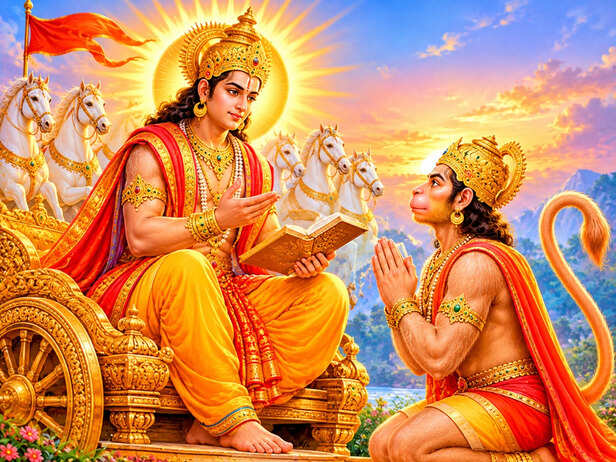
![Ramayana account, Hanuman Ji chose Surya Dev]()
Ramayana account, Hanuman Ji chose Surya Dev
Image credit : chatgpt(ai)
According to a popular devotional account, Hanuman Ji began writing Lord Rama's name on the stones before placing them in the sea. The belief was that the stones bearing Rama's name would float instead of sinking. For Hanuman Ji, this was not simply a construction technique. It was an expression of his complete faith in his beloved Lord. He believed that Rama's name carried a power beyond ordinary human understanding, and every stone became a symbol of that devotion.
Why Hanuman Ji Trusted Rama's Name
Hanuman Ji never considered himself separate from Lord Rama. His strength, courage and abilities were all dedicated to serving his master. Writing Rama's name on the stones reflected this deep connection. He believed that anything associated with Lord Rama could overcome even the greatest obstacles. This is why the name 'Ram' was not just a word for Hanuman Ji. It was his source of strength, his identity and the foundation of everything he did.
The Deeper Connection Between Rama and Hanuman
One of the most beautiful aspects of the Ramayana is the relationship between Lord Rama and Hanuman Ji. Rama saw Hanuman as more than a servant, while Hanuman considered serving Rama the greatest purpose of his life. Their relationship was built on trust, humility and unconditional devotion. Hanuman Ji never performed great deeds to receive praise or rewards. Whether crossing the ocean or helping construct Ram Setu, his only intention was to fulfil Lord Rama's wishes.
Was the Bridge Built Only Through Divine Power?
The Ramayana also describes the important role of Nala and Neela in constructing the bridge. In the Valmiki Ramayana, their engineering ability and the organised efforts of the Vanara army are central to the construction. The story of stones floating through Rama's name is especially popular in devotional retellings. These accounts are best understood within their religious and storytelling traditions rather than as scientific explanations of how stones float.
What Hanuman Ji's Actions Teach Us
The story carries a lesson that remains meaningful even today. Hanuman Ji teaches us that faith is not simply about praying or repeating a name. It is also about putting that faith into action. He did not wait for someone else to solve the problem. He used his strength, intelligence and dedication to serve Lord Rama. His example reminds us that when our actions have a clear purpose, even difficult challenges become easier to face.
The Name That Became a Symbol of Devotion
Ram Setu is remembered as more than a bridge connecting two shores. In devotional tradition, it represents what faith, unity and dedication can achieve. Hanuman Ji's decision to write Rama's name on the stones reflects his belief that the Lord's name was his greatest strength. That is why devotees continue to chant 'Jai Shri Ram' and remember Hanuman Ji's devotion. The deepest message of this story is simple: true devotion is not measured by what we receive, but by how sincerely we serve.
Unlock insightful tips and inspiration on personal growth, productivity, and well-being. Stay motivated and updated with the latest at
My Life XP.