The moment you wipe away nail polish, you expect bare nails. What you often get instead is nails that look fogged over, feel thin at the edge, and snap at the slightest pressure. The remover did its job, but it took something with it that was not meant to go.
What the Nail Plate Is Actually Made Of
![Pale Oil Drops on Stone]()
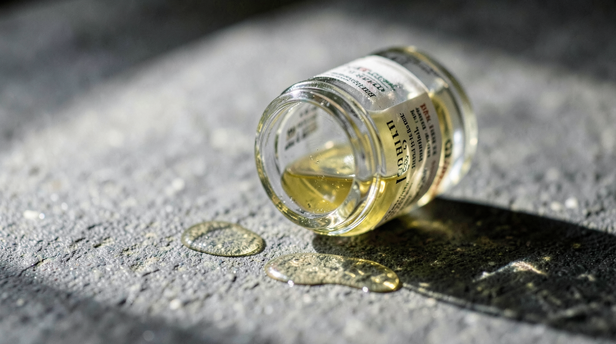
Pale Oil Drops on Stone
Image credit : MyLifeXP Bureau
The nail plate is not a solid sheet. It is built from layers of flattened, dead keratin cells pressed tightly together, held in place partly by the nail's own moisture content and partly by a thin lipid film, a waxy layer of fats that sits between the keratin layers and across the surface. This lipid layer is what gives a healthy nail its slight sheen and its flexibility. It is also what keeps water from escaping the plate too quickly. When that layer is intact, nails bend slightly under pressure rather than snapping. When it is stripped, the keratin layers begin to separate at the edges and the surface scatters light instead of reflecting it, which is the exact optical effect you read as dullness.
What Acetone and Non-Acetone Solvents Do to That Structure
Acetone works by dissolving the polymer chains in nail lacquer fast and completely. It also dissolves lipids with equal efficiency. A single removal session with an acetone-based remover strips a measurable amount of the nail's surface lipid layer along with the polish. The keratin itself is not chemically damaged, but without its lipid binder it becomes porous. Moisture leaves the plate faster than it can be replaced from the nail bed below, and the surface layers begin to lift microscopically, which is what creates that chalky, fibrous texture you can sometimes see in raking light.
Non-acetone removers use ethyl acetate or isopropyl alcohol as the primary solvent. They are slower and need more rubbing to shift a full-coverage lacquer, especially a gel-adjacent formula. The extended contact time and the friction offset some of the gentleness. They still strip lipids, just more slowly. For someone who removes polish every few days, the cumulative effect of a non-acetone remover used with heavy rubbing can match the single-session effect of acetone used efficiently and then rinsed away.
Why Some Nails Show It More Than Others
![Morning Light on Linen]()
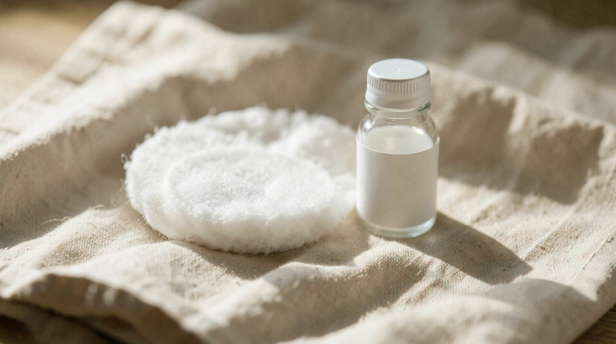
Morning Light on Linen
Image credit : MyLifeXP Bureau
Nail plate thickness varies between people and changes across a single nail, thinner at the free edge, thicker near the lunula. Nails that are naturally thin, or that have been repeatedly filed on the surface, have less lipid reserve to begin with. Frequent hand-washing, low humidity, and certain medications that affect lipid metabolism all reduce baseline nail hydration before the remover is even opened. A person with already-dry nails and a habit of washing up immediately after removal is stacking conditions. The dullness and brittleness they see after removal is the remover's effect landing on a nail that had very little buffer left.
Gel polish removal adds another variable. Soaking the nail in acetone for ten to fifteen minutes to soften a gel formula exposes the plate to solvent for far longer than a standard lacquer removal. The surrounding skin also absorbs acetone during that time, which is why the fingertips feel dry and tight for hours afterward. The nail plate after a gel soak is not just lipid-depleted, it has also lost a proportion of its surface moisture, and the two losses together produce the most pronounced version of the brittle, peeling result.
What Actually Helps Versus What Does Not
Cuticle oil applied immediately after removal is the most direct intervention, and it works for a specific reason: the nail plate is temporarily more porous after solvent contact, which means lipid-based ingredients can penetrate more readily than they would on an intact surface. Jojoba oil and sweet almond oil have molecular weights that allow them to move between keratin layers rather than sitting on top. Petroleum-based products form a seal on the surface and slow water loss, which is useful but a different mechanism, they are not replenishing the lipid layer, they are temporarily substituting for it.
Nail hardeners marketed for brittle nails often contain formaldehyde-releasing compounds that cross-link the keratin, making the plate stiffer. A stiffer nail is not a more flexible one, and flexibility is what prevents snapping. For a nail already thin and lipid-depleted, a hardener can make the brittleness worse by reducing the plate's ability to bend under pressure. A conditioning base coat used between polish applications is generally more useful: it adds a physical layer between the lacquer and the plate and reduces how deeply the remover needs to work at the next removal.
Keeping removal sessions short and efficient matters more than which solvent is chosen. Saturating a cotton pad fully, pressing it against the nail for fifteen to twenty seconds to let the solvent do the dissolving, and then wiping once rather than scrubbing back and forth reduces both solvent contact time and mechanical friction. The nail plate is not improved by effort, it is only abraded by it.
What the Nail Needs After, Not During
The restoration window after removal is real. In the hour after a removal session, the nail plate is more receptive to topical conditioning than it will be once the surface re-seals. Applying a lipid-rich oil and leaving it without washing hands immediately gives it the best chance of being absorbed rather than wiped away. Wearing gloves for washing up in the following hours reduces the rate at which the plate loses the moisture that the solvent disrupted.
New nail growth from the matrix is unaffected by what happens at the plate's surface, the matrix cells have no contact with the remover. The brittleness is a surface and edge phenomenon, which means it is recoverable with consistent conditioning over a few weeks rather than something that requires waiting for a full nail to grow out. The nails that seem permanently damaged after years of gel removal are usually nails that have been repeatedly filed on the surface to rough up adhesion, which physically thins the plate in a way that conditioning alone cannot reverse.
The dullness and brittleness after removal are not a sign that your nails are weak. They are a sign that a solvent did exactly what solvents do, on a structure that was not designed to meet one regularly. The structure can be supported. It just needs the right thing immediately after, not a week later.
Unlock insightful tips and inspiration on personal growth, productivity, and well-being. Stay motivated and updated with the latest at
My Life XP.