Pick up a strand of hennaed hair and a strand of chemically coloured hair and they will feel different in your fingers. The hennaed strand is usually smoother, sometimes slightly stiffer, and it holds its colour in a way that fades gradually rather than growing out in a hard line. That difference is not cosmetic. It comes from two completely unlike interactions with the structure of the hair shaft itself.
The Hair Shaft Has Three Layers and Dye Cares About Two of Them
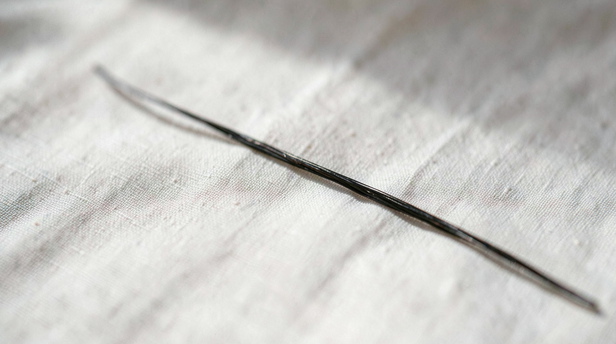
![Single Hair Strand Detail]()
Single Hair Strand Detail
Image credit : MyLifeXP Bureau
Each strand of hair is built in concentric layers. The outermost is the cuticle: overlapping, scale-like cells that lie flat when the hair is healthy and lift when it is damaged or chemically treated. Beneath it is the cortex, which gives hair its strength, elasticity, and natural colour through melanin pigment. At the centre, in thicker strands, is the medulla, which plays little role in colour chemistry.
Chemical dye targets the cortex. To reach it, the dye formula first uses an alkaline agent, almost always ammonia or a milder substitute, to swell the shaft and force the cuticle scales open. A developer, typically hydrogen peroxide, then oxidises and partially dissolves the existing melanin inside the cortex. Artificial colour molecules, small enough to slip through the lifted cuticle, enter the cortex and oxidise into larger molecules that cannot easily leave. The cuticle is then closed back down, trapping the colour inside. This is why a root regrowth line is so sharp: the cortex of the new growth was never touched, and its melanin is entirely intact.
Henna Works From the Outside In, Not the Inside Out
Henna is the dried and powdered leaf of Lawsonia inermis. Its active molecule is lawsone, a small, naturally occurring dye compound. Lawsone does not need an alkaline swelling agent and does not use an oxidising developer. It binds directly to the keratin protein in the cuticle and the outer cortex through a process called hydrogen bonding, the same weak but cumulative attraction that holds water molecules together.
Because lawsone bonds to keratin rather than entering the cortex to replace melanin, henna sits on and within the cuticle layer rather than deep inside the shaft. It does not strip or dissolve existing pigment. On dark hair, it adds a reddish cast that shows most clearly in sunlight. On lighter or grey hair, where there is less competing melanin, the red is more visible. This is also why henna cannot lighten hair: there is no bleaching step, so whatever melanin is already there stays.
The hydrogen bonds lawsone forms with keratin are stable but not permanent in the way a covalently bonded chemical dye is. Henna fades slowly as the outermost cuticle cells shed through normal washing and handling, which is why the colour softens gradually over weeks rather than producing a sudden regrowth line.
What This Means for the Condition of the Shaft
![Botanical Dropper & Leaves]()
Botanical Dropper & Leaves
Image credit : MyLifeXP Bureau
Because henna coats the cuticle rather than forcing it open, it leaves the cuticle structure largely intact. The lawsone molecules that bind to the outer keratin add a thin layer of additional material to the shaft surface. This is why hennaed hair often feels smoother and looks shinier: the cuticle scales are flat and the surface has an extra coating.
Chemical dye, by contrast, requires the cuticle to open. Even when the cuticle closes again afterwards, repeated opening and closing gradually degrades the cuticle cells. This is the structural reason why frequently chemically coloured hair becomes porous over time, the cuticle no longer lies flat or seals properly, and the cortex loses moisture more easily.
Henna is not without its own effects on the shaft. The coating it leaves adds weight and stiffness to the strand. This is why many people find their hair feels thicker after henna but also less flexible. Curl patterns can loosen over multiple applications because the added weight changes how the strand moves. This is a physical consequence of the coating, not damage in the way chemical processing causes it.
The Protein Bond Matters for What You Apply Next
The keratin bonding that lawsone relies on has a practical consequence that is worth understanding before combining henna with any other chemical treatment. Lawsone occupies bonding sites on the keratin protein. When a chemical relaxer, a perm, or a bleach is applied afterwards, the chemicals that need to act on those same keratin sites find them partially occupied. The reaction can be unpredictable, uneven processing, unexpected porosity, or in some cases significant breakage.
This is not a reason to avoid henna, but it is a reason to treat the two systems as genuinely incompatible rather than simply different. Dermatologists generally advise a waiting period of several weeks between henna and any chemical process, and even then the result is not guaranteed to be even. The reverse, applying henna over chemically coloured hair, is usually less problematic because the henna is coating an already-processed shaft rather than competing at the bonding level, though the resulting colour can be harder to predict on porous hair.
What Pure Henna Is and What It Is Not
The word henna on a product label does not guarantee the same chemistry described here. Many products sold as henna contain metallic salts, compounds of lead, copper, or silver, that deposit on the shaft and produce darker, faster colour. These are not lawsone-based and they behave differently: metallic deposits can react violently with hydrogen peroxide, which is why applying a standard chemical dye or bleach over metallic-salt henna is associated with severe breakage and scalp reactions.
Pure henna powder, made only from Lawsonia inermis, produces a colour range from orange to deep auburn depending on the strand's starting colour and the length of application. It does not produce black or very dark brown. A henna product that promises black colour without any added indigo or cassia is almost certainly using metallic salts or synthetic dye alongside the henna, and it does not carry the same structural properties described above.
The distinction matters because the entire case for henna as a gentler alternative rests on the lawsone-keratin mechanism. A product that uses a different mechanism is a different product, regardless of what the label says.
Hair colour is not one category with a safer and a less safe end of a spectrum. Henna and chemical dye are different tools that work on different parts of the shaft through different chemistry. Knowing which layer each one reaches, and what it does there, makes it possible to choose between them for the right reasons rather than the wrong ones.
Unlock insightful tips and inspiration on personal growth, productivity, and well-being. Stay motivated and updated with the latest at
My Life XP.