
How Odia Temple Kitchens Feed Thousands Using Stacked Earthen Pots
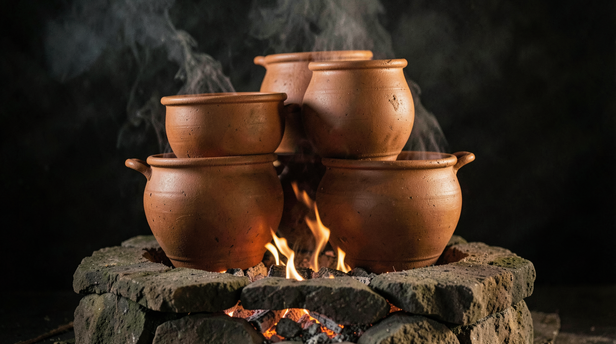
The kitchen attached to the Jagannath temple in Puri is called the Rosha Ghara, and on most days it produces rice, dal, and curries for somewhere between ten thousand and one hundred thousand people. No industrial equipment. No conveyor belts. The fuel is wood, the vessels are unglazed earthen pots, and the cooks, called Suaras, belong to families that have held this role across generations. What looks, from the outside, like an enormous open fire is actually a system of extraordinary precision.
The Stacking Logic and Why It Works
Earthen pots are stacked directly on top of one another over a single wood fire, sometimes five or six pots high on one flame. The pot closest to the fire cooks first and fastest. As it finishes, the pot above it has been gently heating from the steam and conducted heat rising through the stack. By the time the bottom pot is done, the one above it is already well along. The sequence continues upward, each pot inheriting heat from the one below.
This is not improvisation. It is a deliberate use of clay's thermal properties. Unglazed earthen pots absorb heat slowly and release it slowly and evenly. They also allow a small amount of moisture to pass through their walls, which keeps the interior temperature from spiking. Food cooked in them reaches a steady, moderate heat rather than the aggressive high heat of a metal vessel on the same flame. The result is that rice and lentils cook through without scorching at the base, even in the lowest pot, because the clay itself is moderating the contact temperature.
The Role of the Wood and the Fire Architecture
The firewood used in the Puri kitchen is specific. Certain woods are considered appropriate for the sacred kitchen; others are not used regardless of availability. Beyond the ritual dimension, the choice of wood affects the fire's behaviour in practical ways. A slow-burning hardwood produces a steady, sustained flame with consistent heat output, which is exactly what a stacked-pot system needs. A fast-burning wood with variable flame height would disrupt the sequencing.
The hearths are built low and wide, not tall. This keeps the base of the stack close to the ground and gives the cooks direct access to the pot arrangement without ladders or platforms. Multiple hearths run simultaneously, each with its own stack, each managed by a team that watches the colour of the steam, the sound of the boil, and the smell rising from the clay. There are no timers. The cooks read the cooking.
What Gets Cooked and in What Order
The food prepared in this kitchen is called Mahaprasad. The menu is fixed and has been fixed for a very long time: rice in several preparations, dal, a dry vegetable preparation, a sour preparation, and a sweet preparation. The number of dishes prepared on any given day can run to fifty-six, though not all are made in the stacked-pot method, some are fried in large iron pans called Kodhais.
The sequencing of what goes into which pot in which position in the stack follows the cooking time each dish requires. Longer-cooking items go lower. Shorter-cooking items go higher. A preparation that needs only steam and residual heat goes at the top. The Suaras know these relationships without consulting anything written down, because the knowledge was passed to them in the kitchen rather than in a text.
Why Clay and Not Metal
Metal vessels conduct heat faster and more aggressively than clay. In a stacked system, that would mean the bottom pot overheats before the upper pots have had time to progress, breaking the sequence. Clay's slower conductivity is not a limitation being worked around, it is the mechanism the entire system depends on.
There is also the question of what clay does to the food itself. Unglazed terracotta is slightly porous and slightly alkaline. Water and steam passing through the walls carry trace minerals. The slow, even heat preserves volatile compounds in spices that a fast, high-heat cook would drive off. Whether these effects are detectable in the final flavour is something cooks in this tradition assert and food scientists have examined with some interest, though the results are not simple to isolate. What is not disputed is that the food tastes different from the same recipe made in steel on a gas flame, and that the difference is consistent enough that pilgrims who eat Mahaprasad regularly recognise it immediately.
The Scale Without the Machinery
The Puri kitchen employs several hundred cooks working in coordinated teams. The coordination is not managed by a central supervisor calling out instructions. It is managed by the structure of the kitchen itself: each hearth team knows its dishes, its stack position, and its timing. The teams work in parallel, and the outputs converge at the point of distribution.
What makes this scale possible without machinery is the standardisation of the vessel. Every pot in the stack is a known size with known thermal behaviour. The cooks are not adapting to variable equipment; they are working with material that behaves the same way every time, which allows the knowledge to be reliable across teams and across generations.
The earthen pots are not reused. After a cooking session, they are broken and replaced. This is both a ritual requirement and a practical one: a used pot carries residue from the previous cook, and the alkalinity of fresh clay is part of what the system relies on. The cost of this is absorbed into the temple's operation, and the broken shards are considered auspicious rather than waste.
The stacked earthen pot kitchen is not a survival of something that has not yet been replaced. It is a system that works at a scale and with a consistency that has not been improved upon for the purpose it serves. The clay, the wood, the sequence, and the people who read the steam are all load-bearing parts of the same structure.
Unlock insightful tips and inspiration on personal growth, productivity, and well-being. Stay motivated and updated with the latest at My Life XP.