
Why Baisakhi Kada Prasad Is Stirred for So Long Before It Is Served
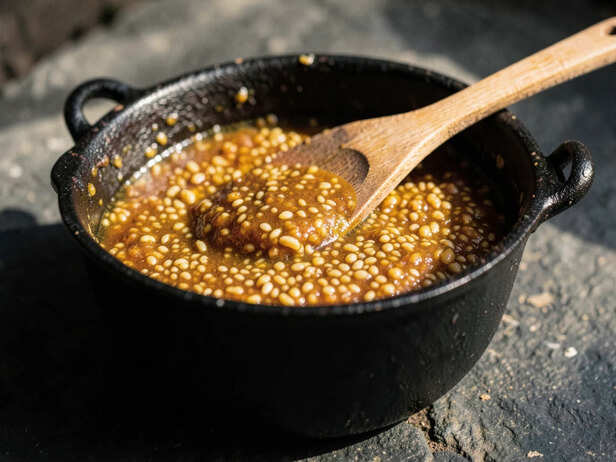
Walk into a gurdwara on Baisakhi and the smell reaches you before the prasad does, a deep, toasted warmth that is part caramelised wheat, part clarified butter, part something that has no name except the specific memory it triggers. The kada prasad arrives in a small mound, pressed into your cupped palms, dense and fudge-like, leaving a thin film of ghee on your hands. What most people do not know is that the texture in that mound, and the fact that it holds its shape at all, is entirely the product of one thing: how long someone stood over a heavy iron karahi and stirred.
What the Stirring Is Actually Doing to the Flour
Kada prasad begins with equal weights of whole wheat flour, ghee, and sugar, with water added to the sugar to make a syrup. The flour goes into hot ghee first, and this is where the stirring begins and does not stop. As the flour heats in the fat, its starch granules absorb the ghee and begin to swell. The proteins in the flour start to denature and set. At the same time, the natural sugars already present in the wheat begin to brown, this is the Maillard reaction, the same process that gives bread its crust and roasted nuts their depth. All of this happens unevenly unless the mixture is kept moving. Stop stirring for thirty seconds and the layer touching the karahi scorches while the top stays raw. The stirring is not ceremony. It is the only way heat travels evenly through a mixture this thick.
Why Ghee Makes the Job Harder and the Result Better
Ghee is almost entirely fat, with the milk solids removed and nearly all the water driven off. This matters because water, in a mixture like this, would act as a moderator, it would absorb heat, slow down browning, and give the cook more margin. Without it, the temperature in the karahi can climb fast and unevenly. The fat coats every particle of flour, which is exactly what gives the finished prasad its smooth, almost sandy texture rather than a gummy one. But that coating only happens if the flour and ghee are in constant motion. A resting mixture separates: fat pools at the surface, flour settles at the bottom, and the two never fully combine. The long stir forces an emulsion that ghee and flour would not form on their own.
What the Sugar Syrup Does When It Meets the Roasted Flour
The flour is stirred in ghee until it turns a deep amber and smells unmistakably nutty, this takes anywhere from twenty minutes to forty, depending on the flame and the quantity. Only then is the sugar syrup added, and this is the moment that demands the most urgent stirring. Hot syrup hitting a hot fat-and-flour mixture seizes almost immediately. The sugar begins to crystallise at the edges of the karahi. The mixture tightens. If the stirring slows now, the prasad sets unevenly, grainy in some parts, oily in others, with a texture that crumbles rather than holds. The continuous motion keeps the crystallisation uniform, distributing the sugar through the flour in a fine, even network rather than in clumps. This is why the finished prasad has a texture that is simultaneously soft and dense: the sugar has set in small, even crystals throughout, bound by the ghee-coated flour.
The Role of the Iron Karahi
Traditional kada prasad is made in a heavy cast-iron karahi, and this is not incidental. Cast iron holds heat steadily and distributes it slowly. A thin aluminium pan would develop hot spots that scorch the flour before the rest of the batch has time to brown. The weight of the karahi also means the temperature does not spike when cold syrup is added, it absorbs the thermal shock and recovers gradually. The wooden or steel ladle used for stirring is wide and flat for the same reason: it needs to reach the curved bottom of the karahi and keep the entire base of the mixture moving, not just the top. The combination of a slow-heating vessel and constant manual movement is doing the work that a thermostat and a mechanical mixer would do in a commercial kitchen.
Why Stopping Early Ruins the Texture
The most common failure in home-made kada prasad is pulling it off the heat too soon, usually because the arms tire or the colour looks close enough. Undercooked prasad has two problems. First, the raw starch in the flour has not fully gelatinised and set, so the mixture stays loose and does not hold its shape when pressed into a palm. Second, the sugar has not distributed evenly through the flour matrix, so the prasad tastes sweet in some bites and bland in others. The long stir is not about devotion expressed through effort, though that meaning is real within the tradition. It is about giving the starch enough time and heat to fully cook, and giving the sugar enough agitation to disperse. The prasad is done when it pulls cleanly away from the sides of the karahi and the ghee begins to separate slightly at the edges, a sign that the starch has absorbed all it can and the mixture has set.
The reason Baisakhi kada prasad takes as long as it does is the same reason a good caramel takes as long as it does: you are asking sugar, fat, and starch to become one thing, and they will only do it on their own schedule. The stirring does not speed that up. It makes sure that when the transformation happens, it happens to the whole batch at once.
Unlock insightful tips and inspiration on personal growth, productivity, and well-being. Stay motivated and updated with the latest at My Life XP.