
What Curry Leaves Give to Hot Oil That They Will Not Give to Water
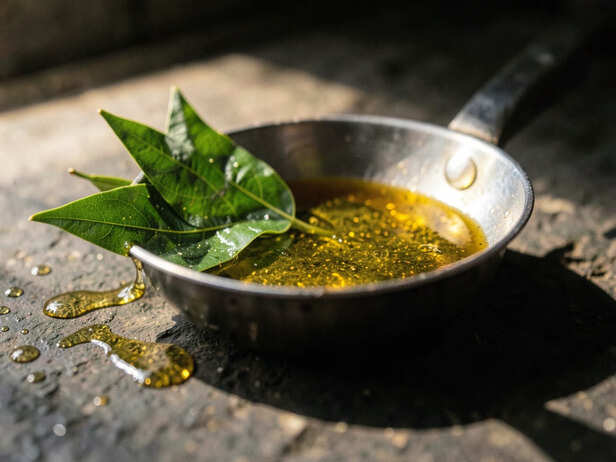
The smell hits before the leaves have finished sputtering. Drop curry leaves into hot oil and the kitchen fills in under ten seconds. Simmer the same leaves in water for twenty minutes and the liquid stays pale, faintly grassy, and largely unconvincing. The leaves look the same going in. What comes out is entirely different. The reason sits in chemistry, but it was cooked into South Indian technique centuries before anyone called it that.
Fat Carries What Water Leaves Behind
The flavour compounds in curry leaves, primarily a group of volatile aromatic molecules including linalool, pinene, and various sesquiterpenes, are lipophilic. That word means fat-loving, and it describes their behaviour precisely. These molecules dissolve readily into oil and resist dissolving into water. When you add curry leaves to hot oil, the heat opens the leaf's cells and the fat pulls the aromatic compounds out and holds them suspended in the cooking medium. When you add the same leaves to water, the same compounds are released but have nowhere stable to go. Most of them escape as steam. What remains in the water is mostly the water-soluble fraction of the leaf: some chlorophyll, a little bitterness, and not much else.
The Temperature Does a Second Job
Heat is not just a carrier here, it is a transformer. The volatile compounds in curry leaves do not simply migrate into oil unchanged. At the temperature of a proper tadka, typically between 160 and 200 degrees Celsius, some of these compounds undergo a controlled breakdown and recombination that produces new aromatic molecules the raw leaf does not contain. This is the same principle behind why toasted spices smell different from raw ones, and why roasted onion tastes nothing like raw onion despite being the same vegetable. Water cannot reach these temperatures at normal pressure, which means a water-based extraction misses the transformation entirely. You get the raw-leaf compounds at best. You miss the cooked ones completely.
Why the Sputtering Matters
The violent crackling when curry leaves meet hot oil is water leaving the leaf in a hurry. Curry leaves hold a significant amount of cellular moisture, and when that moisture hits oil at tadka temperature, it flashes to steam. This rapid exit does two things. First, it mechanically ruptures cell walls that might otherwise release their compounds slowly, which accelerates the extraction. Second, the turbulence created by the escaping steam pushes the aromatic oil compounds outward into the cooking fat rather than letting them drift away. The sputtering is not a sign that something is going wrong. It is the mechanism working. A leaf that goes into oil too cool will not sputter and will not give nearly as much of itself.
What the Oil Does Next
Once the aromatic compounds are dissolved into the cooking fat, they travel. Oil is the medium through which flavour distributes itself in a finished dish. When you pour a curry-leaf tadka over dal, over a coconut chutney, or into a rice preparation, the infused oil carries those compounds into every spoonful. Fat coats the tongue and slows the evaporation of volatile aromatics while you are eating, which is why the flavour of a properly tempered dish lingers. A water-based curry-leaf extract poured over the same dal would deliver its compounds differently, quickly, and mostly to the nose before the food reaches the mouth, with far less of the sustained, coating quality that makes the technique satisfying.
The Leaves Are Not Decoration
A common habit in home cooking is to fish curry leaves out before serving, or to leave them in the pan and eat around them. Both habits suggest the leaves are doing their work as a garnish. They are not. By the time the tadka is done, the leaves have given most of what they have to the oil. The leaf you eat or discard at the end is largely spent. The flavour is already in the fat, already in the dish. This also explains why using too little oil in a tadka produces a flatter result even when the other ingredients are the same, there is not enough fat to carry and distribute what the leaves release.
Fresh Versus Dried, and Why It Is Not a Fair Trade
Dried curry leaves are sometimes substituted when fresh are unavailable. The substitution works at a basic level but loses something specific. Drying removes the moisture that drives the sputtering mechanism, and it degrades some of the more volatile aromatic compounds before they ever reach the oil. The dried leaf gives a quieter, more muted version of the same flavour profile. It is not wrong to use dried leaves when fresh are genuinely unavailable. It is worth knowing that the dish will taste like a quieter version of itself, not an equivalent one.
The technique of the tadka is not a ritual that survived because it is traditional. It survived because it is correct. The oil is not a medium of convenience, it is the only medium in which curry leaves can give what they actually contain. Water gets the shadow of the leaf. Oil gets the thing itself.
.