You probably noticed it on a staircase, or standing on one leg to pull on a shoe, or stepping off a kerb in the dark. Something felt less certain than it used to. Strength was fine. Breathing was fine. But the steadiness that used to be automatic had quietly become something you had to think about.
That shift happens earlier than most people expect, and it has a specific explanation. Balance is not a function of muscle. It is a function of information, and the system that gathers and processes that information starts changing in the fourth decade of life, well ahead of any meaningful loss in muscle mass or aerobic capacity.
Balance Is a Calculation, Not a Feeling
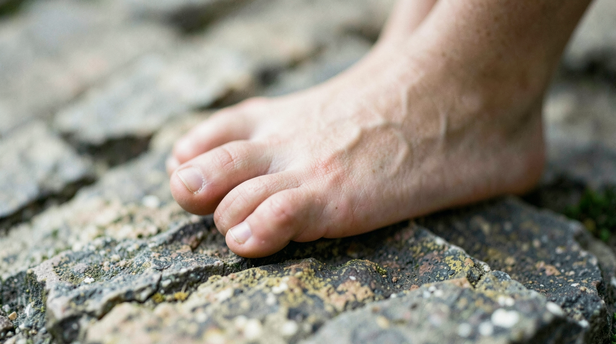
![Foot on Textured Stone]()
Foot on Textured Stone
Image credit : AI
The body does not experience balance as a single sensation. It calculates it continuously from three separate streams of information: signals from the inner ear about head position and movement, signals from the eyes about where the horizon and nearby surfaces are, and signals from receptors in the skin, joints, and muscles, particularly in the feet, ankles, and knees, about what the ground feels like and where the limbs are relative to each other.
The brain weighs these three streams against each other dozens of times per second and issues tiny corrective instructions to the muscles to keep the body's centre of gravity over its base of support. When all three streams are clear and fast, this happens without any conscious effort. When one stream is degraded, eyes closed, uneven ground, dim light, the brain compensates by leaning harder on the other two.
The problem with ageing is that all three streams degrade, but not at the same rate, and not in ways that are obvious until the redundancy is gone.
What Actually Changes, and When
The inner ear contains hair cells in two structures: the semicircular canals, which detect rotation, and the otolith organs, which detect linear movement and the pull of gravity. These hair cells do not regenerate. They begin to decline in number from around the mid-thirties, and by the late sixties a significant proportion are gone. The result is that the inner ear's signal becomes slower and less precise, particularly for detecting small tilts and quick changes in direction.
The joint and skin receptors, collectively called proprioceptors, follow a similar curve. The receptors in the ankle joint are among the most important for upright balance, and studies measuring nerve conduction velocity consistently show slowing in these pathways from the fourth decade onward. The signal still arrives; it just arrives a fraction of a second later than it used to. At walking speed, that fraction matters.
Vision compensates for both of these losses for a long time, which is why balance problems often become noticeable first in low light or on surfaces that are hard to read visually, gravel, wet tiles, a dark hallway. Remove the visual input, and the degraded inner ear and proprioceptive signals are suddenly carrying the load alone.
Muscle strength, by contrast, does not begin its steeper decline until the mid-fifties for most people, and even then the loss is gradual. A person can have the leg strength to catch a stumble and still stumble more often, because the signal that a stumble is beginning arrives too slowly for the catch to be initiated in time.
The Role the Brain Plays
![The sensory signals are only half the picture.]()
The sensory signals are only half the picture.
Image credit : Freepik
The sensory signals are only half the picture. The brain also has to integrate them, predict what is about to happen, and issue the right motor command fast enough to matter. This process, called sensorimotor integration, slows with age independently of what is happening in the peripheral nerves.
Reaction time lengthens. The ability to update a movement plan mid-stride, called anticipatory postural adjustment, becomes less precise. And the cognitive load of balance increases: tasks that were once fully automatic begin to compete for attention. This is why older adults slow down when they talk while walking, and why a moment of distraction, a phone, a question from someone nearby, is more likely to coincide with a misstep than it would have been twenty years earlier.
The brain can adapt and compensate, but it does so more slowly and with less reserve. When two or three of the degraded streams are stressed at the same time, poor light, an uneven surface, a sudden head turn, the calculation fails faster than it would have when the system had more redundancy built in.
Why This Matters Earlier Than Most People Think
The practical consequence of all this is that the window for intervention is earlier than most people assume. Balance training works by challenging the nervous system to refine its predictions and speed up its corrections. It does not restore lost hair cells or reverse nerve conduction slowing, but it does improve how efficiently the brain uses the signals it still has, and it builds the anticipatory strategies that compensate for slower reaction time.
Standing on one leg, walking on uneven surfaces, closing the eyes during simple exercises, and practising movements that require a quick weight shift all stress the system in ways that prompt adaptation. These are not exercises that feel difficult in the way that lifting something heavy feels difficult. The effort is neurological rather than muscular, which is also why people underestimate them and skip them.
Any balance change that is sudden, that involves a new sensation of spinning or of the ground moving, or that is accompanied by hearing changes is worth a doctor's appointment rather than a home programme. The gradual drift described here is a normal feature of ageing; an abrupt change is a different signal entirely.
What Steady Ground Actually Requires
Strength and balance are related but they are not the same thing, and they do not decline on the same schedule. The legs that can carry a person up four flights of stairs may still belong to a nervous system that is slower to detect a stumble, slower to initiate the catch, and more dependent on good light and flat surfaces than it was a decade ago. Recognising that distinction is the first step toward doing something about it, not because a fall is inevitable, but because the system that prevents one responds to practice in ways that the passage of time alone does not undo.
Unlock insightful tips and inspiration on personal growth, productivity, and well-being. Stay motivated and updated with the latest at
My Life XP.