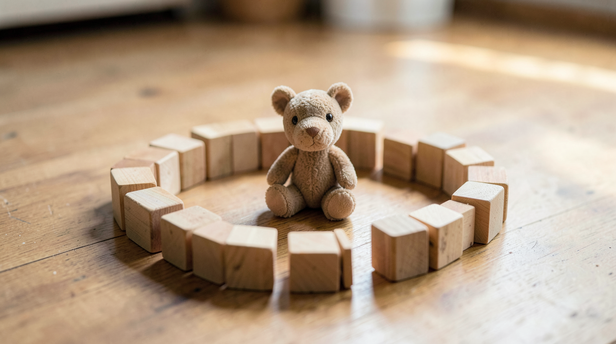
The first time it happens, most parents laugh. A two-year-old crouches over a plastic dinosaur and says, in a voice that is unmistakably yours, 'How many times do I have to tell you?' You laugh because it is uncanny. Then the laugh fades, because you realise what you just heard.
Children do not imitate the way actors do, choosing a voice for effect. They absorb the emotional register of the adults closest to them and replay it in the only safe space they have, play. The stuffed animal, the doll, the toy car cannot answer back. It cannot be hurt. It makes the perfect rehearsal room for everything the child is processing about how people in charge talk to people who are not.
Why Play Is Where Children Process What They Hear
![Morning Playtime Still Life]()
Morning Playtime Still Life
Image credit : MyLifeXP Bureau
Children between two and six are in what developmental psychologists call the preoperational stage, a period when language is arriving faster than the emotional vocabulary to manage it. They experience a great deal they cannot yet name. Play is how they sort it.
When a child picks up a doll and begins directing it, telling it to sit still, praising it for eating well, snapping at it for making a mess, they are not simply replaying a scene. They are rehearsing the emotional logic behind it. They are figuring out: when does a calm voice become a sharp one? What happens in the body just before someone gets impatient? What does it feel like to be the one in charge?
The voice they use in this rehearsal comes from the most emotionally charged interactions they have witnessed. Not the pleasant ones, those rarely carry enough weight to stick. The moments that land hardest are the ones with real feeling behind them: the tight voice when you are running late, the clipped instruction when you are already stretched, the sigh that comes out before you can stop it.
What the Replay Is Actually Telling You
There is a temptation to treat this moment as a verdict. It is not. A child replaying a sharp tone is not indicting a parent, they are doing exactly what healthy development looks like. The ability to internalise adult speech patterns and test them in a low-stakes setting is a sign of a child who is paying close attention and processing well.
What the moment does offer is information. It shows you which emotional register your child has filed away as the primary one. If the voice that comes out of the doll is warm and patient most of the time, with an occasional sharp edge, that is roughly the ratio the child has experienced. If the voice is mostly tense, hurried, corrective, a little loud, that is the register the child has catalogued as normal.
This is not a reason for guilt. Every parent has a version of that voice. The question is not whether it exists but how often it is the dominant sound in the room.
The Habit You Did Not Know You Had
![Generations of Footsteps]()
Generations of Footsteps
Image credit : AI
Most parents, if asked, would describe their tone with their child as patient. Most parents, if they watched a recording of an ordinary Tuesday morning, would be surprised. Not because they are bad parents but because the moments of impatience are distributed across the day in small doses that do not feel significant in the moment, and children are collecting every one.
The specific phrases children replay most reliably are the ones spoken under low-grade stress: the school-morning rush, the end of a long workday, the third time a request has gone unheard. These are not the moments parents remember as defining. They are the moments children remember most clearly, because the emotional charge is high and the child's nervous system is paying full attention.
Hearing those phrases come back through a toy is one of the more honest mirrors a parent will ever encounter. It is not comfortable. It is also genuinely useful.
What You Can Do With What You Heard
The instinct after a moment like this is to correct the child, to say 'we don't talk like that'. That instinct is worth pausing. The child is not misbehaving. They are doing something sophisticated: testing a social script they have observed to understand its emotional logic. Correcting the replay without addressing the source changes nothing.
A more useful response is curiosity. Sit with the child in the play rather than redirecting it. Ask the doll what happened. Let the child narrate the scene. You will learn more about how your child has experienced a recurring dynamic in two minutes of play than in a week of asking 'how was your day'.
The second response is quieter and happens later, away from the child. It is simply noticing: in what situations does that voice appear in you? What is the physical state just before it, are you hungry, behind schedule, already depleted from something else? Stress voices are almost never about the child in front of you. They are about the load you are carrying when the child asks for the fifteenth thing.
Some parents find it useful to build a small buffer at the moments they know are hardest, ten minutes before school, the transition from work to home. Not a performance of patience, but a genuine pause. A glass of water, a breath, a moment of sitting before the next thing begins. The voice that comes out of a rested person is different from the voice that comes out of a depleted one, and children notice that difference before parents do.
The Part That Is Worth Keeping
Not everything the child replays is something to change. Children also absorb the voice that reads a story slowly, the one that laughs at a small joke, the one that says 'come here, let me look at you' when something has gone wrong. Those voices are in the rehearsal room too.
A child who plays at being a parent is a child who is learning how to be in relationship with another person. The fact that your voice is the one they reach for, even the imperfect version of it, means you are the person they are most trying to understand. That is not a small thing.
The sharp phrase that came out of the doll is information. The fact that your child is playing at being you at all is something else: it is evidence that you are the centre of their world, and they are working hard to make sense of it.
What children replay in play is the emotional landscape they are navigating every day. The moment you hear your own words in a small voice directed at a toy is not a failure to examine, it is an invitation to look at the ordinary texture of your days together, and to ask which parts of it you want to keep.
Experiencing stress or misunderstandings in your relationship with your child? Your name energy may play a role. Check your name energy here. Unlock insightful tips and inspiration on personal growth, productivity, and well-being. Stay motivated and updated with the latest at
My Life XP.