4 Powerful Upanishad Truths: Who Are You Really?
Noopur Kumari | Sept 07, 2026, 15:00 IST
The Upanishads contain a vast body of philosophical thought, yet four ancient statements are often treated as its most powerful summaries. Prajnanam Brahma, Aham Brahmasmi, Tat Tvam Asi and Ayam Atma Brahma each approach the same profound question from a different direction. Together, they invite us to look beyond our temporary identities and question what the deepest self really means.

Mahavakyas That Reveal the Hidden Truth of the Upanishads
Image credit : ChatGPT(ai)
What if the answer to “Who am I?” is completely different from what we usually believe? The Upanishads explore this question by looking beyond the body, senses, thoughts and everyday identity. Their core philosophy is traditionally expressed through four powerful statements known as the Mahavakyas, or “great sayings.” Each points toward the relationship between the individual self and Brahman, the ultimate reality. Read together, they create a striking spiritual journey: from understanding consciousness to recognising the deeper unity between the self and the universal reality.
![Seeker Exploring the Inner Self]()
The journey begins with a deceptively simple question: Who am I? In everyday life, we identify ourselves through our name, body, profession, relationships, emotions and thoughts. But Upanishadic inquiry asks us to look deeper. If the body changes, yet we remain aware of those changes, are we only the body? If thoughts constantly change, what is aware of those thoughts? This process of questioning gradually turns attention inward. Instead of searching for identity outside ourselves, the seeker examines experience itself. This sets the foundation for understanding the four Mahavakyas and their central teaching about consciousness, self and ultimate reality.
![Meditation and Pure Awareness]()
The first Mahavakya is Prajnanam Brahma, traditionally associated with the Aitareya Upanishad. It is commonly translated as “Consciousness is Brahman.” The statement shifts attention away from temporary identities toward awareness itself. Our body changes, emotions move and thoughts appear and disappear, but consciousness is what allows these experiences to be known. In this philosophical framework, the deepest reality is not merely an object we can observe. It is connected with consciousness itself. The teaching encourages a person to examine experience carefully and ask what remains when changing identities are set aside. That inquiry becomes the first major step toward deeper self-understanding.
The second Mahavakya, Aham Brahmasmi, comes from the Brihadaranyaka Upanishad and is commonly translated as “I am Brahman.” Its emphasis is different from simply describing consciousness as ultimate reality. Here, the teaching becomes deeply personal. The seeker is not merely hearing an idea about Brahman but recognising a profound identity between the deepest self and Brahman. In Advaita Vedanta, this statement is understood as pointing beyond the ego or personality. It does not mean the everyday individual ego becomes God. Rather, it concerns the deeper Self, understood as not fundamentally separate from ultimate reality.
The third Mahavakya is Tat Tvam Asi, found in the Chandogya Upanishad. It is commonly translated as “That Thou Art” or “You are That.” The phrase appears in a teaching context where the nature of reality and the self is explored through a teacher-student dialogue. Its power lies in turning an abstract philosophical idea into a personal question. What we seek as ultimate truth is not necessarily somewhere distant or separate. In Advaita interpretation, the statement points toward the recognition that the deepest Self is not separate from Brahman. The journey therefore moves from seeking outwardly toward understanding the reality within.
The fourth Mahavakya is Ayam Atma Brahma, associated with the Mandukya Upanishad. It is generally translated as “This Self is Brahman.” The statement brings the earlier teachings together by directly connecting Atman, the deepest Self, with Brahman. The Mandukya Upanishad explores consciousness through the states of waking, dreaming and deep sleep, eventually pointing toward the deeper reality beyond ordinary experience. In this philosophical tradition, the Self is not understood as merely the personality, body or changing mind. Instead, the teaching directs attention toward the deepest level of awareness and its relationship with the ultimate reality described as Brahman.
These four Mahavakyas can be understood as four perspectives on one profound inquiry. Prajnanam Brahma focuses on consciousness. Aham Brahmasmi expresses personal realisation. Tat Tvam Asi points toward the identity of the deeper Self with “That,” or ultimate reality. Ayam Atma Brahma directly connects the Self with Brahman. Together, they challenge the assumption that our everyday identity tells us everything about who we are. Their purpose is not simply to provide four sentences to memorise. Traditionally, they are meant to inspire contemplation, self-inquiry and deeper philosophical reflection about consciousness, identity and reality.
The most powerful lesson may not be memorising the four Mahavakyas, but allowing their question to transform the way we look at ourselves. When we stop defining ourselves only through appearance, possessions, achievements, roles and changing emotions, a deeper inquiry begins. Who is aware of all these experiences? What remains when temporary identities shift? Different schools of Indian philosophy interpret these teachings in different ways, but the Advaita Vedanta tradition places strong emphasis on the non-dual relationship between Atman and Brahman. Ultimately, the Mahavakyas invite us to pause, question familiar assumptions and explore the possibility that our deepest identity is more profound than the labels we carry every day.
Unlock insightful tips and inspiration on personal growth, productivity, and well-being. Stay motivated and updated with the latest at My Life XP.
The Question Begins Within
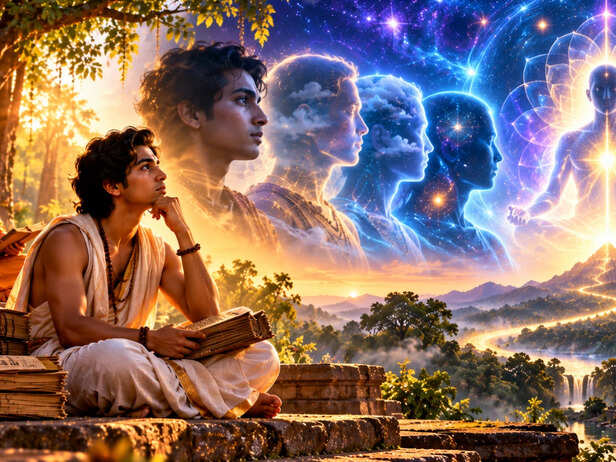
Seeker Exploring the Inner Self
Image credit : ChatGPT (ai)
The journey begins with a deceptively simple question: Who am I? In everyday life, we identify ourselves through our name, body, profession, relationships, emotions and thoughts. But Upanishadic inquiry asks us to look deeper. If the body changes, yet we remain aware of those changes, are we only the body? If thoughts constantly change, what is aware of those thoughts? This process of questioning gradually turns attention inward. Instead of searching for identity outside ourselves, the seeker examines experience itself. This sets the foundation for understanding the four Mahavakyas and their central teaching about consciousness, self and ultimate reality.
Prajnanam Brahma: Consciousness Is Brahman
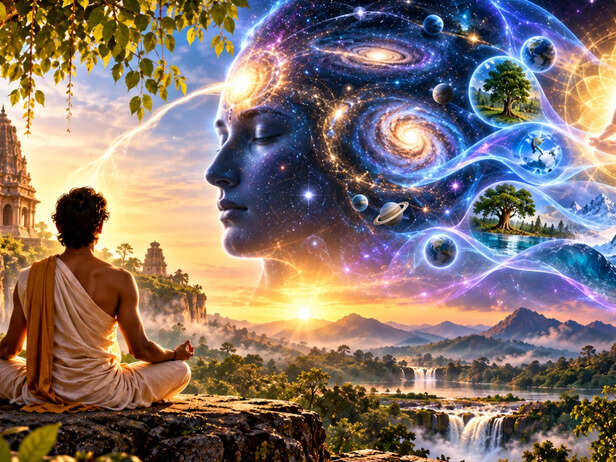
Meditation and Pure Awareness
Image credit : ChatGPT(ai)
The first Mahavakya is Prajnanam Brahma, traditionally associated with the Aitareya Upanishad. It is commonly translated as “Consciousness is Brahman.” The statement shifts attention away from temporary identities toward awareness itself. Our body changes, emotions move and thoughts appear and disappear, but consciousness is what allows these experiences to be known. In this philosophical framework, the deepest reality is not merely an object we can observe. It is connected with consciousness itself. The teaching encourages a person to examine experience carefully and ask what remains when changing identities are set aside. That inquiry becomes the first major step toward deeper self-understanding.
Aham Brahmasmi: The Realisation Turns Personal
Tat Tvam Asi: That Is What You Are
Ayam Atma Brahma: The Self Is Brahman
Four Statements, One Deeper Inquiry
The Question Changes Everything
Unlock insightful tips and inspiration on personal growth, productivity, and well-being. Stay motivated and updated with the latest at My Life XP.