When people think of Diwali, they often remember Lord Rama's return to Ayodhya, the worship of Goddess Lakshmi, and the tradition of lighting earthen lamps. However, another fascinating story connects the festival of lights with Lord Shiva.
This story revolves around Tripurasura and the destruction of three powerful cities. According to Hindu tradition, Lord Shiva defeated the demon and restored peace to the universe. His victory is remembered during
Dev Deepawali, also known as the Diwali of the Gods, which is celebrated on Kartik Purnima, approximately 15 days after Diwali.
The Diwali Connection Many People Overlook
The festival is especially significant in Varanasi, where devotees illuminate the ghats of the Ganga with thousands of lamps. The celebration reflects the belief that the gods rejoiced after Shiva's victory over the forces of evil.
Who Was Tripurasura, and Why Did He Become So Powerful?
![Tripurasura and the Three Celestial Cities]()
Tripurasura and the Three Celestial Cities
Image credit : ChatGPT
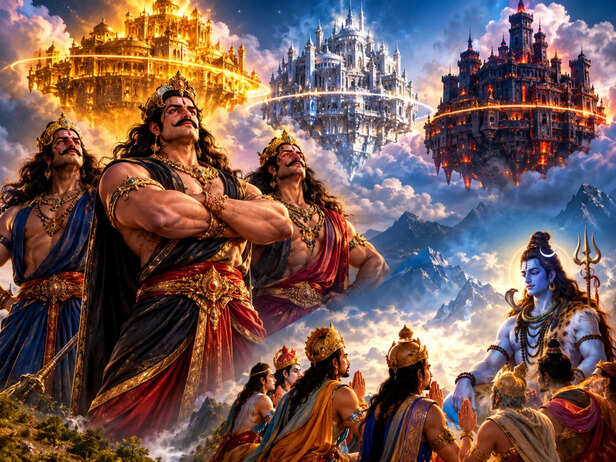
The legend of Tripurasura is associated with three asura brothers, the sons of Tarakasura. Their names are commonly given as Tarakaksha, Kamalaksha and Vidyunmali.
According to the traditional account, the brothers performed intense penance to please Lord Brahma. Pleased with their devotion, Brahma granted them a boon connected to three extraordinary cities.
These cities were known as Tripura. In a widely told version of the story, one was made of gold, another of silver, and the third of iron. They were positioned across different realms and became formidable strongholds.
The brothers initially gained power through their devotion and the boon they received. However, their growing arrogance eventually led them to trouble the gods and disturb the balance of the universe.
The gods realised that their power had become difficult to overcome. They therefore sought Lord Shiva's help to end the threat posed by Tripurasura.
How Did Lord Shiva Destroy the Three Cities?
The destruction of Tripura is one of the remarkable episodes in Hindu mythology because of the extraordinary conditions surrounding the demons' boon.In the traditional narrative, the three cities could be destroyed only under a rare set of circumstances, when they aligned in a particular way. This made the task nearly impossible for the gods.When the time came to confront the asuras, Lord Shiva prepared for battle. In well-known versions of the legend, the gods contributed their powers and elements of the universe came together to form a divine chariot and weapon.
Lord Brahma served as the charioteer in a popular account, while Shiva held the mighty bow and prepared to release a single arrow.When the three cities aligned, Shiva released the arrow and destroyed them. The victory ended the threat posed by Tripurasura and restored balance to the universe.This powerful episode explains why Shiva is worshipped as
Tripurantaka or Tripurari, names associated with the destroyer of Tripura.The story is narrated in Hindu scriptural traditions, including accounts in the Shiva Purana and the Mahabharata. Details vary between tellings, but the central theme remains the destruction of the three cities by Shiva.
Why Is Shiva's Victory Connected to Dev Deepawali?
![Shiva’s Radiant River Festival]()
Shiva’s Radiant River Festival
Image credit : ChatGPT
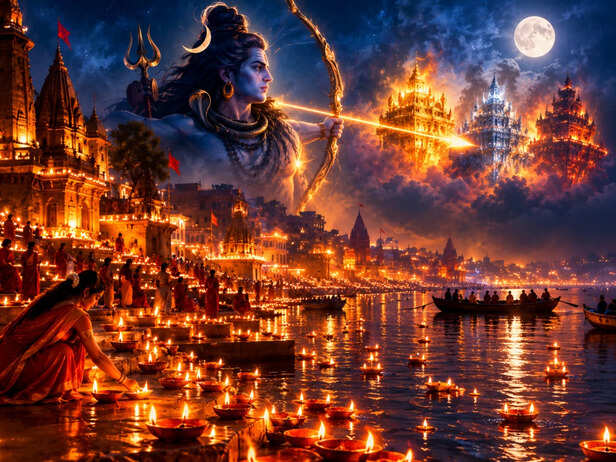
The connection between Shiva and the festival of lights becomes clearer through Dev Deepawali.Unlike the main Diwali celebration, which falls on Amavasya, or the new-moon night, Dev Deepawali takes place on Kartik Purnima, the full-moon day of the Hindu month of Kartik.According to a popular Hindu tradition, the gods celebrated Shiva's victory over Tripurasura by lighting lamps.
This divine celebration is remembered as Dev Deepawali.The festival is also known as Tripurari Purnima or Tripurotsav in traditions that emphasise Shiva's victory over Tripura.Varanasi, one of the most sacred cities associated with Shiva, is particularly famous for its Dev Deepawali celebrations. On this occasion, the ghats along the Ganga glow with countless earthen lamps, while temples, prayers and devotional ceremonies bring the city to life.The sight of the illuminated riverfront reflects the spiritual significance of the occasion: the celebration of divine victory, the removal of darkness, and the restoration of harmony.
What Does the Tripurasura Story Teach Us?
Beyond its mythological significance, the story of Tripurasura offers several ways to reflect on everyday life.
1. Power Without Wisdom Can Lead to Destruction
The asura brothers received extraordinary powers through their devotion, but their growing arrogance led them towards destruction.
The story reminds devotees that power, success and knowledge are meaningful only when accompanied by responsibility and humility.
2. Darkness Is Not Always Outside Us
The destruction of Tripura is often understood symbolically as the victory of good over evil. Its deeper message can also be applied to the inner struggles people face, including pride, anger, greed and ignorance.Just as Shiva destroys the three cities in the legend, devotees may interpret the story as a reminder to overcome negative tendencies within themselves.
3. Light Represents Hope and Renewal
Lighting diyas is one of the most recognisable traditions associated with Diwali and Dev Deepawali. In the context of Shiva's victory, the lamps celebrate the end of oppression and the restoration of peace.For devotees, each lamp can serve as a reminder that difficult periods do not have to define the future.
Why Is Lord Shiva Worshipped as Tripurantaka?
The name Tripurantaka carries the memory of Shiva's victory over the three cities. It represents his role as the divine force that destroys what threatens cosmic balance.The story also highlights an important aspect of Shiva's place in Hindu belief. His power of destruction is not understood only as an ending. It can also represent the removal of harmful forces and the possibility of renewal.This is why the Tripurasura legend remains relevant during Kartik Purnima and Dev Deepawali. It connects an ancient mythological battle with a festival that celebrates light, devotion and spiritual reflection.
The Forgotten Shiva Connection Behind the Festival of Lights
Diwali has several religious and regional meanings, and the story of Lord Rama is only one part of its wider cultural landscape. The legend of Tripurasura reveals another important connection between Hindu mythology and the tradition of lighting lamps.
Through the celebration of Dev Deepawali, devotees remember Lord Shiva's victory and the restoration of harmony in the universe.The story encourages people to look beyond outward celebrations and reflect on the qualities they wish to overcome within themselves. In this sense, the lamps lit in honour of Shiva's victory represent more than a festival tradition. They also express a timeless hope for wisdom, peace and the triumph of good over evil.
Unlock insightful tips and inspiration on personal growth, productivity, and well-being. Stay motivated and updated with the latest at
My Life XP.