Did Maharishi Ved Vyasa Describe Earth Thousands of Years Ago?
Noopur Kumari | Jul 15, 2026, 15:00 IST
A centuries-old interpretation of the Mahabharata claims that Maharishi Ved Vyasa described a map resembling the modern world. The theory gained attention after philosopher Ramanujacharya reportedly created an illustration based on the scripture. While many devotees see this as extraordinary spiritual wisdom, historians consider it a symbolic interpretation rather than scientific evidence. Here's the fascinating story behind this enduring belief.

Ved Vyasa Predict the World Map
Image credit : ChatGPT(AI)
What if an ancient Indian scripture described something that resembles the modern world map centuries before modern geography existed? It sounds unbelievable, yet one fascinating interpretation of the Mahabharata has sparked curiosity among historians, spiritual seekers, and mythology enthusiasts alike. A verse from the Bhishma Parva is often cited by believers who claim Maharishi Ved Vyasa hinted at Earth's geography in a surprising way. But what exactly does the verse say, and why is it still discussed today?
![Ancient Mahabharata Manuscript]()
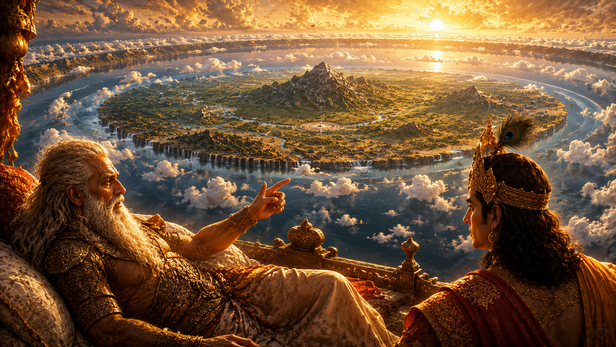
One verse from the Bhishma Parva describes a circular landmass that appears like a reflection in a mirror. It also mentions shapes resembling a peepal leaf and a rabbit. Over time, some scholars and spiritual followers interpreted this poetic description as a symbolic representation of Earth's geography. Although the verse itself does not directly mention a modern world map, its imagery has inspired many discussions across generations.
![Ramanujacharya Studying Scriptures]()
According to a popular belief, the 11th-century philosopher Ramanujacharya created a geographical illustration inspired by Ved Vyasa's description. Supporters of this theory claim that when this drawing is rotated, it resembles today's world map. However, historians note that this remains a traditional interpretation and is not supported by archaeological or scientific evidence. Even so, it continues to fascinate those interested in India's ancient knowledge traditions.
People are naturally drawn to mysteries that connect ancient texts with modern discoveries. The idea that a scripture written thousands of years ago may contain hidden geographical insights creates excitement and curiosity. Whether viewed as symbolism, spiritual knowledge, or coincidence, the theory encourages readers to revisit ancient literature with fresh interest and appreciate the depth of its poetic descriptions.
For many devotees, the Mahabharata contains timeless wisdom that extends beyond ordinary human understanding. Historians and researchers, however, interpret these verses through literature, symbolism, and historical context rather than as scientific geography. Both perspectives continue to coexist, reminding us that ancient scriptures can inspire faith while also inviting scholarly discussion without requiring one interpretation to replace another.
Many Sanskrit scholars believe the verse reflects cosmological symbolism rather than physical cartography. Ancient Indian texts often described the universe using metaphors, sacred geometry, and spiritual imagery. The circular form, mirror comparison, and references to natural shapes may represent philosophical concepts instead of literal continents. Understanding these symbolic traditions helps readers appreciate the richness of the Mahabharata beyond modern comparisons.
Whether or not the verse predicts a modern world map, it reminds us of the incredible intellectual and spiritual heritage preserved in India's epics. Reading these texts with both curiosity and critical thinking allows us to appreciate their wisdom while respecting historical evidence. Ancient literature often raises meaningful questions that continue to inspire research, faith, and thoughtful conversation.
Disclaimer This article is based on traditional beliefs and is intended for informational purposes only.
Unlock insightful tips and inspiration on personal growth, productivity, and well-being. Stay motivated and updated with the latest at My Life XP.
The Verse That Started the Mystery
Ancient Mahabharata Manuscript
Image credit : ChatGPT (AI)
One verse from the Bhishma Parva describes a circular landmass that appears like a reflection in a mirror. It also mentions shapes resembling a peepal leaf and a rabbit. Over time, some scholars and spiritual followers interpreted this poetic description as a symbolic representation of Earth's geography. Although the verse itself does not directly mention a modern world map, its imagery has inspired many discussions across generations.
The Ramanujacharya Connection

Ramanujacharya Studying Scriptures
Image credit : ChatGPT(AI)
According to a popular belief, the 11th-century philosopher Ramanujacharya created a geographical illustration inspired by Ved Vyasa's description. Supporters of this theory claim that when this drawing is rotated, it resembles today's world map. However, historians note that this remains a traditional interpretation and is not supported by archaeological or scientific evidence. Even so, it continues to fascinate those interested in India's ancient knowledge traditions.
Why This Theory Fascinates People
Faith and History See It Differently
What the Original Verse Symbolises
What We Can Learn Today
Disclaimer This article is based on traditional beliefs and is intended for informational purposes only.
Unlock insightful tips and inspiration on personal growth, productivity, and well-being. Stay motivated and updated with the latest at My Life XP.