Did Ravana Really Attend Sita’s Swayamvar? The Truth
Noopur Kumari | Sept 12, 2026, 14:00 IST
The image of Ravana attending Sita’s swayamvar is familiar to millions, but the original textual tradition tells a more nuanced story. Valmiki Ramayana does not describe Ravana participating in the event. Ramcharitmanas mentions Ravana while describing the power of Shiva’s bow, but does not place him physically at the swayamvar. Some later regional Ramayana traditions, however, do portray Ravana as a participant.

watching televised versions of the Ramayana,
Image credit : ChatGPT(ai)
If you grew up watching televised versions of the Ramayana, you may remember Ravana appearing at Sita’s swayamvar, surrounded by powerful kings and confidently attempting to lift Lord Shiva’s mighty bow. But there is an important question behind this familiar scene: is this actually described in the major Ramayana texts? The answer is more complicated than the television version suggests. Valmiki’s Ramayana does not explicitly place Ravana at Sita’s swayamvar, while later retellings and regional traditions tell the story differently. This distinction reveals how the Ramayana tradition has evolved across centuries.
![Ravana at Sita’s Swayamvar]()
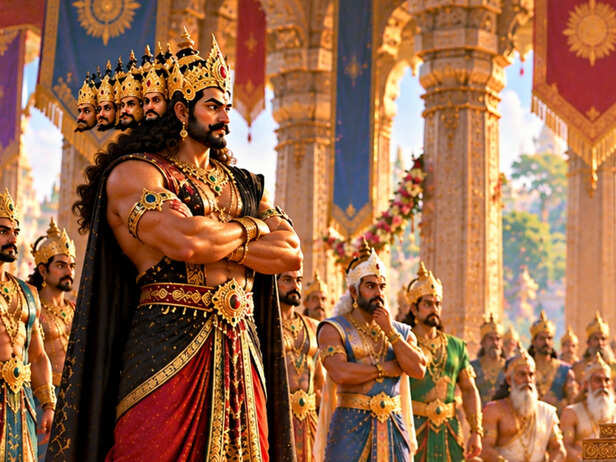
For many viewers, Sita’s swayamvar immediately brings to mind a grand royal assembly filled with powerful kings, including Ravana. In popular television portrayals, Ravana often arrives with confidence, attempts to demonstrate his strength and eventually fails before Rama lifts Shiva’s bow. It makes for a dramatic scene and adds tension to the story. But television adaptations often combine material from different Ramayana traditions. That means a scene shown on screen does not automatically appear in exactly the same form in Valmiki’s Ramayana. To understand the story properly, it helps to separate popular imagery from specific textual accounts.
![King Janaka Showing Shiva’s Bow]()
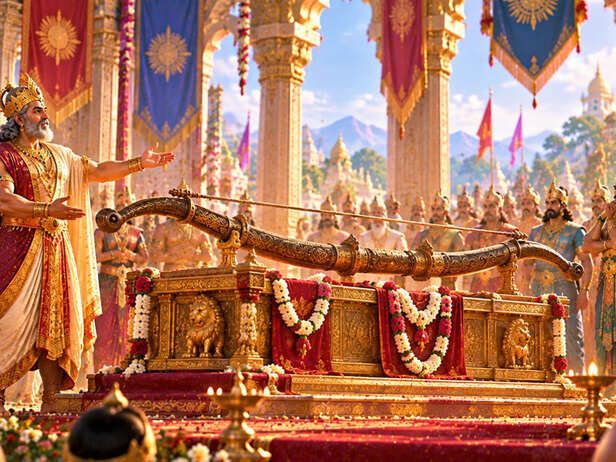
In Valmiki Ramayana, King Janaka explains that many powerful kings had previously tried to lift Shiva’s bow and had failed. However, the text does not explicitly identify Ravana as one of the kings present at Sita’s marriage event. Rama, accompanied by Vishvamitra and Lakshmana, comes to Mithila, where Janaka presents the bow and explains his condition. Rama then lifts and breaks it. This is an important distinction because the popular idea of Ravana standing in the swayamvar assembly is not supported by an explicit scene in Valmiki’s account.
Tulsidas’s Ramcharitmanas gives the story another interesting layer. In the Bala Kanda, the greatness of Shiva’s bow is described by referring to powerful figures such as Ravana and Banasura. However, this does not necessarily mean Ravana was physically sitting in the swayamvar assembly when Rama broke the bow. The passage describes Ravana and Banasura as having encountered the bow and being unable to challenge its power. A closer reading therefore creates an important distinction between Ravana knowing or encountering the bow earlier and Ravana actually attending the swayamvar itself.
The Ravana-at-the-swayamvar story does exist in some later and regional traditions. For example, the Bengali Krittivasi Ramayana and Marathi Bhavarth Ramayana associated with Sant Eknath describe Ravana as being present and attempting to lift Shiva’s bow. In these versions, his pride becomes part of the dramatic episode. Other traditions tell the story differently. This is why saying simply that “Ravana definitely attended” or “the story is completely fictional” misses the larger picture. The Ramayana exists through many literary and regional traditions, and individual episodes can change across languages, centuries and storytelling traditions.
Television played a major role in shaping how modern audiences visualise the Ramayana. Ramanand Sagar’s 1987–88 Ramayan became one of the most influential televised adaptations of the epic and drew from both Valmiki’s Ramayana and Tulsidas’s Ramcharitmanas. Later television and popular storytelling have also incorporated elements from wider Ramayana traditions. As a result, scenes from different textual and regional versions can become part of one familiar visual narrative. This does not make the storytelling meaningless. It simply means viewers should distinguish between an adaptation, a regional tradition and what a particular ancient text explicitly records.
Regardless of whether Ravana is included, the central event remains the same: Rama succeeds where the other powerful kings fail. In Valmiki’s account, Janaka had established a condition involving Shiva’s bow, and Rama ultimately fulfils it. In the Ramcharitmanas, the moment receives an even more dramatic poetic treatment, with the gathering watching as Rama approaches the mighty bow. The focus therefore remains on Rama’s extraordinary strength and destiny, while Ravana’s role varies depending on the version being told.
So, did Ravana attend Sita’s swayamvar? According to Valmiki Ramayana, there is no explicit description of Ravana attending it. Ramcharitmanas also does not clearly place him physically at the ceremony, although it mentions Ravana in connection with Shiva’s bow. Some regional Ramayana traditions do portray him as a participant.
That difference is not a weakness in the tradition. It shows how the Ramayana has lived through Sanskrit texts, regional literature, oral storytelling, theatre and television. The next time you see Ravana standing in Sita’s swayamvar, you will know there is a much deeper story behind that familiar scene.
Unlock insightful tips and inspiration on personal growth, productivity, and well-being. Stay motivated and updated with the latest at My Life XP.
The Famous Scene Is Familiar
Ravana at Sita’s Swayamvar
Image credit : ChatGPT
For many viewers, Sita’s swayamvar immediately brings to mind a grand royal assembly filled with powerful kings, including Ravana. In popular television portrayals, Ravana often arrives with confidence, attempts to demonstrate his strength and eventually fails before Rama lifts Shiva’s bow. It makes for a dramatic scene and adds tension to the story. But television adaptations often combine material from different Ramayana traditions. That means a scene shown on screen does not automatically appear in exactly the same form in Valmiki’s Ramayana. To understand the story properly, it helps to separate popular imagery from specific textual accounts.
Valmiki Ramayana Is Different
King Janaka Showing Shiva’s Bow
Image credit : ChatGPT(ai)
In Valmiki Ramayana, King Janaka explains that many powerful kings had previously tried to lift Shiva’s bow and had failed. However, the text does not explicitly identify Ravana as one of the kings present at Sita’s marriage event. Rama, accompanied by Vishvamitra and Lakshmana, comes to Mithila, where Janaka presents the bow and explains his condition. Rama then lifts and breaks it. This is an important distinction because the popular idea of Ravana standing in the swayamvar assembly is not supported by an explicit scene in Valmiki’s account.
Ramcharitmanas Adds Another Detail
Then Where Did the Story Come From?
Television Made It More Familiar
Rama’s Bow-Breaking Remains Central
The Real Lesson Is About Versions
That difference is not a weakness in the tradition. It shows how the Ramayana has lived through Sanskrit texts, regional literature, oral storytelling, theatre and television. The next time you see Ravana standing in Sita’s swayamvar, you will know there is a much deeper story behind that familiar scene.
Unlock insightful tips and inspiration on personal growth, productivity, and well-being. Stay motivated and updated with the latest at My Life XP.