Does Ananta Shesha Hold the Universe? Science Meets Mythology
Noopur Kumari | Aug 28, 2026, 11:00 IST
Marvel turned the idea of an eternal cosmic guardian into fiction. Science describes a universe dominated by dark matter and dark energy that we still do not completely understand. Ancient Hindu texts use another striking image: Ananta Shesha, the endless serpent associated with the cosmic order and the resting place of Narayana. So is there really a connection, or are we simply seeing patterns across completely different ways of understanding existence?

Loki, Dark Energy and Ananta Shesha
Image credit : ChatGPT (ai)
What if a Marvel story about a being who remains at the end of time suddenly reminded you of an ancient Hindu image of something infinite that survives across cosmic cycles? That is where this fascinating comparison begins. In Loki, the mysterious He Who Remains stands outside the ordinary flow of the timeline. In modern cosmology, scientists know that most of the universe is not made of the ordinary matter we can directly see. And in Hindu tradition, Ananta Shesha is described through powerful cosmic imagery as the infinite serpent associated with the preservation of the universe. These are not the same idea, but the comparison raises an intriguing question.
![He Who Remains Beyond the Sacred Timeline]()
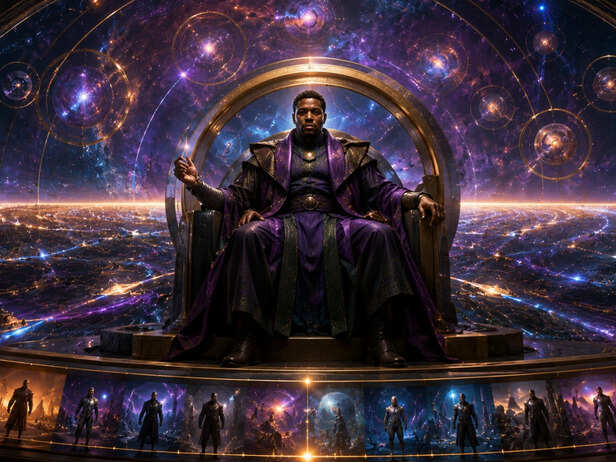
In Loki Season 1, He Who Remains is introduced as a mysterious figure who has reached the end of an enormous chain of timelines. His warning is simple but terrifying: removing him could unleash forces capable of destabilising the timelines. Later, Loki takes responsibility for holding the timelines together. This is storytelling, not a scientific model, but the idea is fascinating because it personifies something that exists beyond ordinary human experience. Instead of asking what holds a single world together, the story asks a much bigger question: what, if anything, remains when everything else changes?
![Dark Matter and Dark Energy Across the Universe]()
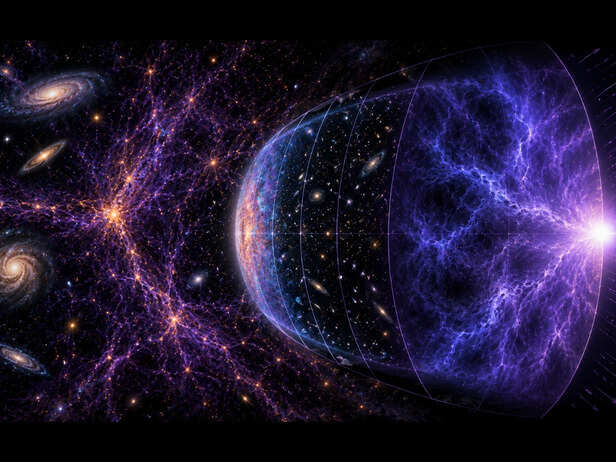
Modern cosmology presents a very different but equally fascinating picture. Ordinary matter, the material that makes stars, planets and people, accounts for only about 5% of the universe's total energy budget in the standard cosmological model. The rest is generally attributed to dark matter and dark energy. These terms do not mean evil or supernatural forces. "Dark" refers to the fact that these components cannot be observed in the same straightforward way as ordinary matter. Scientists infer their presence from their effects on galaxies, cosmic expansion and large-scale structure.
This is where the popular comparison can easily become misleading. Dark matter is not simply invisible energy, and dark energy is not one mysterious substance that scientists have already identified. Dark matter is inferred because its gravitational effects influence galaxies and cosmic structures. Dark energy is the name given to whatever is driving the universe's observed accelerated expansion. Scientists are still investigating their fundamental nature. So when we say roughly 95% of the universe is "dark," it does not mean science has discovered a single entity holding everything together. It means most of the cosmic energy budget remains outside ordinary matter.
Now the story takes a completely different turn. In Hindu tradition, Ananta Shesha, also called Shesha or Ananta, represents an infinite cosmic serpent. The Sanskrit word Ananta itself conveys the idea of endlessness or infinity. In Vaishnava imagery, Lord Vishnu or Narayana is traditionally depicted reclining upon Shesha in the cosmic ocean. The image is deeply symbolic and has been interpreted through religious and philosophical traditions in different ways. It should not be treated as a literal scientific description of dark matter or dark energy. Yet the imagery naturally inspires a huge question: why did ancient traditions repeatedly use infinity, cosmic cycles and a sustaining presence to describe existence?
The Bhagavata
The comparison becomes even more interesting when readers explore the Bhagavata Purana, particularly its descriptions of Ananta and cosmic existence. The text presents Ananta as a powerful divine manifestation associated with the cosmic order, using imagery far removed from modern scientific language. Hindu cosmology also works with enormous cycles of creation, preservation and dissolution. That makes it tempting to compare these ideas with modern discussions about the origin and possible future of the universe. But there is an important boundary: similar imagery does not prove that ancient texts scientifically predicted dark matter or dark energy. The connection is philosophical and metaphorical, not established science.
Here is another question that makes the comparison even more fascinating: is the universe infinite? Scientists know the observable universe has a finite horizon because light has had a limited amount of time to reach us. But that does not tell us whether the entire universe is finite or infinite. Current observations are consistent with a universe that is very close to spatially flat, but its total size remains unknown. This uncertainty leaves room for an extraordinary scientific question. We can measure an enormous portion of the cosmos, yet we still cannot confidently say what lies beyond our observable horizon.
So, is Ananta Shesha the same thing as the unknown 95% of the universe? No scientific evidence establishes that connection. Is Loki's He Who Remains a representation of dark energy or Ananta Shesha? No. They belong to fictional, scientific and religious frameworks respectively. But there is still something beautiful about placing them side by side. All three encourage us to ask questions about continuity, infinity, time and existence. Marvel turns the question into a character. Science turns it into equations and observations. Hindu tradition expresses it through cosmic symbolism. The answers are different, but the human curiosity behind the questions feels remarkably familiar.
When
The fascinating lesson is not that mythology secretly contains modern physics. It is that human beings have always looked beyond the visible world and wondered what sustains existence. Modern science tells us that ordinary matter makes up only a small fraction of the universe's total cosmic budget, while dark matter and dark energy remain major areas of research. Hindu cosmological traditions use a different language, filled with images of endlessness, cosmic cycles and divine preservation. Reading these traditions together can spark curiosity, but they should not be confused with one another.
Unlock insightful tips and inspiration on personal growth, productivity, and well-being. Stay motivated and updated with the latest at My Life XP.
The Marvel Idea of He Who Remains
He Who Remains Beyond the Sacred Timeline
Image credit : ChatGPT (ai)
In Loki Season 1, He Who Remains is introduced as a mysterious figure who has reached the end of an enormous chain of timelines. His warning is simple but terrifying: removing him could unleash forces capable of destabilising the timelines. Later, Loki takes responsibility for holding the timelines together. This is storytelling, not a scientific model, but the idea is fascinating because it personifies something that exists beyond ordinary human experience. Instead of asking what holds a single world together, the story asks a much bigger question: what, if anything, remains when everything else changes?
Science Has Its Own Cosmic Mystery
Dark Matter and Dark Energy Across the Universe
Image credit : ChatGPT(ai)
Modern cosmology presents a very different but equally fascinating picture. Ordinary matter, the material that makes stars, planets and people, accounts for only about 5% of the universe's total energy budget in the standard cosmological model. The rest is generally attributed to dark matter and dark energy. These terms do not mean evil or supernatural forces. "Dark" refers to the fact that these components cannot be observed in the same straightforward way as ordinary matter. Scientists infer their presence from their effects on galaxies, cosmic expansion and large-scale structure.
What Does 'Dark' Actually Mean?
Then Comes Ananta Shesha
The Bhagavata Purana Adds More Mystery
Is the Universe Actually Infinite?
The Real Connection Is the Question
When Mythology Meets Cosmic Curiosity
Unlock insightful tips and inspiration on personal growth, productivity, and well-being. Stay motivated and updated with the latest at My Life XP.