The twelve Jyotirlinga shrines span nearly the entire length and breadth of the Indian subcontinent. Kedarnath sits above three thousand metres in the Garhwal Himalayas. Rameshwaram stands at the southern tip, where the land nearly dissolves into the sea. Between them lie shrines in river gorges, coastal towns, forest edges, and ancient trade cities. No single ruler built this network. No single era created it. The spread is the point.
What a Jyotirlinga Actually Is
![Shiva’s Parikrama]()
Shiva’s Parikrama
The word combines jyoti, meaning light or flame, and linga, the form through which Shiva is worshipped. In the Shiva Purana, the Jyotirlinga is described not as a stone object but as a column of light without beginning or end, the form Shiva took when Brahma and Vishnu contested which of them was supreme. Shiva appeared as an infinite pillar of fire that neither could measure. The twelve Jyotirlinga sites are held to be the places where that light broke through the earth and became accessible to human devotion. The tradition does not say Shiva chose pleasant or convenient locations. It says he appeared where the need was greatest, or where a particular story of devotion or conflict reached its resolution.
Why the Shrines Are Where They Are
Each site has its own account. Somnath in Gujarat stands where the moon god Chandra came to perform penance after a curse stripped him of his light. Mallikarjuna in Andhra Pradesh marks where Shiva and Parvati came to be near their son Kartikeya after a disagreement over his departure. Mahakaleshwar in Ujjain is connected to a demon defeated by Shiva at the request of the city's people. Omkareshwar on an island in the Narmada is where the river itself is said to have worshipped Shiva in the form of a linga made of sand. Vaidyanath in Deoghar carries a story about Ravana, who attempted to carry a Jyotirlinga to Lanka and was tricked into setting it down permanently. Bhimashankar in Maharashtra is where Shiva destroyed a demon who had terrorised both heaven and earth. Trimbakeshwar, also in Maharashtra, is the source of the Godavari river, and the shrine is connected to the sage Gautama's penance. Nageshwar near Dwarka is where Shiva protected a devotee imprisoned by a demon. Kashi Vishwanath in Varanasi is perhaps the most visited of the twelve, sitting in the city that Hindu tradition holds as the oldest continuously inhabited place of learning and pilgrimage. Kedarnath in the Himalayas is where the Pandavas sought Shiva after the war of Kurukshetra, and Shiva, reluctant to grant them an audience, took the form of a bull and submerged into the earth, only his hump remaining above ground, which became the shrine. Trimbakeshwar, Bhimashankar, and Grishneshwar complete the Maharashtra cluster. Rameshwaram, where Rama is said to have installed a linga before crossing to Lanka, anchors the south.
The Geography as Theology
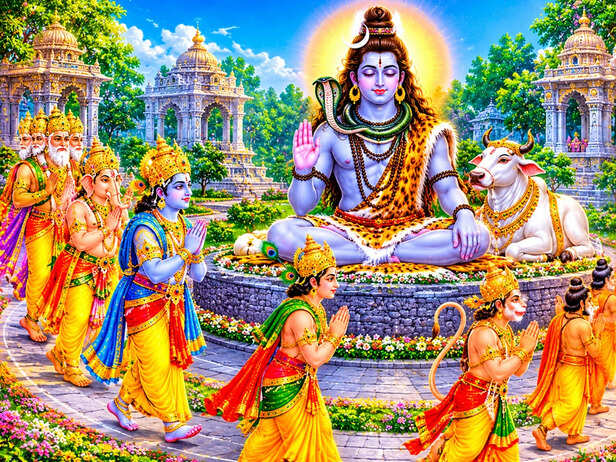
![MahaDev Shiva Connection]()
MahaDev Shiva Connection
Image credit : Pixabay
Scholars of the Shaiva tradition have noted that the twelve sites roughly correspond to the cardinal and intercardinal directions, and to the major river systems of the subcontinent, the Ganga, the Narmada, the Godavari, the coast of the Arabian Sea, the Bay of Bengal. This is not coincidence in the way a planned grid would be. The shrines accumulated their sacred status over centuries, and the list of twelve was consolidated and named in texts like the Shiva Purana and the Kotijagara. What the geography reflects is the range of the tradition itself: Shaivism was not a regional faith. It moved through trade routes, through the wandering of ascetics, through royal patronage in different eras and kingdoms. A shrine that sits at the source of a great river, or at the edge of the sea, or at the highest point a pilgrim could reach on foot, is a shrine that marks the limit of the known world. The Jyotirlinga network, taken together, maps the extent of a civilisation's sacred imagination.
Why the Distance Was the Pilgrimage
In popular tradition, visiting all twelve in a single lifetime is considered among the most meritorious acts a Shaiva devotee can perform. The difficulty of the journey was never incidental to this, it was the substance of it. Kedarnath required months of walking through high mountain passes. Rameshwaram required crossing a long, exposed causeway into the sea. The distances between shrines were not obstacles to the pilgrimage; they were the pilgrimage. The body's effort, the time away from ordinary life, the passage through unfamiliar landscapes and languages, the dependence on the hospitality of strangers, all of this was understood as part of what the journey did to the pilgrim. A network of shrines that could be visited in a week would not carry the same weight. The spread enforced the commitment.
What the Twelve Hold in Common
Despite the distance between them and the different kingdoms and cultures that grew up around each, the twelve Jyotirlinga shrines share a consistent form of worship. The linga at each is not installed by human hands in the tradition's account, it is swayambhu, self-manifested. The daily rituals follow a pattern rooted in the Agamas, the Sanskrit texts that govern Shaiva temple worship. Each shrine has a presiding goddess alongside Shiva, a tradition that reflects the inseparability of Shiva and Shakti in this theology. And each has accumulated, over centuries, a body of local story, regional custom, and vernacular devotion that sits alongside the Sanskrit textual tradition without contradicting it. The twelve are not identical. They are recognisably part of the same understanding of what Shiva is and what his presence in a place means.
The spread of the Jyotirlinga shrines across the subcontinent is not a logistical accident or a product of any single moment of planning. It is the accumulated shape of a living tradition, stories of devotion, conflict, and divine appearance that attached themselves to particular places over a very long time, and were eventually gathered into a list that itself became sacred. The distance between Kedarnath and Rameshwaram is, in this tradition, the distance between the sources of rivers and the edge of the sea, between the highest point of penance and the place where one civilisation's story of devotion crossed into another continent. That the twelve sit so far from each other is not a problem the tradition solved. It is what the tradition is saying.
Unlock insightful tips and inspiration on personal growth, productivity, and well-being. Stay motivated and updated with the latest at
My Life XP.