Is Your Mind Following a Pattern Known in the Vedas?
Noopur Kumari | Sept 08, 2026, 14:00 IST
What if the ancient Vedas and the human brain are describing something surprisingly similar, but in completely different languages? Modern neuroscience studies attention, memory, perception and consciousness, while Vedic philosophy explores the mind, senses and awareness. They are not scientifically identical, yet the comparison raises an intriguing question: did ancient thinkers understand patterns of the mind long before modern science began mapping them?

Your Brain a Hidden Copy of the Vedas
Image credit : ChatGPT (ai)
Your brain does not contain a literal copy of the Vedas. There is no scientific evidence showing that Sanskrit verses or Vedic texts are physically encoded inside the human brain.
But that is not what makes the comparison interesting.
The fascinating question is whether some ideas about the human mind appear in both ancient Indian philosophy and modern neuroscience. The Vedas and later Indian philosophical traditions explored attention, perception, memory, senses and consciousness. Modern science investigates many of these same experiences through experiments and brain imaging.
The languages are different. The methods are different. Yet some of the questions sound surprisingly familiar.
![Human Brain Surrounded by Ancient Symbols]()
One reason this comparison feels so powerful is that the human brain is itself a pattern-finding system. We constantly connect sounds, memories, faces, emotions and experiences to create meaning. Ancient Indian thinkers also spent enormous attention on understanding how humans perceive reality. This does not prove that the brain is a copy of the Vedas. Instead, it shows why people may notice parallels between ancient philosophical ideas and modern studies of cognition. When different traditions examine the same human experience, they can sometimes arrive at similar questions, even when their explanations and methods are completely different.
![Ancient Indian Sage in Deep Meditation]()
Ancient Indian traditions were deeply interested in the relationship between the senses, mind and awareness. Questions about perception and the nature of consciousness appear throughout Indian philosophical literature. The mind was not simply treated as a passive receiver of information. Attention, desire, memory and sensory experience were considered important parts of understanding human life. Modern psychology and neuroscience approach these subjects differently, using observation, experiments and measurable brain activity. Still, the shared curiosity is striking. Both perspectives ask a version of the same basic question: How does human experience actually happen?
Think about what happens when you look at a familiar face. Your eyes receive light, but your experience involves much more than vision. Your brain identifies the person, connects memories, recognises emotions and gives the moment meaning. Ancient Indian thought also paid close attention to the senses and their influence on perception. This creates an interesting bridge between old philosophical questions and modern neuroscience. The important point is not that ancient texts predicted modern brain science. They did not use modern experiments or neurological models. The connection lies in their shared interest in understanding how humans experience the world.
Have you ever noticed how a busy room suddenly becomes quiet when you concentrate deeply on one conversation? Your surroundings have not disappeared. Your attention has simply shifted. Modern cognitive science studies attention as a limited resource that influences what information we process. Indian contemplative traditions also placed enormous importance on controlling attention and reducing mental distraction. Practices such as meditation developed within broader philosophical and spiritual systems that explored the mind’s movements. These similarities are fascinating, but they should not be exaggerated. Meditation philosophy and neuroscience use different frameworks. Their overlap is best understood as a meeting point between ancient introspection and modern scientific investigation.
Here is where the story becomes even more fascinating. Neuroscience can study brain activity associated with perception, decision-making and different states of awareness. But the deeper question of why subjective experience exists remains difficult. Why does seeing colour feel like something? Why does pain have a personal quality? Why do memories feel connected to a sense of self? Indian philosophical traditions explored questions surrounding consciousness for centuries. Modern science continues to investigate them from a different direction. Neither approach has provided a final answer to every question about consciousness. That uncertainty is precisely what keeps the subject so compelling.
It is tempting to claim that every modern scientific discovery was already secretly written in the Vedas. Such claims often sound exciting, but they can oversimplify both science and ancient literature. A stronger approach is to ask better questions. What did ancient thinkers actually say? What does modern research actually demonstrate? Where are the genuine similarities, and where are the differences? This approach makes the comparison more meaningful. Ancient texts can offer philosophical insights into human experience without being presented as neuroscience textbooks. At the same time, modern science can investigate questions that ancient traditions approached through introspection, debate and spiritual practice.
So, is your brain a physical copy of the Vedas? No, science does not support that literal claim. But there is a more interesting possibility worth exploring. Human beings across different periods have repeatedly asked similar questions about perception, attention, memory, identity and consciousness. The Vedas belong to an ancient spiritual and philosophical tradition, while neuroscience belongs to modern experimental science. They should not be confused with each other. Yet their shared fascination with the human experience can inspire us to look inward more carefully. Perhaps the real connection is not that the Vedas are inside your brain, but that the questions they explored still live inside the human mind today.
Unlock insightful tips and inspiration on personal growth, productivity, and well-being. Stay motivated and updated with the latest at My Life XP.
But that is not what makes the comparison interesting.
The fascinating question is whether some ideas about the human mind appear in both ancient Indian philosophy and modern neuroscience. The Vedas and later Indian philosophical traditions explored attention, perception, memory, senses and consciousness. Modern science investigates many of these same experiences through experiments and brain imaging.
The languages are different. The methods are different. Yet some of the questions sound surprisingly familiar.
The Brain Is Built to Find Patterns
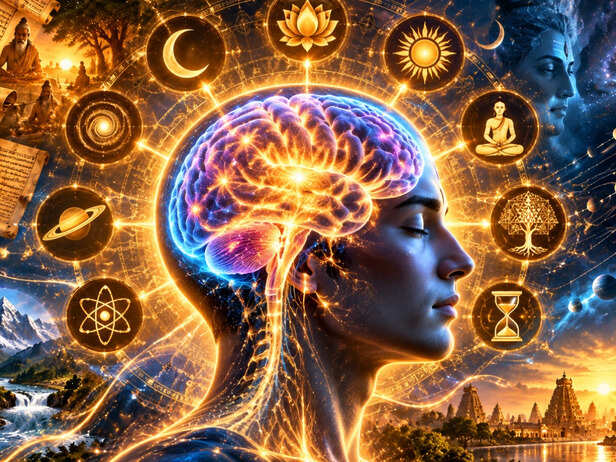
Human Brain Surrounded by Ancient Symbols
Image credit : ChatGPT(ai)
One reason this comparison feels so powerful is that the human brain is itself a pattern-finding system. We constantly connect sounds, memories, faces, emotions and experiences to create meaning. Ancient Indian thinkers also spent enormous attention on understanding how humans perceive reality. This does not prove that the brain is a copy of the Vedas. Instead, it shows why people may notice parallels between ancient philosophical ideas and modern studies of cognition. When different traditions examine the same human experience, they can sometimes arrive at similar questions, even when their explanations and methods are completely different.
Vedic Thought Examined the Mind
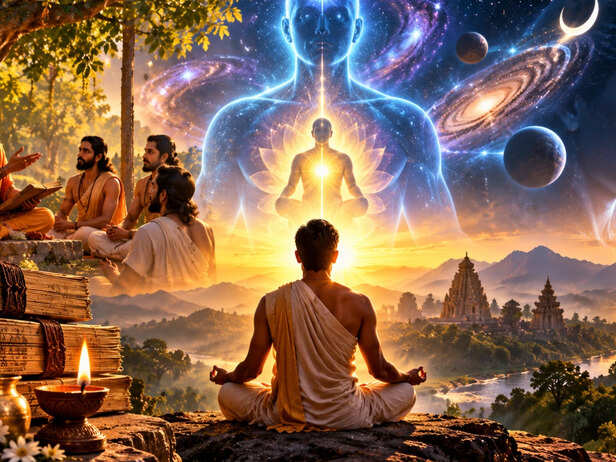
Ancient Indian Sage in Deep Meditation
Image credit : ChatGPT (ai)
Ancient Indian traditions were deeply interested in the relationship between the senses, mind and awareness. Questions about perception and the nature of consciousness appear throughout Indian philosophical literature. The mind was not simply treated as a passive receiver of information. Attention, desire, memory and sensory experience were considered important parts of understanding human life. Modern psychology and neuroscience approach these subjects differently, using observation, experiments and measurable brain activity. Still, the shared curiosity is striking. Both perspectives ask a version of the same basic question: How does human experience actually happen?
Your Senses Shape Your Reality
Attention Changes What You Notice
Consciousness Remains the Big Mystery
Ancient Wisdom Needs Careful Reading
The Real Connection Is the Question
Unlock insightful tips and inspiration on personal growth, productivity, and well-being. Stay motivated and updated with the latest at My Life XP.