Walk into the bhog kitchen of a large temple on a festival morning and you will not find a weighing scale. You will find enormous iron karahis, fires that have been burning since before dawn, and cooks who know exactly how much dal to add to water they have judged by eye alone. The system works. It has worked for centuries. Understanding how tells you something about a kind of knowledge that formal cooking instruction has almost entirely forgotten.
The Hand Is the Measure
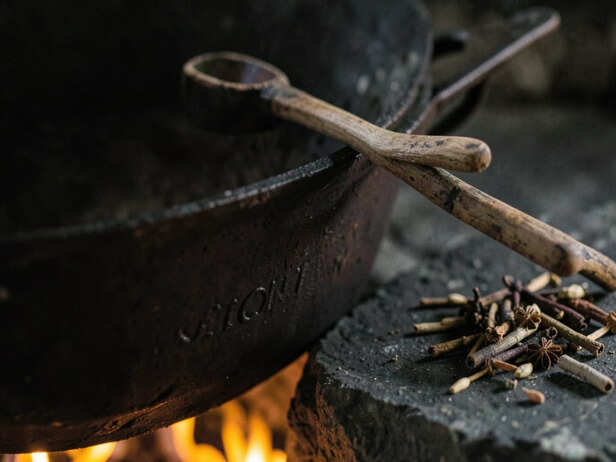
![Ancient Kitchen Still Life]()
Ancient Kitchen Still Life
Image credit : MyLifeXP Bureau
Every prasad cook carries a personal unit of measurement that never leaves them: their own hand. A fistful of rice per person, adjusted for the size of the crowd. A cupped palm of sugar into ghee already at the right colour. The system is not imprecise, it is calibrated to a body that has done the same task thousands of times. The hand knows what a kilo feels like without being told. In temple cooking, this embodied knowledge is considered more reliable than a scale, because a scale cannot tell you when the ghee has reached the right temperature, but a practised hand held near the karahi can.
Ratio Over Recipe
What prasad cooks hold in memory is not a recipe but a ratio. One part dal to four parts water. Twice as much jaggery as flour for a particular sweet. The ratio scales infinitely upward without recalculation, which is exactly what a kitchen feeding ten thousand people on a pilgrimage day needs. A written recipe with gram weights becomes a liability at scale, the arithmetic compounds, the margin for error grows. A ratio held in the body simply multiplies. The cook who has made halwa for a hundred can make it for ten thousand using the same internal logic, adjusting only the size of the vessel and the number of hands stirring.
Fire and Colour as Instruments
In the absence of thermometers, temple cooks read heat through the food itself. Ghee is ready when a drop of batter dropped into it rises immediately and turns golden within a count of three. Sugar syrup has reached the right consistency when a thread pulled between two wet fingers holds for a moment before breaking. Khichdi is done when the steam from the karahi shifts from sharp and starchy to soft and rounded, a distinction that sounds vague until you have stood over enough karahis to know it. Each of these is a real instrument. None of them require calibration. They require attention, and attention is exactly what a tradition built around offering demands.
The Knowledge Passes Without Being Written
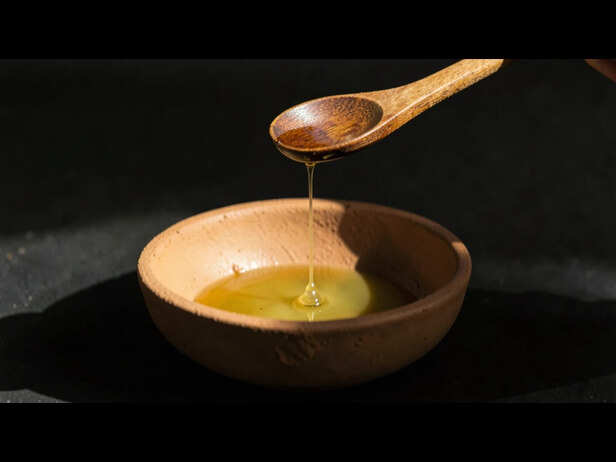
![Ghee Drip Morning Light]()
Ghee Drip Morning Light
Image credit : MyLifeXP Bureau
Almost none of this is written down. In temple kitchens, the transfer happens the way it always has: a younger cook stands beside an older one for years, watching the same gestures repeated until the gestures become their own. This is not a gap in the tradition, it is a feature of it. The act of writing a recipe fixes it. The act of watching someone cook teaches the principle beneath the recipe, which is the thing that survives variation in ingredients, altitude, humidity, and crowd size. A cook trained this way can adapt. A cook trained from a written recipe may not know what to do when the dal is older than usual and needs more water, or when the jaggery is wetter than expected and will change the texture of the sweet.
Why the Food Tastes the Way It Does
Prasad cooked in this manner carries a particular quality that regular restaurant food rarely matches, and it is not mystical. It is the result of cooking in very large volumes over wood or coal fire, which distributes heat differently than gas, and of using ingredients in their simplest, least processed form. Large-batch cooking also allows flavours to develop in ways that small-batch cooking cannot, the dal has more time, the ghee coats more surface, the spices bloom into a larger body of liquid and settle into something rounder. The cook's attention, extended over hours and across a large surface, produces a consistency that is genuinely hard to replicate at home. The scale of the kitchen is part of the recipe.
The prasad kitchen is not a primitive version of a modern kitchen waiting to be upgraded with better tools. It is a different system entirely, built around knowledge that lives in people rather than in instruments, and around a ratio logic that scales where gram-weight recipes cannot. What it asks of a cook is not precision in the modern sense but a different kind of precision, one developed through repetition, attention, and the understanding that the food is being made for an offering, which changes how you stand at the fire.
Unlock insightful tips and inspiration on personal growth, productivity, and well-being. Stay motivated and updated with the latest at
My Life XP.