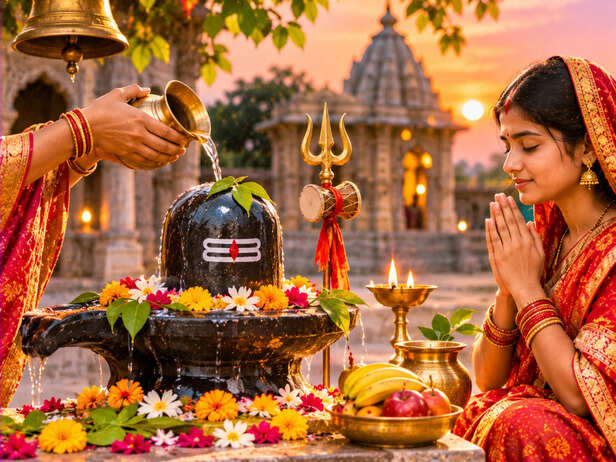
Walk into almost any Shiva temple and the ritual is already in motion. A thin stream of water falls from a copper vessel suspended above the linga, or a devotee tips a small pot and lets it run. No elaborate preparation, no fire, no chanting required. Just water, stone, and the act of letting go.
The Linga Is Not a Statue, It Is a Form Without a Form
![how to impress lord shiva with mantra]()
how to impress lord shiva with mantra
Image credit : Pexels
In most Hindu worship, a deity is represented in a particular shape: seated, standing, holding specific objects, wearing specific ornaments. The Shiva linga breaks this convention deliberately. It is an aniconic form, a presence indicated rather than depicted. Shaiva philosophy, particularly as developed in the Shaiva Agamas and in the Kashmir Shaiva tradition, describes Shiva as the one who exceeds any fixed image. To carve a face would be to limit what the tradition insists cannot be limited. The linga and its base, the yoni pitha, together represent the union of the formless with the manifest world, consciousness with matter, stillness with movement. Water poured over this form is offered to something that cannot be fully named, which is itself a theological statement about the nature of the divine.
What the Tradition Says the Water Is Doing
![Sunset Shiva Worship in a Temple Courtyard]()
Sunset Shiva Worship in a Temple Courtyard
In Shaiva devotional practice, abhisheka, ritual bathing of the deity, is considered among the highest forms of worship. The Shiva Purana describes Shiva as one who is easily pleased by water alone, while more elaborate offerings may satisfy other deities. This is not a minor detail. It places water at the centre of the devotee's relationship with Shiva rather than at its edge. The water is understood in the tradition as a carrier of the devotee's attention. The act of pouring requires the hands to be steady, the mind to be present, and the body to be still. Popular devotional tradition also holds that the continuous stream mirrors the river Ganga, which Shiva is said to hold in his matted hair, the water offered recalls the water contained, and the gesture closes a loop between the cosmic and the immediate.
Why the Linga Is Kept Plain and Undecorated During Abhisheka
When water is poured, the linga is typically bare. Flowers, sandalwood paste, and bilva leaves are offered before or after, not during. The reason the tradition gives is practical in one sense and philosophical in another. Practically, the unobstructed surface allows the water to run continuously and completely, nothing interrupts the contact between the offering and the form. Philosophically, the plainness mirrors what the ritual is asking of the devotee. Shaiva teachers have long described the linga's smooth, uncarved surface as a mirror: it reflects back whatever the worshipper brings. An unadorned surface during the pouring keeps the offering direct. The water is not landing on decoration; it is landing on the form itself.
The Materials Used and What Each One Carries
Water from a river, particularly from the Ganga, is considered the most auspicious offering, though plain water is held to be equally complete. Milk, honey, sugarcane juice, and panchamrita, a mixture of milk, curd, honey, ghee, and sugar, are also used in abhisheka, particularly on significant occasions. Each has a meaning the tradition assigns: milk for purity, honey for sweetness of devotion, ghee for sustenance. But water remains the constant. Even when other substances are offered, the ritual typically closes with a final pour of plain water, returning to the simplest form. In temples where the abhisheka is performed multiple times daily, it is water that runs through every session. The elaborations come and go; the water stays.
Where This Ritual Is Strongest and How It Varies by Region
Abhisheka over the Shiva linga is practised across the whole of India, but its character shifts by region. In Tamil Nadu's Shaiva temples, the ritual is governed by the Shaiva Agamas with great precision, the timing, the vessel, the mantras, and the sequence of substances are all specified. In Varanasi, where the Kashi Vishwanath temple draws continuous worship, the offering is more fluid and personal: a devotee may pour from a small pot bought at the ghat without any formal sequence. In Maharashtra, the Jyotirlinga shrines, the twelve sites held to be self-manifested, draw offerings that follow local temple tradition rather than a single unified practice. What holds across all of them is the unbroken stream and the unadorned stone. The vessel changes, the substance changes, the mantra changes. The gesture does not.
The stream of water and the plain stone are not a stripped-down version of something more complex. They are the complete form of the practice, arrived at by a tradition that decided the simplest offering, made with full attention, says more than any elaborate one. The water carries nothing but itself, and that turns out to be enough.
Unlock insightful tips and inspiration on personal growth, productivity, and well-being. Stay motivated and updated with the latest at
My Life XP.