The shrine has been a direction for days. Now it is a shape on the horizon, and something in the body does not know what to do with that. The feet slow. The mind, which kept itself busy with the road, suddenly has nothing to hold onto. This is the last mile, and it is unlike every mile before it.
The Road Was the Container; the Last Mile Is Something Else
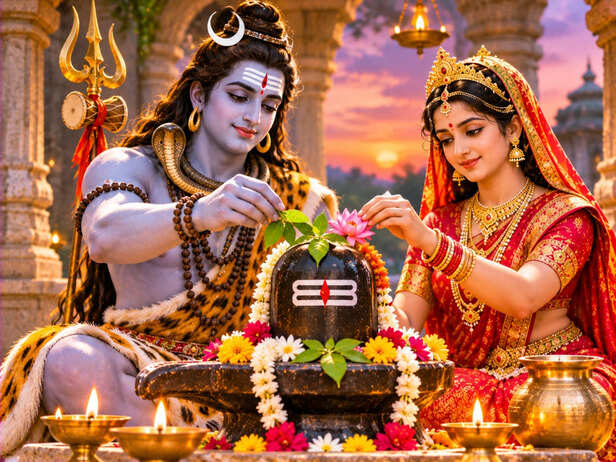
![Lord Shiva and Goddess Parvati During Pradosh Puja]()
Lord Shiva and Goddess Parvati During Pradosh Puja
For most of the journey, the pilgrim is held by the fact of moving. There is a next step, a next village, a next water point. The goal is abstract enough to be a comfort, it pulls without pressing. But the moment the destination becomes visible, that abstraction collapses. What was a longing becomes an appointment.
In popular tradition across Char Dham routes and the Vaishno Devi path, older pilgrims speak of this stretch as the one where people cry without knowing why. Not from pain, not from joy exactly, from something that has no ordinary name. The Sikh tradition of ardas holds that the moment the seeker glimpses the Darbar Sahib is itself a form of grace, separate from arrival. The seeing is its own event.
What is happening, in plain terms, is that the pilgrim has been living inside the future for days. Every step was toward. The last mile collapses toward into here, and the self that was organised around longing has nowhere left to lean.
Why the Body Slows When It Should Hurry
![Devotional Reading with Rama and Hanuman]()
Devotional Reading with Rama and Hanuman
Image credit : chatgpt(ai)
This is the detail that surprises people who have not done it: the pace drops. Not because the legs are spent, often they are not, because anticipation has been carrying the walker, but because something in the person resists the ending.
In one regional telling of the Pandharpur wari tradition, the varkaris describe the last stretch into Pandharpur as the one walked in near silence, even after days of bhajans and communal singing. The noise quiets itself. Nobody announces this. It simply happens.
The slowing is not reluctance. It is closer to reverence that the body expresses before the mind has found words for it. The pilgrim is not avoiding the shrine. She is making room for what she is about to enter. The last mile is where the outer journey and whatever has been happening inside it finally meet.
What the Shrine Already Knows About You
A pilgrim who arrives having walked carries something a visitor who arrives by vehicle does not. This is not a judgment, it is simply what the road does. Every difficulty on the way, the blister, the wrong turn, the night in a dharmshala that smelled of damp wool, the stranger who shared a roti, has been composting into something the pilgrim cannot yet name.
The Jain tradition of the Palitana pilgrimage holds that the 3,800 steps to the Shatrunjaya summit are not an obstacle placed before the shrine but the shrine's first teaching. The climb is the darshan beginning. What you arrive with at the top is not the same as what you carried to the bottom.
This is what the last mile makes visible. The person who can see the shrine is already changed by the road. The arrival only names it.
The Moment of Crossing the Threshold
In many pilgrimage traditions, there is a specific architectural threshold, a gate, a step, a river crossing, a line of lamps, that marks the boundary between the journey and the arrival. At Varanasi, it is the ghat itself, the step down to the water. At Tirupati, in popular tradition, it is the moment the gopuram fills the entire field of vision and there is nothing else to see.
The threshold matters because it makes the change legible. Something that has been happening gradually is given a single moment to stand in. The pilgrim does not become different at the threshold. She recognises, at the threshold, what the road already did.
This is why people stop at these points. Not to rest. To let the recognition catch up with the body.
What the Pilgrim Carries Home That She Did Not Carry In
The return journey is almost never written about, but every pilgrim takes one. And the last mile, the last mile home, not to the shrine, is its own quiet teaching.
What changes is not the person's circumstances. The same kitchen, the same relationships, the same unfinished things. What changes is the distance the pilgrim has from them. The road gave her a long stretch of being nobody's daughter, nobody's mother, nobody's colleague, just a person walking toward something she chose. That experience does not dissolve when she steps back through her own door.
In popular tradition, it is said that the pilgrim brings the tirtha home in her water vessel. The water is symbolic, but the thing it stands for is real: something of the journey survives the return. The last mile to the shrine made her ready to receive it. The last mile home makes her ready to carry it.
The shrine was never only at the end of the road. The road was always part of what the shrine was offering. The last mile is where the pilgrim finally understands this, not as an idea, but as something she can feel in her own slowing feet.
Unlock insightful tips and inspiration on personal growth, productivity, and well-being. Stay motivated and updated with the latest at
My Life XP.