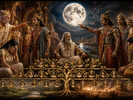
What Sanat Kumar Taught Narada About True Knowledge
Noopur Kumari | Aug 27, 2026, 15:00 IST
We spend much of our lives collecting things that prove we know something. Degrees. Skills. Information. Money. Possessions. Recognition.
But the Chandogya Upanishad presents a deeper question: Can external knowledge alone reveal who we truly are? Through Narada's search and Sanat Kumar's teaching, the story moves from names and words toward mind, intention, consciousness and finally the deeper principle of the Self. Here is the profound lesson hidden inside that ancient conversation.
But the Chandogya Upanishad presents a deeper question: Can external knowledge alone reveal who we truly are? Through Narada's search and Sanat Kumar's teaching, the story moves from names and words toward mind, intention, consciousness and finally the deeper principle of the Self. Here is the profound lesson hidden inside that ancient conversation.

Narada Knew Everything
Image credit : ChatGPT(ai)
What if you could learn hundreds of subjects, remember countless facts and understand the world around you, yet still feel that something essential was missing? That is the powerful question at the heart of a famous dialogue between Narada and Sanat Kumar in the Chandogya Upanishad. Narada approaches Sanat Kumar because he wants to understand the highest truth. When asked what he already knows, Narada lists an extraordinary range of learning. He knows the Vedas, grammar, astronomy, mathematics, rituals, philosophy and many other branches of knowledge. Yet he admits something deeply human. All this knowledge has not freed him from sorrow. Sanat Kumar's response takes the conversation in an unexpected direction. Perhaps knowing about the world is not the same as knowing the one who experiences it.
![Narada Seeks the Highest Truth]()
Narada was not an ignorant seeker. He had already studied an impressive range of subjects. Yet he openly acknowledged that this learning had not given him freedom from sorrow. This is what makes his question so relatable even today. A person can know how the world works and still struggle to understand their own mind. We can collect information about happiness without actually feeling peaceful. Narada's search therefore begins with an important distinction: information can describe life, but self-knowledge asks who is experiencing that life. His dissatisfaction becomes the beginning of a deeper journey.
![Sanat Kumar Teaches Narada]()
Instead of simply giving Narada another piece of information, Sanat Kumar gradually changes the direction of his search. In the teaching, different levels of understanding are considered, moving beyond names and words toward the mind, intention and deeper awareness. The message is subtle but powerful. If we keep collecting facts without examining the consciousness behind them, knowledge can remain external. We may know thousands of names while remaining strangers to ourselves. Sanat Kumar's teaching therefore becomes less about adding another subject to Narada's list and more about discovering what lies behind everything that we call knowledge.
We naturally divide the world by giving everything a name. This is a tree. That is wealth. This is success. That is failure. Names help us communicate, but they do not necessarily reveal the complete reality of something. The Chandogya Upanishad's teaching moves from name to speech, speech to mind and beyond, showing that each level points toward something deeper. It is almost like peeling away layers. The more deeply Narada looks, the less satisfying surface-level knowledge becomes. The real question is no longer, “What do I know?” It becomes, “Who is the one who knows?”
The mind is powerful. It remembers, compares, imagines and makes decisions. Yet the Upanishadic conversation does not stop there. It continues toward deeper principles, including intention and consciousness. This offers a striking lesson for modern life. We often believe that thinking harder will solve every problem. But endless thinking can sometimes create more confusion. Self-understanding requires more than collecting thoughts. It requires noticing the awareness in which those thoughts appear. When a person begins observing their own thoughts instead of being completely controlled by them, a different kind of understanding can slowly emerge.
Human beings naturally want to accumulate. Money, property, status, relationships and achievements can provide comfort and security. But the teaching asks us to look more closely. Anything dependent on another changing object cannot provide permanent freedom. Wealth can disappear. Status can change. Possessions can be lost. Even relationships move through different stages. This does not mean that worldly things have no value. It means they should not be mistaken for the ultimate source of identity. If everything we depend upon is temporary, the deeper question becomes: Is there something within us that is not defined by what we possess?
The teaching eventually points toward the Atman, the Self, as something deeper than the temporary identities we normally carry. We usually define ourselves through roles: someone's child, parent, partner, employee or friend. These identities matter, but they change throughout life. The Upanishadic vision asks us to look beyond these changing labels. A person who develops deeper self-awareness begins to see that their identity cannot be reduced to possessions, achievements or social roles. This shift can change how they experience both happiness and sorrow, because they are no longer placing their entire sense of self in things that constantly change.
Narada begins by saying, in effect, “I know many things, but I still suffer.” That admission is the doorway to the entire teaching. The story reminds us that education and self-knowledge are not necessarily the same journey. We can spend years learning about the world while never asking who we are beneath our changing thoughts and identities. The Upanishadic answer is not simply to reject knowledge or worldly life. Instead, it invites us to go deeper. Observe the mind. Examine your attachments. Question what you consider permanent. And gradually turn attention toward the awareness behind experience.
The most powerful part of Narada's story may not be what he knew.
It may be that he realised his knowledge was not enough.
That realisation is surprisingly relevant today.
We have access to more information than any previous generation. We can learn almost anything within seconds. Yet information alone cannot guarantee peace, clarity or freedom from inner conflict.
The Chandogya Upanishad's dialogue between Narada and Sanat Kumar points toward a different kind of learning: the journey from knowing about things to knowing the Self.
Perhaps wisdom begins when we stop asking only, “How much do I know?”
And begin asking:
“Who is the one who knows?”
That question does not add another fact to our collection.
It changes the direction of the entire search.
Unlock insightful tips and inspiration on personal growth, productivity, and well-being. Stay motivated and updated with the latest at My Life XP
Narada Had Knowledge, But Wanted Truth
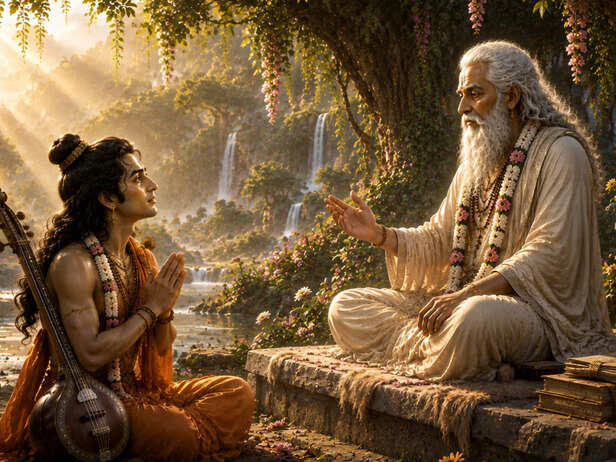
Narada Seeks the Highest Truth
Image credit : ChatGPT (ai)
Narada was not an ignorant seeker. He had already studied an impressive range of subjects. Yet he openly acknowledged that this learning had not given him freedom from sorrow. This is what makes his question so relatable even today. A person can know how the world works and still struggle to understand their own mind. We can collect information about happiness without actually feeling peaceful. Narada's search therefore begins with an important distinction: information can describe life, but self-knowledge asks who is experiencing that life. His dissatisfaction becomes the beginning of a deeper journey.
Sanat Kumar Changes the Question
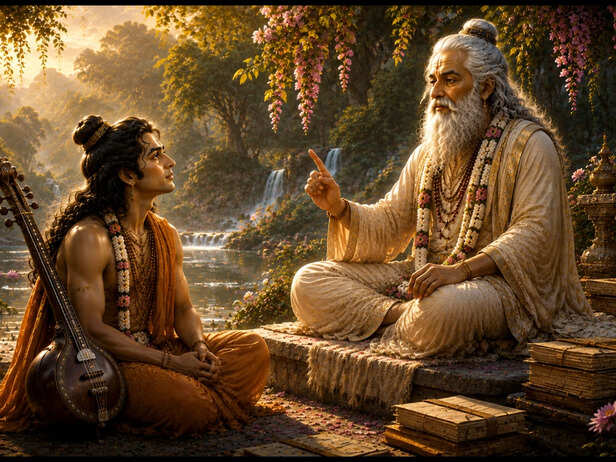
Sanat Kumar Teaches Narada
Image credit : ChatGPT (ai)
Instead of simply giving Narada another piece of information, Sanat Kumar gradually changes the direction of his search. In the teaching, different levels of understanding are considered, moving beyond names and words toward the mind, intention and deeper awareness. The message is subtle but powerful. If we keep collecting facts without examining the consciousness behind them, knowledge can remain external. We may know thousands of names while remaining strangers to ourselves. Sanat Kumar's teaching therefore becomes less about adding another subject to Narada's list and more about discovering what lies behind everything that we call knowledge.
Names Are Not The Whole Reality
The Mind Is Not the Final Answer
Why Possessions Cannot Create Freedom
Self-Knowledge Changes How You See Life
The Real Journey Is Within
The Question That Changes Everything
It may be that he realised his knowledge was not enough.
That realisation is surprisingly relevant today.
We have access to more information than any previous generation. We can learn almost anything within seconds. Yet information alone cannot guarantee peace, clarity or freedom from inner conflict.
The Chandogya Upanishad's dialogue between Narada and Sanat Kumar points toward a different kind of learning: the journey from knowing about things to knowing the Self.
Perhaps wisdom begins when we stop asking only, “How much do I know?”
And begin asking:
“Who is the one who knows?”
That question does not add another fact to our collection.
It changes the direction of the entire search.
Unlock insightful tips and inspiration on personal growth, productivity, and well-being. Stay motivated and updated with the latest at My Life XP