Who Woke Vishnu From Yog Nidra? The Answer May Surprise You
Noopur Kumari | Sept 13, 2026, 13:00 IST
Before creation fully unfolded, there was water everywhere and Lord Vishnu rested in Yog Nidra. Then two powerful demons threatened Brahma, creating a crisis at the very beginning of creation. Brahma turned to the divine power behind Vishnu's sleep, and what happened next gave Nidra Devi a special place in Hindu tradition. Here is the fascinating story behind her origin and meaning.

ChatGPTVishnu From Yog Nidra
Image credit : ChatGPT(ai)
Who is the mysterious divine power behind Lord Vishnu's Yog Nidra? According to Hindu traditions, when Brahma faced danger from the demons Madhu and Kaitabha, Vishnu was deep in divine sleep. Brahma needed help, but Vishnu could not be awakened in the ordinary way.
That is when Brahma invoked the divine power known as Yogamaya.
The story connects this mysterious power with Nidra Devi, the goddess associated with divine sleep. But her role in the story is far more powerful than simply bringing sleep. She is the force whose departure allows Vishnu to awaken and protect creation.
![Adishesha as Vishnu’s Divine Serpent]()
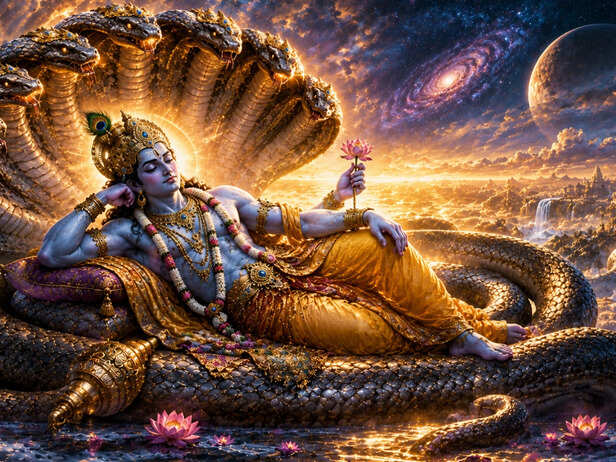
According to the traditional account, before the creation of the world had fully unfolded, Lord Vishnu rested upon the cosmic ocean in a state of Yog Nidra. From his navel emerged a lotus, and Brahma appeared upon it. This moment is important because Vishnu's sleep is not described as ordinary human sleep. Yog Nidra represents a divine state connected with cosmic rest and awareness. While Vishnu remained in this state, the next events of the creation story began to unfold, leading to a danger that would soon bring Brahma face to face with two powerful demons.
![Lord Vishnu with four arms and sacred symbols]()
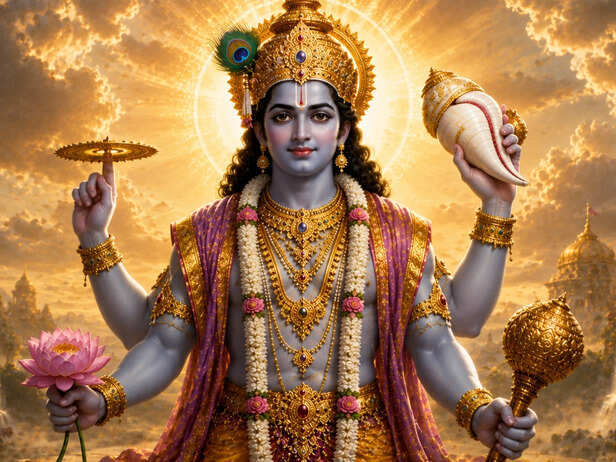
The story says that Madhu and Kaitabha emerged from Vishnu and became powerful demons. They soon threatened Brahma, who was connected with the work of creation. Faced with danger, Brahma looked toward Vishnu for protection. But Vishnu was still absorbed in Yog Nidra. The situation created an unusual problem: the protector himself was in divine sleep. Brahma could not defeat the danger through physical strength alone. Instead, he turned toward the mysterious divine power associated with Vishnu's Yog Nidra and offered prayers for help.
Brahma's prayers were directed toward the great divine power described in Hindu traditions as Yogamaya or Mahamaya. He asked this power to release Vishnu from his Yog Nidra so that the threat could be faced. In the story, the goddess is not weak or passive. She holds such power that even the divine sleep of Vishnu is connected with her presence. Brahma's prayer therefore becomes the turning point. The force associated with divine sleep is now invoked not to make someone sleep, but to withdraw and allow the cosmic protector to awaken.
According to the traditional narrative, the divine goddess manifested and withdrew the Yog Nidra associated with Vishnu. Vishnu then opened his eyes and became aware of the danger facing Brahma. This is the powerful twist in the story. The goddess associated with sleep also holds the power to end that divine sleep. In several Hindu traditions, this divine power is linked with Yogamaya, Mahamaya and Nidra Devi. The story presents sleep not as weakness, but as a sacred force under divine control, capable of both covering awareness and allowing awakening.
Once awakened, Lord Vishnu fought Madhu and Kaitabha to protect Brahma and preserve the order of creation. Their battle became one of the dramatic episodes connected with the early cosmic story. The demons were eventually defeated by Vishnu, ending the threat against Brahma. But the events began with Brahma's prayer to the divine power behind Yog Nidra. This is why the story of Nidra Devi carries a deeper meaning. Her presence comes before the awakening, and her withdrawal becomes part of the moment when Vishnu rises to act.
Nidra Devi is traditionally understood as the divine power associated with sleep, particularly the cosmic Yog Nidra described in stories of Vishnu. Some devotional traditions also connect her with Yogamaya and Mahamaya, the divine energy praised by Brahma in the Madhu-Kaitabha story. This should be understood within its religious and philosophical context, as different texts and traditions may describe the goddess and her forms differently. The central idea remains powerful: sleep is not viewed only as physical rest but can also symbolise withdrawal, stillness and the mysterious boundary between ordinary awareness and awakening.
Many devotees recite prayers or mantras connected with Nidra Devi before sleep as part of their spiritual practice. Such chanting may help some people feel calm, focused and emotionally settled before bedtime, especially when combined with a peaceful routine. However, no mantra can be promised as a medical cure for insomnia or other sleep disorders. If someone has long-term difficulty sleeping, frequent waking or severe daytime tiredness, medical advice may be needed. Devotion can support inner peace, while healthy sleep habits and proper care remain important for physical wellbeing.
The story of Nidra Devi begins with an unusual question: who has the power to awaken the protector when the world needs protection?
According to this tradition, Brahma turned to the divine power behind Vishnu's Yog Nidra.
That makes Nidra Devi's story more than a tale about sleep. It speaks of a sacred force connected with both stillness and awakening. Vishnu sleeps, the world faces danger, Brahma prays, the divine power manifests and Vishnu rises.
Perhaps that is the deeper beauty of the story.
Sometimes rest and awakening are not opposites. One prepares the way for the other.
That is when Brahma invoked the divine power known as Yogamaya.
The story connects this mysterious power with Nidra Devi, the goddess associated with divine sleep. But her role in the story is far more powerful than simply bringing sleep. She is the force whose departure allows Vishnu to awaken and protect creation.
Before Creation, Vishnu Was in Yog Nidra
Adishesha as Vishnu’s Divine Serpent
Image credit : chatgpt(ai)
According to the traditional account, before the creation of the world had fully unfolded, Lord Vishnu rested upon the cosmic ocean in a state of Yog Nidra. From his navel emerged a lotus, and Brahma appeared upon it. This moment is important because Vishnu's sleep is not described as ordinary human sleep. Yog Nidra represents a divine state connected with cosmic rest and awareness. While Vishnu remained in this state, the next events of the creation story began to unfold, leading to a danger that would soon bring Brahma face to face with two powerful demons.
Madhu and Kaitabha Appeared Suddenly
Lord Vishnu with four arms and sacred symbols
The story says that Madhu and Kaitabha emerged from Vishnu and became powerful demons. They soon threatened Brahma, who was connected with the work of creation. Faced with danger, Brahma looked toward Vishnu for protection. But Vishnu was still absorbed in Yog Nidra. The situation created an unusual problem: the protector himself was in divine sleep. Brahma could not defeat the danger through physical strength alone. Instead, he turned toward the mysterious divine power associated with Vishnu's Yog Nidra and offered prayers for help.
Brahma Prayed to the Divine Power
The Goddess Allowed Vishnu to Awaken
Vishnu Then Faced the Two Demons
Why Is She Called Nidra Devi?
A Prayer Can Bring Peace Before Sleep
The Goddess Behind Divine Sleep
According to this tradition, Brahma turned to the divine power behind Vishnu's Yog Nidra.
That makes Nidra Devi's story more than a tale about sleep. It speaks of a sacred force connected with both stillness and awakening. Vishnu sleeps, the world faces danger, Brahma prays, the divine power manifests and Vishnu rises.
Perhaps that is the deeper beauty of the story.
Sometimes rest and awakening are not opposites. One prepares the way for the other.