Imagine a quiet Himalayan village after sunset. Suddenly, the sound of traditional drums fills the air. People gather, an elder begins singing an ancient story, and everyone listens closely. But this is not an ordinary musical performance. In Uttarakhand, this centuries-old tradition is known as Jagar, a ritual in which local deities are invoked through music, storytelling and devotion. What makes it fascinating is that people believe the deity can manifest through a person known as a Dangariya. Behind these drumbeats lies a spiritual world that many people outside the mountains know very little about.
Jagar Is More Than a Night-Time Prayer
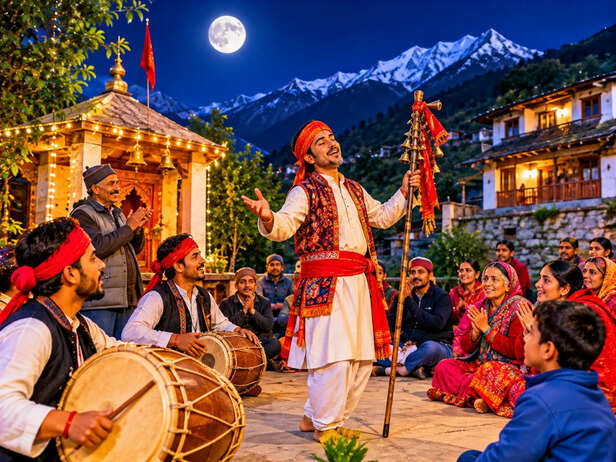
![Traditional Jagar Ceremony in a Himalayan Village at Night]()
Traditional Jagar Ceremony in a Himalayan Village at Night
Image credit : CHATGPT(AI)
The word Jagar is associated with awakening, and the ritual is performed to invoke local deities and ancestral spirits. Families or entire village communities gather for the ceremony, which is generally held at night. Unlike an ordinary temple prayer, Jagar combines music, oral storytelling and ritual practices. People believe that the deity responds to the invocation and becomes present through a human medium. The tradition is especially associated with the Kumaon and Garhwal regions, although its practices differ from one community to another.
The Jagariya Sings the Deity's Story
![Jagariya Singing Ancient Folk Ballads During Jagar]()
Jagariya Singing Ancient Folk Ballads During Jagar
Image credit : CHATGPT(AI)
At the centre of Jagar is the Jagariya, the traditional singer and ritual performer who narrates the deity's story. Accompanied by instruments such as the dhol, damau, hudka and thali, the singer recounts ancient legends, heroic deeds and stories connected with the village. The performance is not simply about remembering the past. Each song builds a connection between the deity, the community and its ancestors. As the singing and drumbeats continue, devotees believe the divine presence is being invoked.
Who Is the Dangariya?
One of the most fascinating parts of Jagar is the role of the Dangariya. This is the person who becomes the medium of the deity during the ritual. According to local belief, as the Jagariya sings the deity's story and the rhythm intensifies, the deity manifests through the Dangariya. The medium may dance, communicate with devotees and respond to their concerns. People approach with prayers, questions and family matters. For the community, this is not a performance but a deeply personal religious experience.
Why Is Bhairav Called the Village Protector?
In many Himalayan traditions, Bhairav is worshipped as a powerful guardian deity. He is associated with the protection of sacred places, village boundaries and communities. This is why devotees may regard him as a Kshetrapal, meaning the protector of a particular territory. During Jagar, people invoke their local Bhairav to express gratitude, seek blessings and share their worries. The relationship is deeply connected with the land and family traditions. However, the identity and role of Bhairav can vary across villages and local religious practices.
The Ten Mahavidyas Have Different Forms of Shakti
The spiritual traditions of the Himalayas also have a deep connection with Shakti worship. In Hindu Shakta traditions, the ten Mahavidyas represent ten powerful forms of the Divine Mother. They are Kali, Tara, Tripura Sundari (Shodashi), Bhuvaneshwari, Bhairavi, Chhinnamasta, Dhumavati, Bagalamukhi, Matangi and Kamala. Each goddess has a distinct form, symbolism and spiritual significance. Kali represents time and transformation, Tara is associated with divine protection, while Kamala is connected with prosperity. Together, they represent the many expressions of feminine divine power.
The Hidden Connection Between Mahavidyas and Nine Planets
A lesser-known belief in some Tantric and astrological traditions connects the ten Mahavidyas with the nine planets, known as Navagrahas. According to one commonly cited modern association, Kali is linked with Saturn, Tara with Jupiter, Tripura Sundari with Mercury, Bhuvaneshwari with the Moon, Chhinnamasta with Rahu, Dhumavati with Ketu, Bagalamukhi with Mars, Matangi with the Sun and Kamala with Venus. Bhairavi is associated with the ascendant (Lagna). These associations are not universal and should not be treated as a fixed system found in every ancient scripture.
Why This Tradition Still Lives in the Mountains
Jagar survives because it is not limited to worship. It carries the memories, folklore and identity of Himalayan communities. The stories sung by Jagariyas connect younger generations with their ancestors, village deities and local history. Even people who have moved to cities often return to their native villages to participate in traditional ceremonies. Researchers have also documented how Jagar has become an important expression of Uttarakhandi cultural identity. Every generation that learns these songs and stories helps keep this heritage alive.
The Drumbeats Carry an Entire Culture
The next time you hear the sound of a dhol and damau echoing through the mountains, remember that it may be more than music. It could be the beginning of a Jagar, where ancient stories are sung, village deities are remembered and families reconnect with their roots. From Bhairav worship to the ten Mahavidyas, Uttarakhand's spiritual traditions hold layers of history and belief that deserve to be understood. Perhaps the most beautiful part is that these traditions have survived not just in books but through the voices, music and faith of ordinary villagers.
Unlock insightful tips and inspiration on personal growth, productivity, and well-being. Stay motivated and updated with the latest at
My Life XP.