Why Did Lord Ram Allow Meghnath to Bind Him
Noopur Kumari | Sept 10, 2026, 16:00 IST
Garuda could not understand how Meghnath could bind Shri Ram with the Nagpash. Mahadev directed him toward a mysterious teacher beneath a great banyan tree. There, Garuda heard a Ram Katha that seemed to describe events before they had even happened. The revelation that followed introduced him to Kaka Bhushundi and changed how he understood Ram’s divine leela.

shocking Truth Behind Ram’s Nagpash
Image credit : chatgpt(ai)
If Lord Ram was truly Narayan, the Supreme Being who could free anyone from every bondage, then why did Meghnath’s Nagpash bind him during the Ramayana war? This question once troubled Garuda too. The answer, according to a fascinating devotional tradition, was not about weakness at all. It was about divine leela, and the mysterious sage who helped Garuda understand the deeper nature of Shri Ram.
![Garuda Asking Mahadev About Shri Ram]()
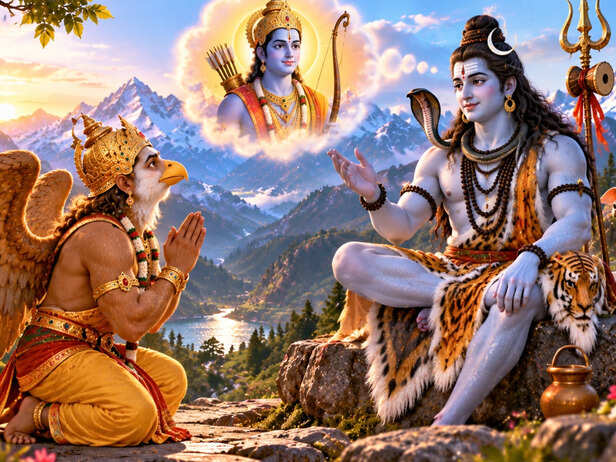
The Nagpash episode raised a powerful question in Garuda’s mind. If Shri Ram was Narayan, how could Meghnath’s serpent weapon restrain him? Garuda understood the immense power associated with Narayan, so the incident seemed difficult to explain. Instead of accepting a simple answer, he approached Mahadev with his doubt. This is where the story takes an unexpected turn. Rather than giving Garuda a direct explanation, Mahadev told him that the answer could be found on Neelgiri Mountain. Garuda followed the instruction, unaware that the journey would introduce him to one of the most mysterious devotees in Hindu tradition.
![Garuda Beneath the Sacred Banyan Tree]()
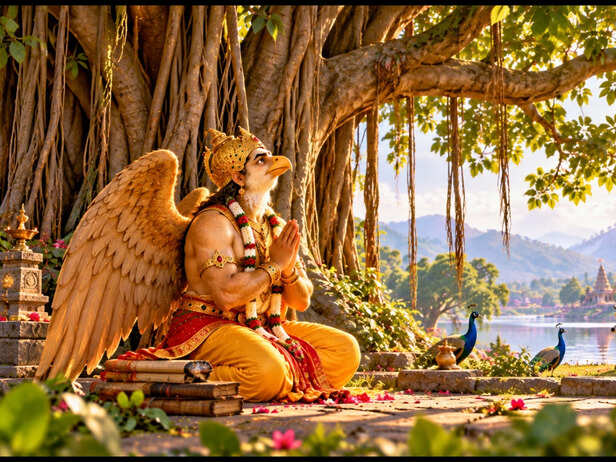
When Garuda reached Neelgiri Mountain, he saw a remarkable teacher sitting beneath a huge banyan tree and narrating the story of Shri Ram. But something immediately felt impossible. The Ramayana war was still unfolding, yet the teacher was speaking about events as though they had already happened. He described Ram’s victory over Ravan and his return to Vaikuntha. Garuda was stunned. How could someone narrate the future as if it were already history? His confusion only grew when the teacher calmly explained that these events were not new to him. He had witnessed the divine story before.
The teacher explained that he had witnessed Shri Ram in different stages of his divine story. He had seen Ram’s childhood, the battle with Ravan and the extraordinary devotion of Hanuman. He had also witnessed Lakshman’s role as an incarnation connected with Sheshnag. Garuda could hardly believe what he was hearing. How could one being have witnessed these events across different ages? The answer pointed toward a much deeper idea in the devotional tradition: divine stories can unfold repeatedly across cosmic cycles. The teacher was not merely telling Ram Katha. He was speaking as someone who claimed to have experienced it.
Garuda finally asked the question that had been building inside him: Who are you? The teacher revealed that he was Kaka Bhushundi. According to the devotional account, his spiritual journey had once been very different. He was devoted to Mahadev but did not respect devotees of Narayan. His attachment to one form of divinity had turned into disrespect toward another. This became the central lesson of his life. The tradition describes Mahadev as placing a curse connected to this spiritual imbalance. Kaka Bhushundi would continue through cycles of birth until devotion toward Narayan awakened within his heart.
The curse became part of a much larger spiritual journey. According to the traditional narrative, Kaka Bhushundi witnessed different ages and repeatedly encountered the divine manifestations of Narayan. He saw the story of Shri Ram unfold and gradually developed deep devotion toward him. What began as a narrow form of devotion slowly became a broader understanding of the divine. His journey suggests that spiritual growth is not always immediate. Sometimes pride, attachment and rigid thinking have to be confronted before genuine devotion can emerge. Eventually, Kaka Bhushundi became a devoted narrator of Ram Katha.
Now Garuda could understand the answer to his original question. If Shri Ram was Narayan, then being caught in the Nagpash could not simply be interpreted as ordinary defeat. In the devotional understanding of the story, Ram’s actions were part of his leela, allowing events to unfold according to a divine purpose. His apparent helplessness therefore carried a deeper meaning. The episode teaches devotees not to judge divine actions only through ordinary human ideas of victory and defeat. What appears to be weakness on the surface may have another meaning within the larger spiritual narrative.
The story ultimately moves beyond the Nagpash itself. Garuda’s question represents a doubt many devotees may experience: if the divine is all-powerful, why does suffering, defeat or difficulty appear at all? The traditional answer is that divine leela cannot always be understood through ordinary human reasoning. Kaka Bhushundi’s journey adds another lesson. Devotion should not become a reason to disrespect another path or another form of the divine. His transformation from one-sided devotion to deep love for Narayan gives the story an emotional ending. Garuda came seeking an explanation about Ram’s bondage and left with a deeper understanding of devotion.
The most powerful part of this story is not that Shri Ram was bound.
It is why his apparent bondage should not be mistaken for weakness.
Garuda went looking for an answer and discovered Kaka Bhushundi, a sage whose own spiritual journey had crossed ages, beliefs and transformations. His story reminded Garuda that divine actions cannot always be judged by what appears to happen on the surface.
In the devotional tradition, Shri Ram’s Nagpash becomes another example of divine leela.
Sometimes the greatest mystery is not how God can be defeated, but why the divine chooses to appear defeated at all.
Garuda’s Question About Ram
Garuda Asking Mahadev About Shri Ram
Image credit : ChatGPT(ai)
The Nagpash episode raised a powerful question in Garuda’s mind. If Shri Ram was Narayan, how could Meghnath’s serpent weapon restrain him? Garuda understood the immense power associated with Narayan, so the incident seemed difficult to explain. Instead of accepting a simple answer, he approached Mahadev with his doubt. This is where the story takes an unexpected turn. Rather than giving Garuda a direct explanation, Mahadev told him that the answer could be found on Neelgiri Mountain. Garuda followed the instruction, unaware that the journey would introduce him to one of the most mysterious devotees in Hindu tradition.
The Strange Ram Katha
Garuda Beneath the Sacred Banyan Tree
Image credit : ChatGPT (ai)
When Garuda reached Neelgiri Mountain, he saw a remarkable teacher sitting beneath a huge banyan tree and narrating the story of Shri Ram. But something immediately felt impossible. The Ramayana war was still unfolding, yet the teacher was speaking about events as though they had already happened. He described Ram’s victory over Ravan and his return to Vaikuntha. Garuda was stunned. How could someone narrate the future as if it were already history? His confusion only grew when the teacher calmly explained that these events were not new to him. He had witnessed the divine story before.
He Had Seen Ram Before
The Sage Revealed His Past
Many Lives Changed His Heart
Garuda Finally Understood the Nagpash
The Deeper Lesson of Ram’s Leela
The Real Meaning Behind Ram’s Nagpash
It is why his apparent bondage should not be mistaken for weakness.
Garuda went looking for an answer and discovered Kaka Bhushundi, a sage whose own spiritual journey had crossed ages, beliefs and transformations. His story reminded Garuda that divine actions cannot always be judged by what appears to happen on the surface.
In the devotional tradition, Shri Ram’s Nagpash becomes another example of divine leela.
Sometimes the greatest mystery is not how God can be defeated, but why the divine chooses to appear defeated at all.