Have you ever wondered why the word 'Hindu' does not appear in the original Sanskrit Valmiki Ramayana? We often identify Lord Rama, Hanuman, Ravana and Prahlada through religious labels today, but ancient Indian texts frequently describe people through their lineage, actions, devotion and duties. The interesting question is not simply why one word is missing. It is what the Ramayana teaches us about dharma, identity and the way people understood their responsibilities. The answer opens a fascinating window into ancient Indian thought.
Why Is 'Hindu' Not Used in the Ramayana?
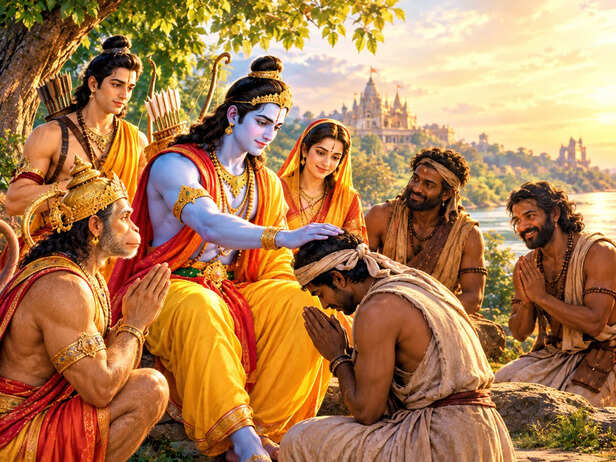
![Rama’s Blessing by the Riverside-1]()
Rama’s Blessing by the Riverside-1
Image credit : CHATGPT(AI)
The original Sanskrit Valmiki Ramayana belongs to a period when the word 'Hindu' was not commonly used as a religious identity in the way it is today. The term has a much older geographical history, originating from the Persian form of 'Sindhu', the name of the Indus River. Over time, its meaning changed and it came to describe religious communities. This historical development helps explain why searching for the modern meaning of Hindu in an ancient Sanskrit epic can be misleading.
People Were Known by Their Lineage and Actions
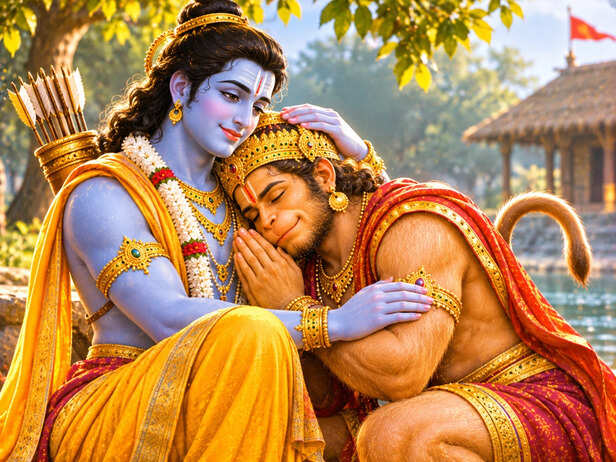
![Lord Rama Never Wanted Hanuman to Repay His Favours]()
Lord Rama Never Wanted Hanuman to Repay His Favours
Image credit : CHATGPT(AI)
Look at the names and descriptions associated with the Ramayana. Rama is known as Raghava because of his connection to the Raghu dynasty. Ravana is identified as the king of Lanka, while Hanuman is remembered as a devoted servant of Lord Rama. These descriptions tell us about their family backgrounds, responsibilities and roles in the story. However, this does not mean people had no religious beliefs or spiritual traditions. It shows that ancient texts used several forms of identity, depending on the context.
Ravana and Hanuman Had Different Paths
Ravana was a great scholar, a devotee of Lord Shiva and a powerful ruler, yet his pride and actions ultimately led to his downfall. Hanuman, on the other hand, is remembered for his humility, courage and complete devotion to Lord Rama. Their stories offer an important contrast: knowledge, power and devotion alone do not define a person's character. Their choices and actions matter too. The Ramayana repeatedly explores the difference between dharma and adharma through the lives of its characters.
Even Rama's Greatest Identity Was Dharma
Why did Lord Rama accept fourteen years of exile despite being the rightful heir to Ayodhya? He chose to honour his father's promise and uphold his responsibility. This is one of the central lessons of the Ramayana. Rama is often remembered as Maryada Purushottam, the ideal man who upheld dignity and righteousness. The epic repeatedly connects his character with dharma, showing that doing what is right can demand personal sacrifice.
What Does Sanatana Dharma Actually Mean?
The word 'Sanatana' means eternal or timeless, while 'Dharma' has a much wider meaning than simply religion. Depending on the context, it can refer to righteousness, duty, moral responsibility, law and the principles that sustain life. In the Ramayana, dharma is not just an idea discussed by sages; it is something characters must practise through their decisions. It guides how they treat their parents, fulfil responsibilities and respond to injustice.
Did the Ramayana Say Everyone Was Hindu?
The absence of the word 'Hindu' does not prove that everyone in the Ramayana belonged to one religious community or that religion did not exist. Ancient India had established traditions of worship, Vedic rituals, philosophical discussions and different paths of spiritual practice. The word 'Hindu' gradually developed through a long historical process. Therefore, it is more accurate to say that the Ramayana expresses its spiritual and ethical ideas through concepts such as dharma, karma, devotion and duty rather than modern religious terminology.
The Real Lesson: Your Actions Define Your Character
One of the strongest lessons of the Ramayana is that a person's character is revealed through their choices. Rama upheld his responsibilities, Hanuman served with complete devotion, and Ravana's arrogance led him towards destruction. Their stories encourage us to look beyond outward appearances and understand the values guiding a person's actions. Religious identity has its own place, but the Ramayana also reminds us that truth, compassion, responsibility and righteousness must be reflected in the way we live.
Unlock insightful tips and inspiration on personal growth, productivity, and well-being. Stay motivated and updated with the latest at
My Life XP.