What if you could see Lord Vishnu's human form, Narasimha's lion face and Varaha's boar face together in a single divine sculpture? Such a rare representation exists inside the famous Lakshmana Temple in Khajuraho, Madhya Pradesh. Known as Vaikuntha Vishnu, this extraordinary form brings together different aspects of Vishnu's divine power. But there is more to this sculpture than its unusual appearance. Its connection with ancient Kashmir, forgotten religious traditions and the symbolism of Vishnu's divine weapons makes it one of the most fascinating forms of Hindu iconography.
A Form That Combines Three Divine Faces
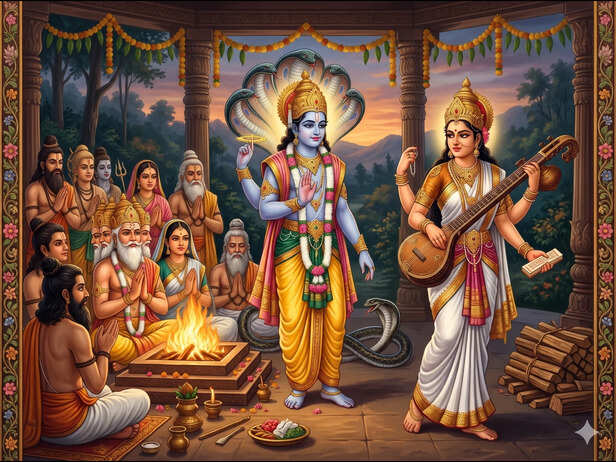
![GeminiLord Vishnu Stops Goddess Saraswati]()
GeminiLord Vishnu Stops Goddess Saraswati
Image credit : CHATGPT(AI)
Most people know Lord Vishnu through his separate Narasimha and Varaha avatars. However, Vaikuntha Vishnu brings these forms together in a single divine representation. The sculpture features a central human face, a lion face associated with Narasimha and a boar face associated with Varaha. This is not simply another depiction of either avatar. It represents Vishnu's combined divine presence and his power to protect the universe in different forms. That is what makes this unusual representation so fascinating.
The Mythological Story Behind This Form
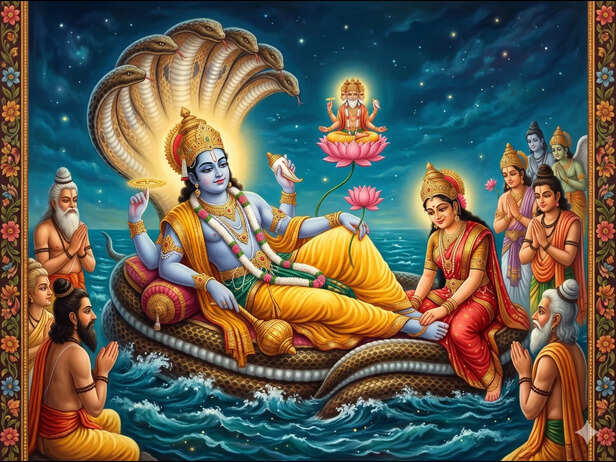
![Lord Vishnu in Yoga Nidra on the Cosmic Ocean]()
Lord Vishnu in Yoga Nidra on the Cosmic Ocean
Image credit : CHATGPT(AI)
A popular explanation of this unusual form connects it with a powerful demon who possessed the faces of a lion and a boar. According to this local mythological interpretation, the demon received a boon that made him difficult to defeat. Lord Vishnu then assumed a combined form to overcome him. However, this particular demon story should be understood as a traditional retelling rather than a universally established account in Hindu scriptures. The better-documented religious interpretation identifies the lion and boar faces with Vishnu's Narasimha and Varaha aspects.
Why This Form Is Called Vaikuntha Vishnu
The name Vaikuntha Vishnu is associated with a distinctive form of Vishnu worship, particularly known in ancient Kashmir. In its established Kashmiri iconography, the deity is often represented with four faces: a human face in front, lion and boar faces on the sides, and a fierce face at the back. This four-faced representation is also called Vaikuntha Chaturmurti. The different faces are not separate gods but represent different aspects of Vishnu's divine nature and cosmic power.
The Thousand-Year-Old Idol at Khajuraho
One of the most fascinating places to see this form is the Lakshmana Temple in Khajuraho, Madhya Pradesh. Built during the Chandella period and dedicated in 954 CE, the temple is more than a thousand years old. Its main sanctum houses a three-headed representation of Vaikuntha Vishnu. The central human face is accompanied by the lion and boar faces, although parts of the sculpture have suffered damage over time. This rare image makes the temple especially interesting for devotees, historians and lovers of ancient Indian art.
Why This Form Was Worshipped in Kashmir
The story of Vaikuntha Vishnu does not begin at Khajuraho. This distinctive form was especially important in ancient Kashmir between the eighth and tenth centuries. It became a prominent royal and religious image, particularly during the period of the Kashmiri dynasties. Several sculptures from this period show Vishnu with multiple faces and four arms. One remarkable example from the eighth century is now displayed at the Metropolitan Museum of Art in New York. This historical connection reveals how widely this unique form was respected in ancient India.
Why the Gada and Chakra Appear as Separate Figures
There is another unusual detail in certain Vaikuntha Vishnu sculptures. Instead of simply holding the gada and chakra, Vishnu is accompanied by two smaller figures representing these divine weapons. They are known as Gada Devi and Chakra Purusha. These figures personify Vishnu's mace and discus as independent divine attendants. The Metropolitan Museum's eighth-century Kashmir sculpture provides a particularly clear example of this artistic tradition. This detail shows how ancient Indian artists gave symbolic objects their own identities within religious sculpture.
The Deeper Meaning of Vaikuntha Vishnu
The most meaningful aspect of Vaikuntha Vishnu is the way it brings different divine qualities together. The human face represents the central divine presence, while the lion and boar faces recall the protective powers associated with Narasimha and Varaha. Rather than seeing these as separate forms competing with one another, the sculpture presents them as different expressions of the same deity. It reminds devotees that Lord Vishnu is worshipped through many forms, each connected with the protection and preservation of the universe.
Unlock insightful tips and inspiration on personal growth, productivity, and well-being. Stay motivated and updated with the latest at
My Life XP.