The answer takes us into the world of Hindu mythology, where even the simplest symbols can carry deeper spiritual meanings. Maa Kalaratri's appearance reminds devotees that divine power does not always come in a form that looks beautiful or frightening. Sometimes, it appears in ways that challenge our expectations and teach us to look beyond outward appearances.
Her donkey, known as her vahana or divine mount, is an important part of her traditional iconography. While religious traditions describe her form and vehicle, the deeper symbolic meanings associated with the donkey can also inspire us to reflect on humility, patience, courage, and the strength to keep moving forward during difficult times.
Let's discover who Maa Kalaratri is, why she rides a donkey, and what this unusual association can teach us about life.
Who Is Maa Kalaratri, the Seventh Form of Goddess Durga?
Maa Kalaratri is worshipped on the seventh day of Navratri and is regarded as one of the most powerful forms of Goddess Durga.
Her name is commonly understood through the words
Kala, associated with time or darkness, and
Ratri, meaning night. Her form is traditionally described with a dark complexion, dishevelled hair, three eyes, and four hands. She carries weapons and is often depicted with a protective or blessing gesture.
Although her appearance may seem frightening, her role is not simply to inspire fear. She represents the fierce power of the Divine Mother that confronts destructive forces and protects her devotees.
She is also known as Shubhankari, a name associated with auspiciousness and well-being. This contrast is central to understanding her form: what appears fearsome can also be protective.
During Navratri, devotees worship Maa Kalaratri with faith and prayers, seeking courage, protection, and strength to face life's challenges.
But one detail makes her form especially interesting: her vahana is a donkey.
Why Does Maa Kalaratri Ride a Donkey?
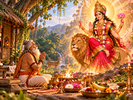
![Navratri mythology]()
Navratri mythology
Image credit : AI
In traditional depictions of Maa Kalaratri, the donkey is her divine mount. Unlike the lion associated with many depictions of Goddess Durga, the donkey is a humble animal that does not immediately suggest royal power or fierce strength.
This contrast makes her vahana fascinating.
In Hindu religious imagery, a deity's vehicle is not merely a means of transportation. It is an important part of the deity's traditional representation and can carry symbolic meaning.
However, it is worth making a distinction: Hindu traditions do not always provide one single explanation for every symbolic detail. While Maa Kalaratri's association with a donkey is part of her established iconography, interpretations of what the animal represents can vary.
The donkey can inspire several meaningful reflections.
1. The Donkey Reminds Us That Strength Does Not Always Look Powerful
When people imagine strength, they often picture a lion, an elephant, or a powerful warrior. A donkey rarely comes to mind.
Yet donkeys are known for their ability to carry heavy loads and continue travelling through demanding conditions.
This offers a simple way to reflect on Maa Kalaratri's fierce form. Divine strength does not need to look attractive, impressive, or familiar to be powerful.
In the same way, people who appear quiet or ordinary can possess extraordinary courage. Someone caring for a family through difficult times, a student overcoming personal struggles, or a person rebuilding life after a setback may demonstrate a kind of strength that others never notice.
Maa Kalaratri's imagery invites devotees to look beyond appearances and recognize that true strength can take many forms.
2. Her Vahana Can Inspire Us to Practise Humility
The donkey is often associated with humble service and everyday work. Unlike animals traditionally linked with royalty, it is closely connected with ordinary life.
This contrast can encourage reflection on humility.
People sometimes believe that they must appear successful, powerful, or important to earn respect. They may judge others by their wealth, appearance, position, or achievements.
But spiritual growth often begins when we stop measuring our worth through outward recognition.
The image of a powerful goddess riding a humble animal can remind us that dignity and greatness are not limited to appearances.
A person who helps others without expecting praise, works honestly, or remains kind during difficult times may demonstrate a deeper form of strength than someone who constantly seeks recognition.
This is a spiritual lesson we can take from the imagery, rather than a universally prescribed meaning of the donkey.
3. It Reminds Us to Keep Moving Through Difficult Times
Life does not always move according to our plans. There are days when responsibilities feel overwhelming, problems seem endless, and even small tasks require considerable effort.
The donkey's association with carrying loads offers a useful image for reflecting on perseverance.
Consider someone who is caring for an ill family member while managing work and household responsibilities. Their strength may not be dramatic or visible, but they continue to show up each day.
Similarly, a student who struggles with a subject but keeps practising is showing determination.
Maa Kalaratri is traditionally associated with confronting darkness and destructive forces. Her imagery can therefore inspire devotees to face difficulties with courage rather than assuming that every challenge means they have failed.
Perseverance does not mean carrying every burden alone. It also means knowing when to rest, seek help, and take the next step at a manageable pace.
4. Her Fierce Appearance Teaches Us Not to Judge by Looks
One of the most striking features of Maa Kalaratri is the contrast between her frightening appearance and her auspicious, protective role.
Her dark complexion, wild hair, and fierce expression may initially seem intimidating. Yet devotees worship her as a form of the Divine Mother.
Her donkey adds another unexpected element to this image.
Together, these features invite us to question our habit of judging things by their outward appearance.
We may sometimes mistake a quiet person for someone who lacks confidence, or assume that someone who looks different from us has little to offer. We may also overlook the value of ordinary people and everyday acts of kindness.
Maa Kalaratri's form reminds devotees that appearances do not tell the whole story. What matters is understanding the deeper nature and purpose behind what we see.
What Makes Maa Kalaratri Different From Other Forms of Goddess Durga?
Each of the nine forms of Goddess Durga worshipped during Navratri represents a distinct aspect of the Divine Mother within the Navadurga tradition.
Maa Shailputri is commonly associated with mountains and the beginning of the spiritual journey, while Maa Chandraghanta is known for her bell-shaped crescent moon. Maa Kushmanda is associated with the creation of the universe, and Maa Skandamata is recognised as the mother of Skanda.
Maa Kalaratri stands out for her fierce appearance and her association with confronting darkness and destructive forces.
Her traditional vehicle is also distinctive. While Goddess Durga is widely depicted riding a lion or tiger, Maa Kalaratri is commonly shown riding a donkey.
These differences illustrate the variety of forms through which Hindu traditions represent the power of the Divine Mother. Each form offers devotees a different focus for worship, reflection, and devotion.
What Can We Learn From Maa Kalaratri and Her Donkey?
Beyond mythology and religious imagery, Maa Kalaratri's form can inspire us to reflect on a few everyday lessons.
- Stay strong during difficult times. Challenges are a part of life, and facing them often requires patience and courage.
- Do not judge people by appearances. Someone's real worth cannot always be understood from how they look or what they possess.
- Value humility. You do not need to be the loudest or most celebrated person in a room to make a meaningful difference.
- Keep moving forward. Progress may be slow, but small, steady steps can help us navigate difficult situations.
- Remember that courage and kindness can exist together. Strength does not have to mean harshness; it can also mean protecting others and standing up for what is right.
These are personal reflections inspired by the goddess's traditional imagery, rather than a claim that every religious tradition assigns these exact meanings to her donkey.
A Divine Reminder Hidden in an Unexpected Form
Maa Kalaratri reminds us that true strength isn't always found in appearances or status. Her unusual vahana, the humble donkey, inspires us to embrace patience, humility, and perseverance.
This Navratri, remember that courage isn't about never facing darkness—it's about finding the strength to move forward, even when life feels difficult.
Unlock insightful tips and inspiration on personal growth, productivity, and well-being. Stay motivated and updated with the latest at
My Life XP.