Why Is Maa Durga Worshipped While Women Are Blamed?
Noopur Kumari | Oct 01, 2026, 18:00 IST
A woman is worshipped as Maa Durga, but a woman walking home after sunset may still be told that she should have stayed inside. A girl is praised for being independent, but after questions about her clothes, timing, company or location can quickly replace questions about the accused and the failures around her.

Worshipping Durga
Image credit : chatgpt(ai)
During Navratri, millions of people bow before Maa Durga as a symbol of Shakti, courage and feminine power. Yet outside the temple, an uncomfortable question remains: why does society so often respond to violence against women by telling women where they should not go, when they should return home and how they should behave?
![Maa Durga and a Woman Walking in the City]()
During Navratri, Maa Durga is celebrated as Shakti, yet real women are often expected to prove that they were “careful enough” before they receive sympathy after violence. This contradiction deserves an honest conversation. A woman is not less deserving of safety because she travelled alone, visited a park, returned late or trusted someone she knew. Safety advice can be useful, but it should never become a way of transferring responsibility from the offender to the victim. Women are not goddesses who must remain protected inside a temple. They are human beings who deserve equal freedom, dignity and safety in public spaces.
The alleged gang rape at Aastha Kunj Park involved a 17-year-old girl, according to police reports. Subsequent reporting raised questions about the park’s security infrastructure. Hindustan Times reported poorly lit stretches, limited guards and concerns over CCTV coverage, while the park covers about 142 acres and has multiple entry points. The Delhi administration subsequently ordered a safety audit of parks, including reviews of lighting, security and patrolling. These details matter because they move the discussion away from a victim’s behaviour and toward the conditions that authorities can actually improve.
![Woman Sitting Alone in a Public Park]()
After sexual violence, society sometimes asks questions such as: Why was she outside? Why was she alone? Why did she go there after dark? Those questions may sound like safety advice, but they can easily become victim blaming when they imply that the survivor caused or invited the crime. The responsibility for sexual violence lies with the person who commits it. Women can make choices about their own safety, but those choices cannot guarantee protection from someone else's criminal actions. A safer society needs both personal awareness and public accountability. One should never replace the other.
After the Aastha Kunj incident, authorities directed increased vigilance and controlled entry after sunset while a broader safety assessment was undertaken. Such restrictions may be presented as an immediate safety measure, but they raise a larger question: what happens if the solution always becomes “women should not go there”? A safer public space also needs working lights, visible guards, functioning CCTV, secure boundaries, clear entry points and regular patrolling. A recent inspection of Delhi parks found several such gaps across different locations. Safety should improve the space rather than simply reduce who can use it.
The comparison with Maa Durga can be emotionally powerful, but it should not create another unrealistic expectation for women. Real women can be strong and vulnerable, confident and afraid, independent and in need of help. They do not have to behave like a goddess to deserve respect. A daughter coming home late, a student crossing a park, a woman meeting a friend or a professional returning from work is still a human being with the same right to safety. Respect should not depend on whether society considers her “good,” “traditional” or “careful.”
Perhaps the most meaningful Navratri question is not whether women should behave like goddesses. It is whether society is willing to treat every woman as a human being whose safety matters. Worshipping Maa Durga while blaming a survivor for being outside creates a contradiction that deserves attention. Women should still take sensible precautions, just as everyone should, but precautions are not permission for others to harm them. Public safety requires safer infrastructure, responsible institutions, accountable offenders and a culture that stops turning a survivor's behaviour into the centre of the story.
Unlock insightful tips and inspiration on personal growth, productivity, and well-being. Stay motivated and updated with the latest at My Life XP
A Goddess Is Worshipped, a Woman Is Questioned
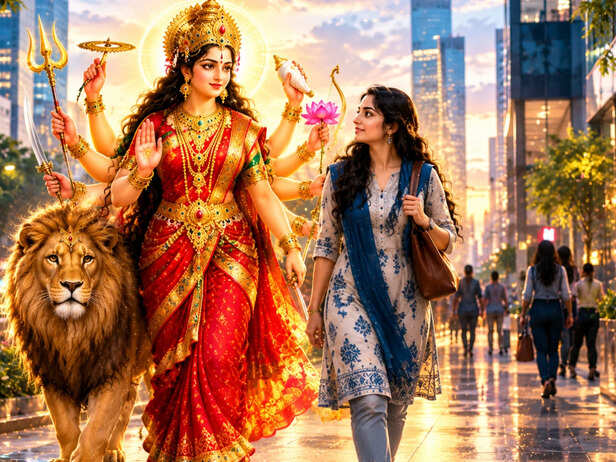
Maa Durga and a Woman Walking in the City
Image credit : ChatGPT (ai)
During Navratri, Maa Durga is celebrated as Shakti, yet real women are often expected to prove that they were “careful enough” before they receive sympathy after violence. This contradiction deserves an honest conversation. A woman is not less deserving of safety because she travelled alone, visited a park, returned late or trusted someone she knew. Safety advice can be useful, but it should never become a way of transferring responsibility from the offender to the victim. Women are not goddesses who must remain protected inside a temple. They are human beings who deserve equal freedom, dignity and safety in public spaces.
Aastha Kunj Was Not Just About One Incident
Why Does the Question Become “Why Was She There?

Woman Sitting Alone in a Public Park
Image credit : Freepik
After sexual violence, society sometimes asks questions such as: Why was she outside? Why was she alone? Why did she go there after dark? Those questions may sound like safety advice, but they can easily become victim blaming when they imply that the survivor caused or invited the crime. The responsibility for sexual violence lies with the person who commits it. Women can make choices about their own safety, but those choices cannot guarantee protection from someone else's criminal actions. A safer society needs both personal awareness and public accountability. One should never replace the other.
Restricting Women Is Not the Same as Making Places Safe
Women Are Human, Not Symbols
7. The Real Meaning of Shakti
Unlock insightful tips and inspiration on personal growth, productivity, and well-being. Stay motivated and updated with the latest at My Life XP