Why Only 3 Could Win the Fish Eye Test? The Truth
Noopur Kumari | Aug 26, 2026, 12:00 IST
The fish-eye challenge looks like a test of archery, but it actually demands several skills at once. The archer cannot rely on direct vision. He has to judge the target through its reflection while the fish keeps moving. That means strength alone is not enough. A powerful warrior could still fail if his timing, concentration or control was imperfect. Arjuna is celebrated for mastering this kind of focused archery. Karna is also portrayed as an exceptional archer, while Krishna's abilities are described very differently because he is not simply presented as an ordinary warrior. But the biggest question remains:
What made this challenge so difficult that only the greatest warriors could even attempt it successfully?
What made this challenge so difficult that only the greatest warriors could even attempt it successfully?

Imagine being asked to hit a tiny target that you cannot even look at directly.
Image credit : ChatGPT (ai)
Imagine being asked to hit a tiny target that you cannot even look at directly. Above you, a golden fish is rotating. Beneath it, a pool of oil reflects its image. You must look only at that reflection, understand the fish's movement and release an arrow at exactly the right moment.
This was not an ordinary archery challenge. In popular retellings of the Mahabharata, three extraordinary figures are often connected with this level of skill: Arjuna, Karna and Krishna. But there is an important twist. The famous fish-eye challenge is primarily associated with Draupadi's swayamvara, and traditions differ on exactly who attempted it and what happened. So why were these warriors considered capable of such an almost impossible feat? The answer is not simply strength. It is about precision, concentration, training and extraordinary control over the mind.
![Arjuna aiming at the rotating golden fish]()
The challenge was deliberately complicated. The archer had to string a powerful bow, shoot an arrow upward and strike the eye of a rotating fish while observing only its reflection. This required much more than physical strength. The warrior needed to coordinate vision, balance, timing, hand control and mental focus in a single movement. One small mistake could send the arrow in the wrong direction. That is why the challenge became a symbol of exceptional concentration. It was not simply asking, "Who is the strongest?" It was asking, "Who can remain perfectly focused when almost every normal advantage has been removed?"
![Arjuna mastering the impossible archery challenge]()
Arjuna is repeatedly portrayed in the Mahabharata tradition as an exceptionally disciplined archer. His training under Drona focused not only on shooting but also on concentration. The famous story of the bird's eye illustrates this quality. When Drona asked his students what they could see while aiming, Arjuna famously focused only on the target. Whether every detail of this teaching story is interpreted literally or symbolically, its message is clear. Arjuna's greatest advantage was not simply muscular power. It was his ability to remove distractions and concentrate completely on one objective That is exactly the kind of skill the fish-eye challenge demanded.
Karna is where the question becomes more complicated. The Mahabharata presents him as a remarkably skilled warrior and one of Arjuna's greatest rivals. He possessed exceptional knowledge of weapons and received advanced training from Parashurama according to the epic tradition. However, the famous Draupadi swayamvara episode does not establish a simple version in which Karna successfully completes the fish-eye challenge. Different retellings add or alter details. So it would be misleading to state as an unquestionable fact that Karna successfully performed exactly the same test. The stronger point is this: Karna had the warrior skills and archery reputation that make the challenge plausible for him, but the epic tradition does not give us a straightforward successful Karna version of the test.
Krishna is often included in modern discussions about who could have completed extraordinary feats. But there is an important distinction.
Krishna is not portrayed in the Mahabharata simply as another competitor trying to win Draupadi's hand. His role is much larger. He is presented as a powerful divine figure, strategist, guide and, in many traditions, the Supreme Being. Therefore, comparing Krishna directly with Arjuna and Karna as if all three were competing under identical circumstances can create confusion. The more accurate interpretation is that Arjuna and Karna are celebrated primarily for their martial and archery abilities, while Krishna's power is presented on an entirely different level.
Here is the hidden lesson behind the challenge. A warrior could have enormous physical strength and still fail. Why? Because the target was moving, the archer could not look at it directly and the shot required precise timing. The challenge demanded a combination of: Strength to control the bow Vision to read the reflection Concentration to ignore distractions Timing to release the arrow Experience to judge movement That combination explains why the challenge is remembered as something only an extraordinary archer could master. The real battle was happening inside the mind before the arrow was even released.
The most fascinating part of the fish-eye story is not the golden fish. It is the mind of the archer. Looking at a reflection while aiming at a moving target requires the brain to process distance, direction and movement without relying on ordinary direct sight. That is why Arjuna's legendary concentration matters so much. His training prepared him for situations where distraction could mean failure. And this is what makes the ancient story surprisingly relatable. Modern life also rewards people who can focus while everything around them competes for attention. The bow and arrow have changed. The challenge of concentration has not.
The safest answer is that the premise needs a little clarification. The Mahabharata does not establish a universal rule that exactly three people, Krishna, Arjuna and Karna, were capable of passing the fish-eye test. The famous challenge is associated with Draupadi's swayamvara, and later retellings often expand the list of extraordinary warriors who might have been capable of it. Arjuna's successful feat is the central episode. Karna's reputation makes him an obvious comparison, while Krishna's divine status makes him a different category altogether. So the deeper answer is not about a fixed list of three. It is about the rare combination of skill, concentration, timing and extraordinary ability required to accomplish such a feat.
Unlock insightful tips and inspiration on personal growth, productivity, and well-being. Stay motivated and updated with the latest at My Life XP.
This was not an ordinary archery challenge. In popular retellings of the Mahabharata, three extraordinary figures are often connected with this level of skill: Arjuna, Karna and Krishna. But there is an important twist. The famous fish-eye challenge is primarily associated with Draupadi's swayamvara, and traditions differ on exactly who attempted it and what happened. So why were these warriors considered capable of such an almost impossible feat? The answer is not simply strength. It is about precision, concentration, training and extraordinary control over the mind.
The Test Was Designed to Be Nearly Impossible
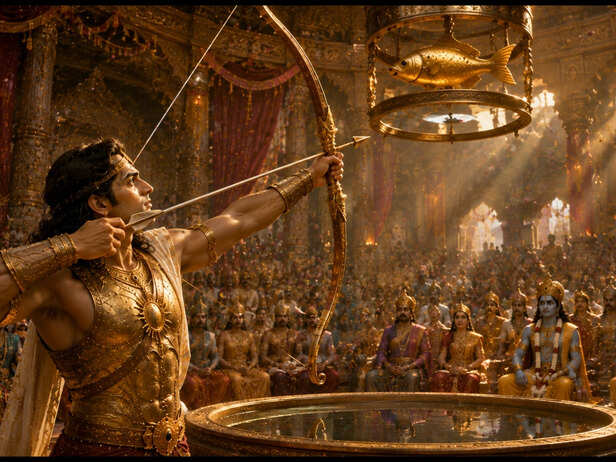
Arjuna aiming at the rotating golden fish
Image credit : ChatGPT(ai)
The challenge was deliberately complicated. The archer had to string a powerful bow, shoot an arrow upward and strike the eye of a rotating fish while observing only its reflection. This required much more than physical strength. The warrior needed to coordinate vision, balance, timing, hand control and mental focus in a single movement. One small mistake could send the arrow in the wrong direction. That is why the challenge became a symbol of exceptional concentration. It was not simply asking, "Who is the strongest?" It was asking, "Who can remain perfectly focused when almost every normal advantage has been removed?"
Arjuna Had the Perfect Skill Set
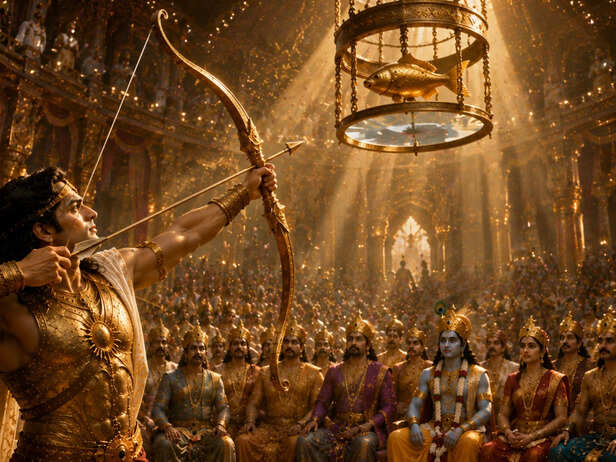
Arjuna mastering the impossible archery challenge
Image credit : ChatGPT(ai)
Arjuna is repeatedly portrayed in the Mahabharata tradition as an exceptionally disciplined archer. His training under Drona focused not only on shooting but also on concentration. The famous story of the bird's eye illustrates this quality. When Drona asked his students what they could see while aiming, Arjuna famously focused only on the target. Whether every detail of this teaching story is interpreted literally or symbolically, its message is clear. Arjuna's greatest advantage was not simply muscular power. It was his ability to remove distractions and concentrate completely on one objective That is exactly the kind of skill the fish-eye challenge demanded.
But What About Karna?
Krishna Was Different From Both
Krishna is not portrayed in the Mahabharata simply as another competitor trying to win Draupadi's hand. His role is much larger. He is presented as a powerful divine figure, strategist, guide and, in many traditions, the Supreme Being. Therefore, comparing Krishna directly with Arjuna and Karna as if all three were competing under identical circumstances can create confusion. The more accurate interpretation is that Arjuna and Karna are celebrated primarily for their martial and archery abilities, while Krishna's power is presented on an entirely different level.
Strength Alone Could Never Win
The Real Secret Was Focus
So Why Only These Great Figures?
Unlock insightful tips and inspiration on personal growth, productivity, and well-being. Stay motivated and updated with the latest at My Life XP.