Why Ramdas Saw Something Special in Ganpati at Morgaon
Noopur Kumari | Sept 16, 2026, 16:00 IST
The story begins with a man named Narayan, whose search for spiritual meaning eventually transformed him into the saint known as Samarth Ramdas. His devotion to Lord Rama became central to his life. Yet during his travels, he reached Morgaon, where he encountered Mayureshwar Ganesha. What happened there is traditionally linked to the creation of “Sukhkarta Dukhharta,” a Marathi aarti that is now closely associated with Ganesh worship in Maharashtra.

During Ganesh Chaturthi, there is one aarti whose first words
Image credit : ChatGPT(ai)
During Ganesh Chaturthi, there is one aarti whose first words can instantly change the atmosphere: “Sukhkarta Dukhharta.” It is heard in homes, temples and Ganpati pandals across Maharashtra. But have you ever wondered who created it and what inspired it? The answer becomes surprisingly fascinating when you learn about Samarth Ramdas, the saint whose devotion was deeply associated with Lord Rama. Tradition says that when Ramdas reached Morgaon and stood before Mayureshwar, one of the Ashtavinayak forms of Ganesha, that encounter inspired a composition that would eventually become one of the most recognisable Ganpati aartis.
![Young Narayan Leaving His Wedding]()
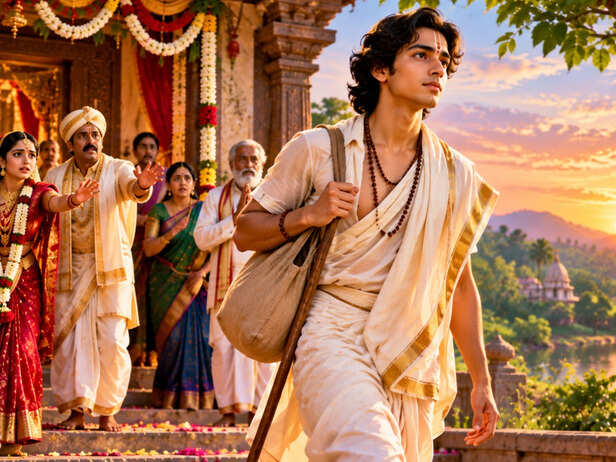
Tradition tells of Narayan, the man who would later become Samarth Ramdas. Born on Ram Navami, he developed a deep devotion to Lord Rama and Hanuman. The turning point came during his wedding ceremony. As the priest uttered the traditional warning, “Shubh Mangal Saavdhan,” Narayan reportedly took the word “saavdhan” as a powerful reminder to wake up to a different calling. He left the wedding and began a spiritual journey. Over time, his devotion deepened so intensely that Narayan became known as Ramdas, meaning a servant or devotee of Rama. His life thereafter became closely associated with Rama bhakti.
![story behind Sukhkarta Dukhharta has a beautiful twist.]()
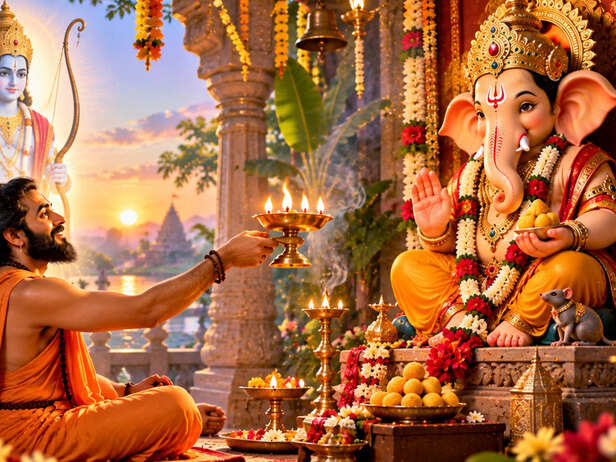
Ramdas travelled widely during his spiritual journey and eventually reached Morgaon, home to the Mayureshwar form of Lord Ganesha. Morgaon is traditionally regarded as the principal shrine of the Ashtavinayak pilgrimage, the eight revered Ganesha temples of Maharashtra. Here, something unusual happened in the story. Ramdas was a devotee of Rama, yet the deity before him was Ganesha. Still, devotion does not always stay inside neat boundaries. Standing before Mayureshwar, Ramdas is traditionally believed to have been moved deeply enough to create a composition for Ganesha. That composition became “Sukhkarta Dukhharta.”
“Sukhkarta Dukhharta” is traditionally attributed to Samarth Ramdas and is associated with his encounter with the Mayureshwar image at Morgaon. It is a Marathi devotional aarti dedicated to Ganesha and is traditionally set to the Jogiya raga. The opening itself captures the emotional essence of Ganpati worship, describing Ganesha as the one who brings happiness and removes sorrow. What makes the composition even more striking is that the final verse includes the words identifying Ramdas as “the servant of Rama,” subtly bringing his own devotion into a hymn addressed to Ganesha.
There is something deeply personal about the aarti. It does not sound like a distant philosophical prayer. It feels like someone standing before the deity and speaking directly from the heart. That may be one reason it became so deeply embedded in Ganesh worship. The aarti is widely sung during Ganesh Chaturthi and in Ganesha temples across Maharashtra. The traditional association with Jogiya also gives the composition a distinctive musical identity. For generations, the words have moved beyond the story of their creation and become part of how devotees experience Ganpati.
The most beautiful part of the story may be the apparent contradiction. Ramdas was deeply devoted to Rama, yet he composed one of the best-known aartis to Ganesha. But within the broader Hindu devotional tradition, different forms of the divine are often approached through different names and forms. The story therefore need not be understood as choosing one deity over another. Instead, it can be seen as a moment in which devotion recognised divinity in another form. That is what makes the Morgaon episode so compelling. A devotee of Rama stood before Ganesha and found enough inspiration to create something generations would continue singing.
Today, “Sukhkarta Dukhharta” is much bigger than the story of one saint and one temple. It has become part of the soundscape of Ganesh Chaturthi, especially in Maharashtra, where it is commonly sung during Ganesha worship. Its strength lies in its simplicity. You do not need to know every detail of Ramdas's life to feel something when the aarti begins. The familiar words, melody and collective voice create an atmosphere that can make an entire gathering pause. That is perhaps the greatest legacy of a devotional composition: it survives not merely as history, but as lived tradition.
There is a reason the story feels almost poetic. A man who once walked away from a wedding in search of his true purpose eventually became a saint whose words would bring millions together in devotion. At Morgaon, tradition says that his encounter with Mayureshwar gave birth to an aarti that continues to be heard centuries later. The deeper lesson is not only about how the aarti was created. It is about what happens when a person becomes completely absorbed in devotion. Sometimes, when the mind stops searching for an answer and simply becomes still, something meaningful emerges.
Unlock insightful tips and inspiration on personal growth, productivity, and well-being. Stay motivated and updated with the latest at My Life XP.
Narayan Who Left the Mandap
Young Narayan Leaving His Wedding
Image credit : ChatGPT(ai)
Tradition tells of Narayan, the man who would later become Samarth Ramdas. Born on Ram Navami, he developed a deep devotion to Lord Rama and Hanuman. The turning point came during his wedding ceremony. As the priest uttered the traditional warning, “Shubh Mangal Saavdhan,” Narayan reportedly took the word “saavdhan” as a powerful reminder to wake up to a different calling. He left the wedding and began a spiritual journey. Over time, his devotion deepened so intensely that Narayan became known as Ramdas, meaning a servant or devotee of Rama. His life thereafter became closely associated with Rama bhakti.
A Ram Bhakt Reaches Morgaon
story behind Sukhkarta Dukhharta has a beautiful twist.
Image credit : chatgpt(ai)
Ramdas travelled widely during his spiritual journey and eventually reached Morgaon, home to the Mayureshwar form of Lord Ganesha. Morgaon is traditionally regarded as the principal shrine of the Ashtavinayak pilgrimage, the eight revered Ganesha temples of Maharashtra. Here, something unusual happened in the story. Ramdas was a devotee of Rama, yet the deity before him was Ganesha. Still, devotion does not always stay inside neat boundaries. Standing before Mayureshwar, Ramdas is traditionally believed to have been moved deeply enough to create a composition for Ganesha. That composition became “Sukhkarta Dukhharta.”
The Aarti That Came From That Moment
Why This Aarti Feels Different
The Rama-Ganesha Connection
Why ‘Sukhkarta Dukhharta’ Lives On
The Moment You Stop Listening
Unlock insightful tips and inspiration on personal growth, productivity, and well-being. Stay motivated and updated with the latest at My Life XP.