Why Shiva Chose Nageshwar to Defeat Hidden Fear
Noopur Kumari | Aug 21, 2026, 11:00 IST
Why did Lord Shiva appear as Nageshwar after a terrifying battle between demons and divine forces? The answer lies in a forgotten story of devotion, a promise made by Goddess Parvati and Shiva's unusual decision to protect both sides.

Nageshwar Jyotirlinga
Image credit : ChatGPT(AI)
We all carry fears that nobody else can see. Some are obvious, while others sit quietly inside us, deeply rooted and difficult to explain. The more we try to fight them, the stronger they sometimes seem. Ancient Hindu tradition offers a different way of looking at fear: understand it with courage, awareness and compassion rather than running from it.
The story of Nageshwar Jyotirlinga carries a powerful message about exactly this struggle. It is a story of a demon king, a devoted merchant, Goddess Parvati's promise and Lord Shiva's extraordinary compassion. But beneath the mythology lies an unforgettable idea: when darkness becomes overwhelming, divine light can change the way we face fear.
![Daruka Forest Surrounded by Darkness]()
Long ago, according to the traditional legend, there was a mysterious forest known as Darukavana, associated with the demoness Daruka. She was a devoted worshipper of Goddess Parvati and possessed powerful mystical abilities. Through her powers, the forest was believed to move across the sea, allowing the demons living there to attack and rob passing travellers. Fear became part of the world around them. But one day, a merchant named Supriya was captured along with others. Unlike those around him, Supriya did not surrender to fear. His devotion to Lord Shiva became his source of inner strength.
![Supriya Worships Shiva in Captivity]()
Inside the demon prison, Supriya did something unexpected. Instead of becoming consumed by fear, he created a Parthiva Shiva Linga and began meditating on Lord Shiva. His calmness angered the demon king Daruka. How could someone remain peaceful when surrounded by danger? Daruka decided to kill him. But Supriya continued his prayers. This moment creates the heart of the story: fear was physically surrounding Supriya, yet it had not conquered him internally. His devotion became a light inside the darkness, and according to the legend, that devotion was about to receive a divine answer.
As Daruka raised his weapon against Supriya, the Shiva Linga suddenly became the source of a powerful divine light. Lord Shiva appeared to protect his devotee. In his fierce form, Shiva destroyed the demons threatening the prisoners. For a moment, it seemed that the conflict had reached its final conclusion. The devotee was protected, the danger had been removed and the demons faced destruction. But then came an unexpected turn. Daruka was a devotee of Goddess Parvati, and the Goddess appeared to protect her devotee and uphold the promise she had made.
The story now becomes deeper than a simple battle between good and evil. Shiva had appeared to protect his devotee, but Parvati had promised protection to Daruka and her lineage. Shiva's compassion toward his devotee and Parvati's commitment to her promise both mattered. Rather than allowing one promise to completely destroy the other, Shiva chose a path of balance. According to the legend, he allowed the demons protection for a limited period while ensuring that humans would also remain protected. The story suggests that divine wisdom is not always about choosing one side. Sometimes it is about finding a compassionate balance.
Shiva Became
To protect humanity, Lord Shiva manifested his divine light as a Jyotirlinga at the sacred place. This form became known as Nageshwar, traditionally associated with the legend of Darukavana. Because Goddess Parvati's intervention played an important role in the story, she is also worshipped there in the form of Nageshwari. The imagery is powerful. A place associated with fear, demons and danger became associated with divine light and protection. The serpent symbolism connected with Nageshwar also adds another layer, reminding devotees of the fears that can remain coiled within the human mind.
The serpent is an important symbol in Shaivite tradition. It can represent danger and fear, but it can also represent transformation, spiritual energy and control over instinctive forces. This makes the name Nageshwar especially meaningful in the context of the story. The very image that can frighten people becomes connected with Shiva's divine presence. The lesson is subtle: we do not always overcome fear by destroying everything that frightens us. Sometimes we learn to understand it, face it and transform our relationship with it. That is where the story becomes relevant beyond its mythological setting.
The deepest message of the Nageshwar story is not simply that Shiva defeated demons. It is about what happens when fear takes control of the mind. When we are frightened, everything can appear darker and more dangerous. The story offers another perspective: light does not always mean that the problem disappears immediately. Sometimes light simply allows us to see the problem clearly. Supriya's devotion gave him that inner light, while Shiva's appearance transformed a place of fear into a place of protection. The lesson remains powerful today: face fear with awareness, compassion and courage rather than allowing it to control you.
The story of Nageshwar Jyotirlinga begins with fear but ends with light.
A frightened group of prisoners found hope through devotion. A demoness's devotion brought Goddess Parvati into the conflict. Shiva faced a difficult balance between protecting his devotee and respecting Parvati's promise. And from that extraordinary situation emerged the sacred presence of Nageshwar.
That is perhaps why the story continues to resonate.
Fear can feel like a serpent coiled inside us. The more we fight it blindly, the more powerful it can seem. But when awareness becomes the light, fear can finally be seen for what it is.
The traditional Nageshwar Jyotirlinga is associated with the coastal region of Gujarat, and devotees continue to visit the sacred site with faith and reverence.
Sometimes, we do not need to become fearless. We simply need enough light to see our fear clearly.
Unlock insightful tips and inspiration on personal growth, productivity, and well-being. Stay motivated and updated with the latest at My Life XP.
The story of Nageshwar Jyotirlinga carries a powerful message about exactly this struggle. It is a story of a demon king, a devoted merchant, Goddess Parvati's promise and Lord Shiva's extraordinary compassion. But beneath the mythology lies an unforgettable idea: when darkness becomes overwhelming, divine light can change the way we face fear.
The Forest Where Fear Ruled

Daruka Forest Surrounded by Darkness
Image credit : ChatGPT (AI)
Long ago, according to the traditional legend, there was a mysterious forest known as Darukavana, associated with the demoness Daruka. She was a devoted worshipper of Goddess Parvati and possessed powerful mystical abilities. Through her powers, the forest was believed to move across the sea, allowing the demons living there to attack and rob passing travellers. Fear became part of the world around them. But one day, a merchant named Supriya was captured along with others. Unlike those around him, Supriya did not surrender to fear. His devotion to Lord Shiva became his source of inner strength.
Supriya Refused To Give In
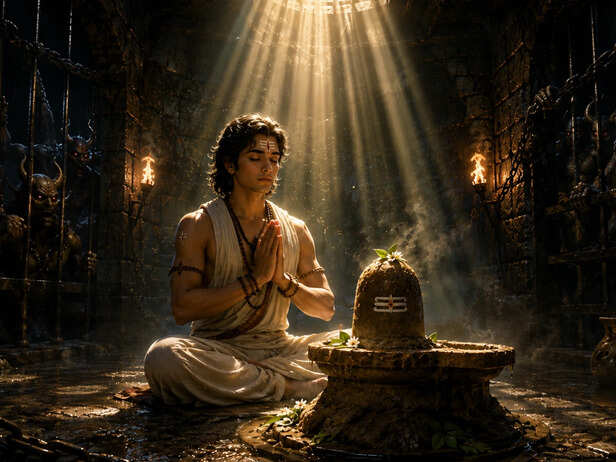
Supriya Worships Shiva in Captivity
Image credit : ChatGPT(AI)
Inside the demon prison, Supriya did something unexpected. Instead of becoming consumed by fear, he created a Parthiva Shiva Linga and began meditating on Lord Shiva. His calmness angered the demon king Daruka. How could someone remain peaceful when surrounded by danger? Daruka decided to kill him. But Supriya continued his prayers. This moment creates the heart of the story: fear was physically surrounding Supriya, yet it had not conquered him internally. His devotion became a light inside the darkness, and according to the legend, that devotion was about to receive a divine answer.
Shiva Appeared From The Light
Shiva And Parvati Faced A Dilemma
Shiva Became Nageshwar
The Serpent Is More Than A Symbol
The Real Lesson Is About Inner Fear
The Hidden Meaning Of Nageshwar
A frightened group of prisoners found hope through devotion. A demoness's devotion brought Goddess Parvati into the conflict. Shiva faced a difficult balance between protecting his devotee and respecting Parvati's promise. And from that extraordinary situation emerged the sacred presence of Nageshwar.
That is perhaps why the story continues to resonate.
Fear can feel like a serpent coiled inside us. The more we fight it blindly, the more powerful it can seem. But when awareness becomes the light, fear can finally be seen for what it is.
The traditional Nageshwar Jyotirlinga is associated with the coastal region of Gujarat, and devotees continue to visit the sacred site with faith and reverence.
Sometimes, we do not need to become fearless. We simply need enough light to see our fear clearly.
Unlock insightful tips and inspiration on personal growth, productivity, and well-being. Stay motivated and updated with the latest at My Life XP.