
Buddha Purnima 2026: Why Buddha Is Seen as Vishnu’s Avatar
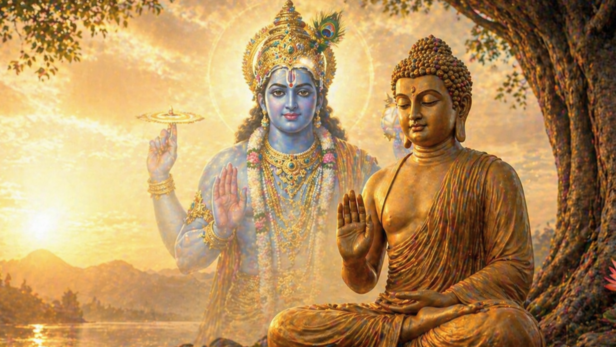
There are certain ideas in Indian spiritual tradition that feel both familiar and quietly mysterious, ideas that people hear repeatedly yet rarely pause to examine in depth. One such idea is the belief that Buddha, the enlightened teacher who spoke about suffering, awareness, and liberation, is also regarded in many Hindu traditions as an avatar of Lord Vishnu, the preserver of the universe. On Buddha Purnima 2026, which will be celebrated on 1st April, when millions reflect on Buddha’s life and teachings, this connection becomes even more compelling. It brings together two powerful streams of thought into a single, deeper question about truth, purpose, and transformation.
Understanding What an Avatar Truly Means
In Hindu philosophy, the idea of an avatar is not simply about divine appearance or mythology. It is about timing, necessity, and balance. Vishnu is believed to descend whenever dharma begins to decline and confusion begins to dominate human life. Each avatar is not just a form, but a response, shaped by the needs of the world at that moment. Some avatars restore order through strength, some through strategy, and some through wisdom. This flexibility is essential to understanding why Buddha is included among them in several traditions, because it shows that preservation does not always take the same form.
The World Buddha Entered Was Already in Crisis
To understand why Buddha is seen as an avatar, it is important to understand the condition of the world during his time. Spiritual practices had become heavily ritualistic, often centered around complex ceremonies, external offerings, and rigid systems that sometimes distanced people from direct experience. For many, religion had shifted from inner realization to outward performance. In such a climate, what was needed was not another display of power or authority, but a return to clarity and simplicity.
This is where Buddha emerges as a transformative figure. Instead of reinforcing existing structures, he questioned them. Instead of emphasizing rituals, he emphasized awareness. He spoke about suffering not as something to escape externally, but as something to understand internally. His teachings on desire, attachment, and mindfulness created a path that moved away from complexity and toward direct experience.
Why Buddha’s Role Aligns with Vishnu’s Purpose
At first glance, Buddha’s teachings may appear separate from the traditional role of Lord Vishnu. But when seen through the lens of purpose rather than form, the alignment becomes clear. Vishnu’s role is to preserve balance, and preservation does not always mean maintaining what exists. Sometimes it means correcting what has gone off course. Buddha did exactly that. By shifting the focus from external ritual to inner awareness, he restored a deeper understanding of dharma. He did not destroy tradition, but he refined its essence. In this sense, his presence can be seen as a subtle yet powerful intervention, one that addressed confusion not through force, but through insight.
A Shift from External Power to Inner Awakening
If you observe the broader pattern of Vishnu’s avatars, a gradual shift becomes visible. Earlier incarnations often deal with survival, protection, and restoration of order in a physical sense. Later forms begin to explore complexity, morality, and human consciousness. Buddha represents a turning point in this progression, where the focus moves almost entirely inward. He represents the idea that the greatest battles are not always external. They are internal, rooted in the mind, in perception, and in understanding. This shift is profound because it changes the very definition of power. Power is no longer about control over the world, but about clarity within oneself.
Why This Idea Still Feels Relevant Today
The connection between Buddha and Vishnu is not just philosophical or historical. It feels deeply relevant even today. In a world that is often driven by noise, distraction, and constant external pressure, the need for inner clarity has never been greater. The idea that divinity can manifest as awareness rather than authority suggests that solutions to many modern struggles may not lie outside, but within.
Unlock insightful tips and inspiration on personal growth, productivity, and well-being. Stay motivated and updated with the latest at My Life XP.