
Could the Pandavas Have Won Without Krishna’s Guidance?
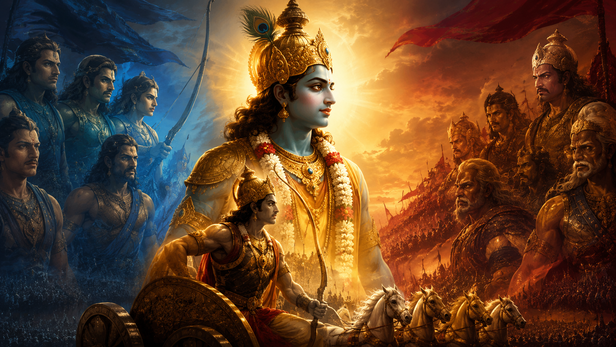
The Mahabharata is often remembered not just as a war between two royal families, but as a larger philosophical narrative about dharma, human weakness, and divine intervention. At the heart of this epic stands Krishna, not as a warrior in the traditional sense, but as a strategist, charioteer, and guide whose presence shapes nearly every major turning point of the Kurukshetra war. This raises one of the most debated questions in Hindu mythology: could the Pandavas have actually won without Krishna’s guidance? The answer is not simple, because the epic itself presents both human capability and divine orchestration working together in a carefully balanced narrative.
Krishna as Strategy, Stability, and Moral Compass
Krishna is not portrayed as a direct combatant in the Kurukshetra war, but his influence extends across emotional, moral, and strategic layers of the conflict. He serves as Arjuna’s charioteer and delivers the Bhagavad Gita, which resolves Arjuna’s moral paralysis at the beginning of the war. Without this intervention, Arjuna’s hesitation is not a minor detail but a critical breaking point. Several traditional interpretations and retellings suggest that Arjuna may have refused to fight entirely without Krishna’s philosophical guidance, which would have collapsed the Pandava war effort at its foundation. In this sense, Krishna is not just a supporter but the stabilizing force that keeps the Pandava side mentally and emotionally intact during extreme pressure.
The Pandavas Were Powerful, But Not Unbreakable
The Pandavas were far from weak. Arjuna was one of the greatest archers of his age, Bhima was unmatched in brute strength, and their alliance with kingdoms like Panchala and Matsya gave them significant military advantage. Historical and narrative analysis of the epic suggests that many key Kaurava warriors were eventually defeated by Pandava forces even in direct combat scenarios. However, the war was not a simple comparison of strength. It was a layered battlefield involving psychological warfare, shifting alliances, moral dilemmas, and moments where rules of war were repeatedly challenged.
Even within the epic itself, it is implied that at several points the Pandava side faced critical losses and near-collapse situations that required external guidance or unconventional strategies to recover.
Krishna as the Architect of Turning Points
The Kurukshetra war is filled with moments where Krishna’s decisions directly alter outcomes. Traditional retellings and later interpretations describe his role as shaping key turning points, such as guiding Arjuna’s focus against Bhishma, influencing events surrounding Jayadratha’s death, and ensuring Karna’s vulnerabilities are strategically exposed. Arjuna is often portrayed as the central warrior whose performance defines the Pandava side. But even his actions are frequently shown as dependent on Krishna’s timing, emotional guidance, and battlefield positioning. Without this coordination, the Pandavas may have had strength individually, but lacked unified direction in moments where confusion or emotional breakdown could shift the war’s outcome.
The Psychological Weak Point: Doubt and Dharma Conflict
One of the most important factors often overlooked is not physical strength, but psychological resistance. The Mahabharata repeatedly shows that Arjuna, and at times other Pandavas, struggle with moral hesitation. Without Krishna’s philosophical framing of duty (dharma), the Pandavas face an internal contradiction: fighting their own relatives, teachers, and elders. This emotional conflict is not secondary; it is central to the narrative tension of the epic. Many traditional interpretations argue that without Krishna’s intervention, this hesitation alone could have reduced the Pandavas’ effectiveness long before any decisive battlefield moment occurred.
Could the Pandavas Still Have Won?
If the war is viewed purely as a military equation, the Pandavas did have strong warriors, powerful allies, and capable commanders. Some interpretations suggest that they could still have inflicted heavy damage on the Kaurava forces, possibly even winning after a prolonged and more chaotic conflict. However, the epic tradition emphasizes that victory in Kurukshetra was not only about force. It was about maintaining dharma in a deeply morally complex war where conventional rules were constantly broken.
Without Krishna’s guidance, the Pandavas may have lacked:
- strategic coordination at critical moments
- emotional stability under extreme loss
- philosophical justification to continue fighting
- unified long-term direction in the war
This makes their victory significantly uncertain rather than guaranteed.
Conclusion: Victory Was Not Just Strength, But Alignment
The question of whether the Pandavas could have won without Krishna does not have a single definitive answer within the epic tradition. What emerges instead is a layered understanding of how the Mahabharata frames success. The Pandavas had strength, skill, and legitimacy on their side, but Krishna provided something different: clarity in confusion, strategy in chaos, and emotional stability in moral crisis. Without him, victory may still have been possible in theory, but the Mahabharata as we know it suggests that it would have been fragmented, far more destructive, and potentially lacking the very concept of dharma that defines the outcome of the war. In that sense, Krishna is not just a participant in victory. He is the lens through which victory itself becomes meaningful.
Unlock insightful tips and inspiration on personal growth, productivity, and well-being. Stay motivated and updated with the latest at My Life XP.