
Gandabherunda: The Most Powerful Forgotten Avatar
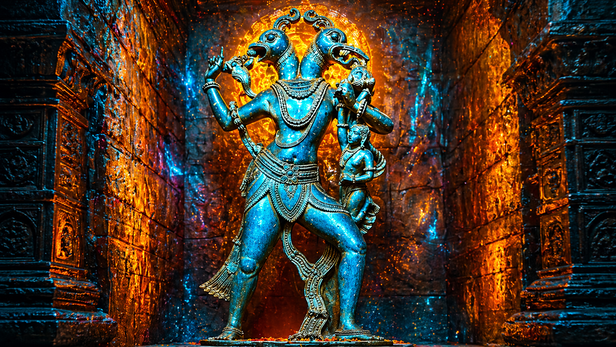
What if one of the most powerful divine forms in Hindu mythology is barely talked about today? We all know the fierce story of Narasimha the protector who appeared to destroy evil. But what happened after that victory is where the real mystery begins. Because the story didn’t end with Hiranyakashipu’s death. It escalated. Into a level of power fear and transformation that even the gods struggled to control.
The Rage That Didn’t End
After defeating Hiranyakashipu, Narasimha did not return to calm. His anger continued to rise, becoming something even the gods could not approach. The energy was no longer just protective it was destructive. Fear spread across all realms. Even Lakshmi hesitated to come near. This moment reveals a powerful idea: even divine forces can cross limits when balance is broken. The problem was no longer evil it was uncontrolled power itself. And something equally powerful was needed to restore cosmic order.
When Shiva Took a Fierce Form
To calm the growing chaos, Shiva manifested as Sharabha a powerful and complex form designed to subdue Narasimha. This was not a simple intervention. It was a direct response to overwhelming force. The battle between these two forms was intense and symbolic. It represented not conflict, but balance destruction meeting control. The universe stood still as two supreme energies collided. But instead of ending the chaos something unexpected happened. The story evolved again, reaching an even deeper level of mystery.
The Rise of Gandabherunda
In response to Sharabha, Narasimha transformed into Gandabherunda a rare and terrifying form with two powerful heads and immense energy. This avatar symbolised ultimate intensity, a force beyond imagination. Its presence alone created fear among gods. The battle now was not just about control it was about dominance of cosmic power. Gandabherunda represents a truth often ignored: when power is challenged, it evolves. This transformation was not weakness. It was escalation. And it pushed the limits of what even divine beings could handle.
A Battle With No Single Ending
Here’s where the story becomes truly fascinating. There is no single ending. Some traditions say Sharabha won. Others believe Gandabherunda emerged victorious. And in some versions, devotion like that of Prahlada brought peace. These variations exist due to “Kalpa Bheda,” meaning different outcomes in different cosmic cycles. This idea changes everything. It tells us that truth is not always fixed. It evolves with time, perspective, and the cycle of creation itself.
What This Story Really Teaches
At its core, this story is not about which form won. It is about balance. Every force, no matter how divine, needs control. Gandabherunda and Sharabha are not enemies they are symbols. One represents unstoppable energy. The other represents regulation. Together, they reflect life itself. We all face moments of intense emotion, power, or anger. The lesson? True strength is not in rising endlessly but in knowing when to stop.
Balance Over Power
The story of Gandabherunda is more than an ancient tale it reflects the struggles we face within ourselves. It reminds us that even the greatest power can become dangerous when it loses balance. Strength without control can create chaos, not victory. In life, we often focus on overcoming others, proving ourselves, or winning battles outside. But the deeper truth is different. The real challenge is within. It is about managing anger, ego, and impulses that rise unexpectedly. True growth begins when we learn to control these forces. Because in the end, mastering yourself is the greatest victory you can ever achieve.
Unlock insightful tips and inspiration on personal growth, productivity, and well-being. Stay motivated and updated with the latest at My Life XP.
Frequently Asked Questions (FAQs)
1. Who is Gandabherunda?
Gandabherunda is believed to be a powerful and rare form associated with Narasimha. It represents extreme strength and unstoppable energy, often described as a two-headed mythical bird symbolising intense power beyond limits.
2. Why did Narasimha take the Gandabherunda form?
After defeating evil, Narasimha’s anger did not calm. To counter the force of Sharabha, he is believed to have taken the Gandabherunda form. This transformation symbolised an escalation of divine energy.
3. What is the Sharabha avatar?
Sharabha is a fierce form of Shiva, created to control and pacify Narasimha’s uncontrollable rage. It represents balance and restraint.
4. Who won the battle between Sharabha and Gandabherunda?
There is no single answer. Different traditions offer different outcomes. Some say Sharabha won, others believe Gandabherunda prevailed, while some say the conflict ended through devotion and divine intervention.
5. Why are there different versions of this story?
This is explained by the concept of cosmic cycles or “Kalpa Bheda,” where events can unfold differently across different ages or universes.