
Karna Was Right but Still Lost the War, Why?
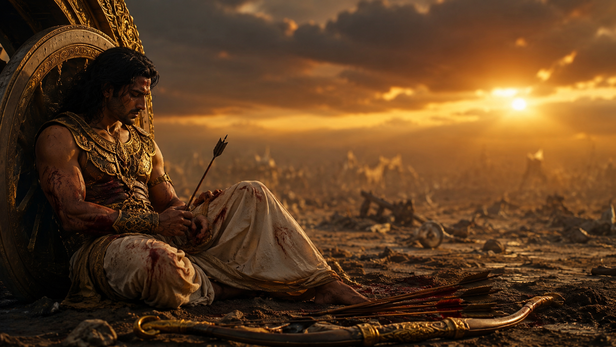
History has a peculiar way of simplifying people into heroes and villains. The Mahabharata, however, resists that simplicity, and nowhere is this more evident than in the life of Karna. Born into abandonment, raised outside privilege, and denied respect despite unmatched talent, Karna’s life reads less like a tale of villainy and more like a story of relentless struggle against fate.
But here’s the uncomfortable twist : Karna was right in his loyalty, his values, and his sense of justice yet he still lost.
This challenges everything we are taught to believe. That good intentions lead to good outcomes. That righteousness ensures victory. Karna’s story quietly dismantles that illusion.
Loyalty vs. Morality: When Standing By Someone Becomes a Trap
Karna’s greatest virtue was his unwavering loyalty to Duryodhana but it was also his greatest downfall. Duryodhana gave him dignity when the world mocked him. In return, Karna gave him absolute allegiance. From Karna’s perspective, this wasn’t blind loyalty. It was gratitude. It was honoring the one person who saw his worth when others didn’t. But here lies the tension: Can loyalty still be “right” when it supports a fundamentally unjust cause? Karna knew Duryodhana’s flaws. He wasn’t naive. Yet he chose to stand by him, even when it meant opposing dharma. In his mind, abandoning Duryodhana would have been a betrayal worse than fighting against righteousness. This is where Karna’s “rightness” becomes complicated. His intention was pure, but his alignment was flawed.
The Burden of Identity: Fighting a Battle You Didn’t Choose
Karna’s life begins with rejection. Born to Kunti but abandoned at birth, he grows up as a charioteer’s son, constantly reminded of his “place” in society. His fight was never just about the battlefield, it was about legitimacy. Every insult he endured, every opportunity denied to him, pushed him toward a path where proving himself became more important than questioning where he stood. His rivalry with Arjuna wasn’t just personal; it was symbolic of everything Karna was denied. So when Duryodhana offered him a kingdom, it wasn’t just generosity, it was validation. In this light, Karna’s choices begin to make sense. He wasn’t choosing adharma; he was choosing dignity. And sometimes, the human need for dignity can outweigh abstract ideals of righteousness.
Generosity That Became Self-Destruction
Karna is often remembered as the ultimate giver. His charity knew no bounds, he would never refuse anyone who asked.
But what happens when virtue becomes excessive? The most defining example is when he gives away his divine Kavach (armor) and Kundal (earrings), knowing fully that it would cost him his life. This wasn’t ignorance, it was a conscious sacrifice. Was this righteousness? Or was it a form of self-sabotage disguised as virtue? Karna’s generosity made him admirable, but it also made him vulnerable. He valued his identity as a giver more than his own survival.And this raises a difficult truth: Even the noblest traits, when taken to extremes, can lead to downfall.
The Tragedy of Knowing the Truth Too Late
One of the most heartbreaking moments in Karna’s life is when Kunti reveals his true identity, that he is the eldest Pandava.
In that moment, everything shifts. He finally has the opportunity to reclaim his rightful place, to stand on the “winning” side, to align with dharma. But he refuses. Not because he doesn’t care but because he cares too much. Walking away from Duryodhana at that point would mean abandoning the one relationship that defined his life. Karna chooses consistency over correction. He chooses loyalty over truth. Was that wrong? Or was it, in its own way, deeply honorable? This moment defines Karna’s tragedy: He knew the right path, but chose not to take it.
Destiny vs. Choice: Was Karna Meant to Lose?
Karna’s life constantly walks the line between fate and free will. He was cursed multiple times. His chariot wheel sinks at the worst possible moment. His knowledge fails him when he needs it most. It almost feels as though the universe itself was aligned against him. But was it just destiny or the cumulative result of his choices? Karna had moments where he could have altered his path. He could have distanced himself from Duryodhana. He could have accepted Kunti’s offer. He could have chosen dharma over loyalty. Yet, each time, he chose the path that felt right to him emotionally, even if it was strategically flawed. And that’s where the deeper lesson lies: Sometimes, we don’t lose because we are wrong. We lose because we are attached to people, to identities, to narratives that no longer serve us.
The Cost of Choosing Loyalty over Alignment
Karna’s story is not about a villain who lost. It’s about a man who was, in many ways, right, and still failed.
He was right to seek dignity.
Right to value loyalty.
Right to give without hesitation.
But life doesn’t reward isolated virtues. It rewards alignment. Karna’s tragedy lies in the fact that his virtues were pointed in the wrong direction. His loyalty served injustice. His generosity weakened his own position. His sense of honor prevented him from correcting his path. And that’s the unsettling truth his story leaves us with: Being right in intention does not guarantee the right outcome. Sometimes, the difference between winning and losing isn’t about morality but about where you choose to stand when it matters most.
Unlock insightful tips and inspiration on personal growth, productivity, and well-being. Stay motivated and updated with the latest at My Life XP.