
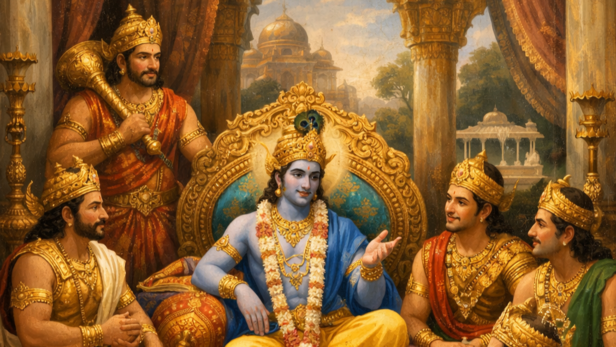
For centuries, the Mahabharata has stood not merely as a monumental epic of ancient India, but as a story woven into the very fabric of South Asian culture, philosophy and spirituality. Generations have grown up hearing its tales of heroism, tragedy, divine intervention and moral conflict, and yet one question continues to spark passionate debate across dinner tables, classrooms and online forums alike: Was the Mahabharata real history or a grand myth crafted to convey timeless truths?
This question- deceptively simple on the surface- unfolds into layers of history, archaeology, literature and belief that refuse to be neatly categorised. Today, with the lens of modern research, we can begin to explore what ancient evidence actually reveals about the possibility that the Mahabharata’s events may have roots in real human history.
At the heart of this discussion is the understanding that the Mahabharata is not just a story preserved in a single manuscript; it is a vast tradition transmitted over millennia, with echoes in archaeological sites, ancient cultures and even linguistic and material traces across the Indian subcontinent.
Echoes in the Earth: Archaeological Clues Across India
One of the most compelling avenues for understanding the Mahabharata’s historicity is archaeology. Across northern India, numerous sites have yielded artefacts and settlement remains that correspond- at least in broad strokes- to descriptions found in the epic.
Excavations at places like Hastinapur, believed to be the ancient capital of the Kuru dynasty, have uncovered Painted Grey Ware (PGW) - a type of pottery that archaeological dating places roughly in the first half of the second millennium BCE. This material culture has been associated with early historic and protohistoric settlements in the region and aligns with the period some scholars tentatively suggest for the events described in the epic.
Similarly, across more than thirty-five archaeological sites in North India, artefacts such as copper utensils, iron tools, seals and pottery have been unearthed, leading some researchers to argue that these finds correlate with the urban and martial life depicted in the Mahabharata.
In regions like Old Delhi- historically linked with Indraprastha, the legendary Pandava capital- PGW fragments and settlement remains have also been found, hinting at ancient occupation layers that may intersect with the era traditionally associated with the epic’s narrative. Then there is the submerged city near Dwarka off the coast of Gujarat, which some marine archaeologists and historians have connected with the legendary kingdom of Krishna. While interpretations vary, the very existence of ancient submerged structures fuels curiosity about how mythic descriptions might intersect with geological and archaeological reality.
History and Text: Where Literature Meets Evidence
Historical inquiry into the Mahabharata is complicated by the very nature of the text itself. The epic was composed and transmitted over centuries, blending narrative, philosophy, genealogy and mythic imagination. As a result, scholars caution against treating it as a straightforward historical chronicle in the modern sense.
Yet this does not render the Mahabharata entirely divorced from historical possibility. Historians often treat the epic as a source- not a definitive record- which must be read alongside material evidence, linguistic patterns and comparative studies of ancient texts. Some estimates based on genealogical lists and archeo-astronomical interpretations suggest that a core conflict could plausibly have roots in the late second or early first millennium BCE, even if later embellishments were added over time.
In this light, the Mahabharata can be seen as a fusion of history and myth - where real cultural memories of conflict, kingship and social change became interwoven with narrative layers that express philosophical and moral depth.
Belief, Skepticism and the Space In Between
Across academic circles and public discourse, there is no consensus on a singular historical truth behind the Mahabharata. Some argue that, in the absence of direct, incontrovertible archaeological evidence - such as inscriptions or mass graves conclusively tied to the epic’s battle - the Mahabharata remains fundamentally a mythologized narrative.
Others take a more nuanced view, suggesting that even if the Mahabharata is not a literal historical record, it may preserve memories of ancient social conflicts or real inter-tribal struggles that were later dramatised and expanded into epic form. The debate is not simply about fact versus fiction, but about how human societies remember, transform and transmit the past.
Why This Matters Today
Whether the Mahabharata is ultimately categorised as history, myth, or something in between, the conversation itself reveals much about how humans understand their past and identity. In a world increasingly interested in uncovering the roots of civilisation and the shared stories that shape cultures, the Mahabharata stands as both a literary masterpiece and a window into ancient human imagination.
The ancient evidence - from pottery shards to submerged ruins, from textual traditions to genetic and linguistic clues - does not deliver a simple verdict. What it does offer is a rich tapestry of clues that encourage us to look beyond easy binaries of “real” and “myth,” and to appreciate how deep human memory can shape, and be shaped by, the stories we tell. In the end, the Mahabharata remains as alive today as it has ever been - not just as an epic of the past, but as a living conversation about who we are, where we come from and how we make meaning out of history itself.
Unlock insightful tips and inspiration on personal growth, productivity, and well-being. Stay motivated and updated with the latest at My Life XP.