
Narada Jayanti 2026: The Truth Behind His Devotion to Vishnu
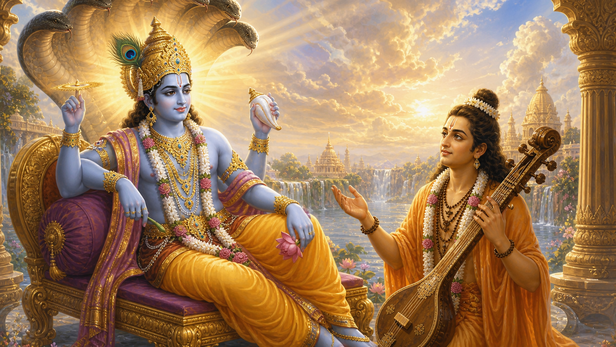
Every year, Narada Jayanti arrives quietly, without the scale of larger festivals, yet it carries a depth that is often overlooked. In 2026, Narada Jayanti will be observed on 2nd May, commemorating the birth of Narada, one of the most fascinating and complex figures in Hindu tradition. Known as a divine sage, a messenger between worlds, and a devoted follower of Lord Vishnu, Narada is often remembered for his constant movement, his presence in critical moments, and his seemingly paradoxical role in many stories. But beneath the surface of these narratives lies a deeper truth about devotion itself, one that goes far beyond what most people assume.
Who Narada Really Is Beyond the Stories
Narada is not just a wandering sage who appears unexpectedly in mythological events. He is described in ancient texts such as the Puranas and the Mahabharata as a Devarshi, a divine sage who moves freely across realms, carrying knowledge, music, and messages between gods, humans, and celestial beings. He is often depicted with a veena in his hand, constantly chanting the name of Vishnu, embodying a form of devotion that is both continuous and alive. What makes Narada unique is that he does not withdraw from the world in silence. Instead, he moves through it, engages with it, and even influences it. His presence is rarely passive. He asks questions, provokes situations, and brings hidden truths to the surface. This active engagement is the first clue to understanding the nature of his devotion.
Why Narada’s Devotion Appears Contradictory
At first glance, Narada’s actions can seem confusing. In many stories, he appears to create conflict, reveal secrets, or trigger events that lead to major consequences. This has led to a common misunderstanding that Narada is a troublemaker. However, this interpretation misses the deeper intention behind his actions. Narada does not create chaos for its own sake. He reveals what is already present but hidden. In many narratives, his interventions expose ego, attachment, or imbalance, forcing characters to confront truths they would otherwise avoid. His role is not to disrupt harmony, but to restore it by bringing clarity. This is a crucial distinction, because it shows that his actions are aligned with a higher purpose, one that reflects his unwavering devotion to Vishnu.
The Deeper Meaning of His Devotion to Vishnu
To understand Narada’s devotion, it is important to understand what devotion means in the context of Hindu philosophy. Devotion, or bhakti, is not limited to rituals or expressions of reverence. It is about alignment with the divine will, about living in a way that reflects truth, balance, and awareness. Narada’s devotion to Lord Vishnu is not passive or confined to prayer. It is dynamic. He serves as a channel through which divine order is maintained. His actions, even when they appear disruptive, are ultimately directed toward restoring balance. In this sense, his devotion is not just emotional. It is functional. It operates through action, speech, and presence.
This is why Narada is often seen as the embodiment of bhakti yoga, the path of devotion. He does not separate spiritual life from worldly interaction. Instead, he integrates the two, showing that true devotion can exist within movement, conversation, and even conflict.
Why Narada Is Always Present at Turning Points
One of the most striking patterns in stories involving Narada is his presence at critical moments. Whether it is a king’s decision, a sage’s penance, or a divine event, Narada often appears just before something significant unfolds. This is not coincidence. It reflects his role as a catalyst. A catalyst does not create change from nothing. It accelerates what is already in motion. Narada’s presence often brings hidden dynamics to the surface, allowing transformation to occur. This aligns with his devotion, because it shows that his purpose is not to control outcomes, but to facilitate the unfolding of dharma.
Narada Jayanti 2026: More Than a Celebration
On 2nd May 2026, as devotees observe Narada Jayanti, the focus is not only on remembering Narada’s birth, but also on reflecting on the nature of devotion he represents. Traditional observances may include prayers, chanting, and reading scriptures, but the deeper significance lies in understanding his example. Narada’s life suggests that devotion is not about withdrawal from the world, but about engaging with it consciously. It is about recognizing that every action, every interaction, and every moment can be an expression of alignment with the divine.
The Truth Most People Miss
The real truth behind Narada’s devotion is that it challenges the way devotion is commonly understood. It shows that devotion is not always calm, quiet, or predictable. Sometimes, it is active, questioning, and transformative. Sometimes, it disrupts in order to heal. Narada represents a form of devotion that is alive, one that does not avoid complexity but moves through it with clarity and purpose. His connection to Lord Vishnu is not based on distance or formality, but on constant awareness and alignment.
Conclusion: A Devotion That Moves, Not Stays Still
Narada’s story is not just about a sage who sings the name of Vishnu. It is about a way of being. It is about a devotion that moves through the world, that engages with life, and that seeks to reveal truth in every situation. As Narada Jayanti 2026 is observed, the deeper message becomes clear. Devotion is not limited to temples or rituals. It is a continuous state of awareness, a way of living that reflects balance, truth, and connection. And perhaps that is why Narada never stays in one place. Because true devotion is not static. It flows, it adapts, and it transforms, just like life itself.
Unlock insightful tips and inspiration on personal growth, productivity, and well-being. Stay motivated and updated with the latest at My Life XP.