
The Divine Shiva Hymn Composed by Ravana That Shook the Gods
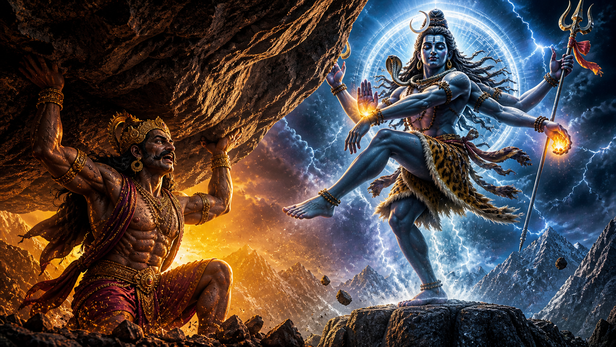
In the vast landscape of Hindu mythology, few compositions carry the same aura of intensity, devotion, and dramatic storytelling as the hymn attributed to Ravana, the legendary king of Lanka, who is remembered both as a powerful scholar and the principal antagonist of the Ramayana. The hymn in question is the Shiva Tandava Stotra, a Sanskrit composition dedicated to Lord Shiva, describing his cosmic dance, his divine attributes, and the overwhelming energy of creation and destruction that defines his presence.
According to traditional belief, this hymn was not created in comfort or peace, but emerged during a moment of extreme tension and spiritual confrontation, where Ravana’s pride, strength, and devotion all collided in a single divine encounter that would later become one of the most powerful devotional compositions in Hindu tradition.
The Kailash Episode and the Moment of Surrender
One of the most widely retold mythological narratives connected to the origin of the Shiva Tandava Stotra takes place at Mount Kailash, the celestial abode of Shiva. In this story, Ravana attempts to lift Mount Kailash in a display of his immense power, but the act is halted instantly when Shiva presses the mountain down with a single movement of his toe, trapping Ravana beneath its weight.
What follows is not destruction, but transformation. Trapped and overwhelmed, Ravana does not succumb to defeat in silence; instead, he begins to sing in praise of Shiva, expressing devotion with extraordinary poetic depth and rhythmic intensity. This moment of surrender is considered the emotional and spiritual origin of the hymn, where arrogance gives way to reverence, and force is replaced by devotion. As per traditional accounts, Shiva, moved by this intense expression of devotion, releases Ravana and even grants him boons, reinforcing the idea that even beings associated with ego and conflict are not beyond the reach of divine grace when sincerity emerges.
The Shiva Tandava Stotra: A Hymn of Cosmic Power
The composition that emerges from this encounter is known as the Shiva Tandava Stotra, a highly rhythmic Sanskrit hymn that glorifies the cosmic dance of Shiva, known as Tandava. This dance is not merely artistic symbolism but represents the eternal cycle of creation, preservation, and dissolution that governs existence itself.
The hymn vividly describes flowing rivers, serpentine ornaments, the crescent moon, and the destructive yet purifying fire associated with Shiva’s third eye. Its language is dense, musical, and deliberately structured to reflect the vibration of cosmic energy, making it one of the most powerful stotras in devotional literature. Scholarly and traditional sources consistently identify it as a classical stotra rather than a “lost” or obscure text, and it remains widely recited in devotional practice even today, firmly establishing its place within living spiritual tradition rather than forgotten mythology.
Ravana Beyond the Label of Darkness
The character of Ravana is often simplified in popular storytelling, yet traditional interpretations present him as a far more complex figure. He is described not only as a ruler and warrior but also as a deeply learned scholar of Vedic knowledge, music, and spiritual practice. His devotion to Shiva, despite his role as an antagonist in the Ramayana narrative, adds layers of philosophical complexity to his character. This duality is precisely what makes the Shiva Tandava Stotra so compelling. It reflects the idea that spiritual depth and moral contradiction can exist within the same individual, and that devotion in Hindu philosophy is not limited by external identity but measured by internal intensity and sincerity.
Why This Hymn Continues to Fascinate Across Generations
The enduring fascination with the Shiva Tandava Stotra lies not only in its mythological origin but also in its literary and spiritual power. The hymn combines poetic brilliance, rhythmic complexity, and devotional intensity in a way that continues to inspire recitation, musical adaptation, and cultural reinterpretation across centuries. Its central theme remains universally powerful: the idea that transformation is always possible, that devotion can emerge even in moments of conflict, and that divine connection is not defined by perfection but by sincerity. In that sense, the hymn attributed to Ravana is not just a mythological artifact, but a continuing reminder of the vast emotional and spiritual spectrum within which Hindu philosophy understands existence itself.
Unlock insightful tips and inspiration on personal growth, productivity, and well-being. Stay motivated and updated with the latest at My Life XP.