
The One Mistake That Triggered Lord Shiva’s Greatest Fury
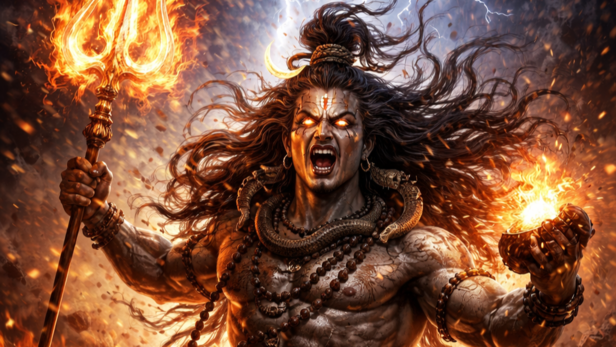
There are moments in Hindu mythology where the universe seems perfectly balanced, where even the most powerful forces remain calm, detached, and beyond the turbulence of emotion- and then there are moments when that balance collapses so completely that even the stillness of a God is shattered. This is one such moment. Because among all the legends of Lord Shiva- the ascetic who sits in deep meditation, the God who forgives with quiet compassion, the force that remains unmoved while the world changes- there exists a story where that calm breaks, where grief transforms into something uncontrollable, and where a single mistake unleashes a fury so immense that it destroys everything in its path.
A Father’s Pride, A Daughter’s Love
Daksha Prajapati was not an ordinary king, but a powerful creator and a man deeply rooted in pride, hierarchy and the visible order of the world, someone who believed that divinity must reflect status, discipline and control. And then there was Shiva. A God who defied every one of those expectations, who lived in cremation grounds, covered himself in ash, wore serpents as ornaments, and existed far beyond the boundaries of social approval or material identity. To Daksha, Shiva was not divine. He was disorder. But to Sati, Daksha’s own daughter, Shiva was not chaos, but truth, and her love for him was not an act of rebellion, but a recognition of something deeper than the world her father believed in. And in that difference began a conflict that would not end quietly.
The Yajna That Became an Insult
When Daksha organized a grand yajna, it was meant to be more than a ritual- it was a declaration of power, prestige and authority, a gathering of gods, sages and celestial beings that would reinforce his place in the cosmic order. Everyone was invited. Everyone except Shiva. This was not an accident. It was a decision. A deliberate act meant to diminish, to exclude and to publicly deny Shiva’s place among the divine.
Sati, upon hearing of the yajna, felt a pull that was impossible to ignore, because it was not just a ritual, but her father’s home, her past, and a part of herself she could not simply abandon, and despite Shiva’s quiet warning, she chose to go. What awaited her there was not acceptance. It was humiliation. Daksha’s words did not merely insult Shiva- they attacked the very foundation of Sati’s love, turning something sacred into something he could dismiss. And in that moment, something irreversible was set in motion.
The Moment That Triggered Everything
Unable to bear the dishonour directed at Shiva, Sati did not respond with anger or argument, because what she felt went beyond confrontation and into something far deeper and more final. In an act that stunned everyone present, she chose to end her life, immolating herself in the very fire that was meant to symbolise purity and devotion, transforming the yajna into a site of tragedy. This was not just an act of despair. It was a breaking point. A moment where love collided with ego- and ego won.
When Shiva’s Silence Turned Into Fury
When the news reached Shiva, the universe did not shake immediately and there was no instant display of anger, because what came first was silence- a silence that carried within it a grief so profound that it could not be expressed in ordinary ways. But grief, when it reaches its deepest form, does not remain still. It transforms. From that grief emerged something the world had never witnessed before- Virabhadra, a fierce manifestation born from Shiva’s pain, not from ego, not from vengeance, but from a loss that could not be contained. And when that force descended upon Daksha’s yajna, it did not merely disrupt the ritual. It destroyed it. The carefully constructed order collapsed, the sacred space turned into chaos and Daksha himself faced the consequence of a mistake that had gone too far to be corrected.
The Consequence That Could Not Be Undone
In the aftermath of destruction, the story takes a turn that is often misunderstood, because Shiva does not leave the world in ruins and in many tellings, he restores Daksha to life, bringing him back not as he was, but transformed, marked by the cost of his actions. But this was not a return to normalcy. It was not a reversal. Because what had been lost- Sati- was not brought back in that moment. And that is where the true weight of the story lies. Because some consequences do not disappear with forgiveness, and some losses do not fade with time. They remain.
Why This Story Still Feels So Powerful Today
This is not just a story about divine anger or destruction, but about something far more human- the way pride can blind a person to truth, the way a single moment of arrogance can undo something sacred, and the way consequences often arrive not as immediate punishment, but as lasting absence.
It reflects a reality that continues to exist even today, where words once spoken cannot be taken back, where actions once done cannot be undone and where the cost of a mistake is not always visible in the moment it is made.
The Final Thought
In the end, this is not simply a story about Shiva’s fury, but about what gave birth to it, because his anger was never just destruction- it was the expression of a grief so deep that it could no longer remain silent, a grief that turned stillness into force and calm into something unstoppable. And that is why this story continues to endure- not because of the violence it contains, but because of the truth it reveals.
That sometimes, it only takes one mistake to trigger something that cannot be controlled, something that does not fade, something that leaves behind a mark far greater than the moment itself. Because in the end, Shiva did not just destroy a yajna. He revealed what happens when even the calmest force in existence is pushed beyond its limit.
Unlock insightful tips and inspiration on personal growth, productivity, and well-being. Stay motivated and updated with the latest at My Life XP.