
Was Mandodari Really Sita’s Mother? Shocking Story
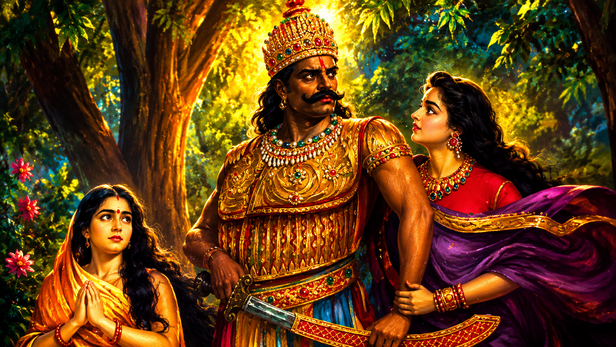
For centuries, devotees have known Mata Sita as the divine daughter of Mother Earth, discovered by King Janak while ploughing the fields. But what if another hidden version of the Ramayana tells a completely different story? A story where Sita was not found accidentally but secretly abandoned. According to some lesser-known Ramayana traditions like the Adbhuta Ramayana and certain Jain Ramayanas, Mata Sita was actually born to Ravana and Mandodari. And fearing a terrible prophecy about his own destruction, Ravana supposedly abandoned the child far away from Lanka. This forgotten tale still shocks many people today.
The Ramayana Version Most People Never Hear About
Most people grow up hearing the Valmiki Ramayana, where King Janak discovers baby Sita while ploughing the earth. But texts like the Adbhuta Ramayana present another mysterious version. According to this story, Sita was actually born in Lanka to Ravana and Mandodari. This version is far less known because it is not considered part of the main traditional narrative followed by most devotees. Yet its shocking twist continues to attract curiosity because it completely changes the emotional relationship between Ravana and Sita in unexpected ways.
The Prophecy Ravana Was Terrified Of
According to the lesser-known legend, a tapasvini once cursed Ravana and declared that she would return as the cause of his destruction. Later, when Mandodari gave birth to a girl child, Ravana feared the prophecy might come true through her. Terrified of his own destiny, he supposedly ordered the infant to be abandoned inside a box and sent away from Lanka. The irony of the story is what makes it unforgettable. The same Ravana who tried escaping fate eventually walked directly toward it, because destiny in ancient epics can never truly be avoided.
How King Janak Found Baby Sita
The story further says that the abandoned child eventually reached Mithila, where King Janak discovered her while ploughing the land during a sacred ritual. Seeing the divine child emerge from the earth, Janak accepted her as a blessing from Bhumi Devi and raised her with immense love and purity. This part of the narrative connects both versions together because even in the alternate tale, Sita ultimately becomes associated with Mother Earth. Her upbringing in Mithila transformed her into the embodiment of grace, sacrifice, patience, and dharma that devotees continue to worship today.
Why This Story Still Creates Debate
The story of Mandodari being Sita’s mother continues to create debate because many people mistake it for the original Ramayana narrative. However, scholars often clarify that this version appears mainly in the Adbhuta Ramayana and certain Jain retellings, not in Valmiki Ramayana. Indian epics have evolved through countless regional and philosophical traditions over centuries, leading to multiple interpretations of the same characters. Some versions focus more on symbolism and destiny rather than historical consistency. That is why stories like these continue to fascinate readers while also creating confusion among devotees unfamiliar with different Ramayana traditions.
The Deeper Symbolism Hidden Inside The Story
Beyond shock and curiosity, many spiritual thinkers see deep symbolism hidden inside this rare narrative. Ravana represents ego, power, and arrogance, while Sita symbolises purity, dharma, and divine truth. In this interpretation, Ravana unknowingly becomes connected to the very force destined to destroy his pride. The story suggests that evil often creates the seeds of its own downfall. No matter how powerful someone becomes, destiny eventually returns balance. This symbolic layer is one reason why alternate Ramayana stories continue surviving through generations despite not being part of the main accepted narrative followed by most Hindus today.
Unlock insightful tips and inspiration on personal growth, productivity, and well-being. Stay motivated and updated with the latest at My Life XP.
Frequently Asked Questions (FAQs)
1. Was Mandodari really Sita’s mother?
According to some lesser-known texts like the Adbhuta Ramayana and certain Jain Ramayanas, Mandodari is described as Sita’s mother. However, this is not the version found in the Valmiki Ramayana.
2. What does the Valmiki Ramayana say about Sita’s birth?
The Valmiki Ramayana states that King Janak found baby Sita while ploughing the earth during a sacred ritual, which is why she is considered the daughter of Bhumi Devi (Mother Earth).
3. Why did Ravana supposedly abandon baby Sita?
In the alternate legend, Ravana feared a prophecy that a girl child would become the reason for his destruction, so he allegedly abandoned the infant far away from Lanka.
4. Which Ramayana mentions this story?
This version mainly appears in the Adbhuta Ramayana and some Jain retellings of the Ramayana, not in the primary Valmiki Ramayana.
5. Is this story accepted by all Hindus?
No. Most devotees primarily follow the Valmiki Ramayana version where Sita is regarded as the divine daughter of Earth.