
The Most Powerful Shiva Mantra That Removes Fear Instantly
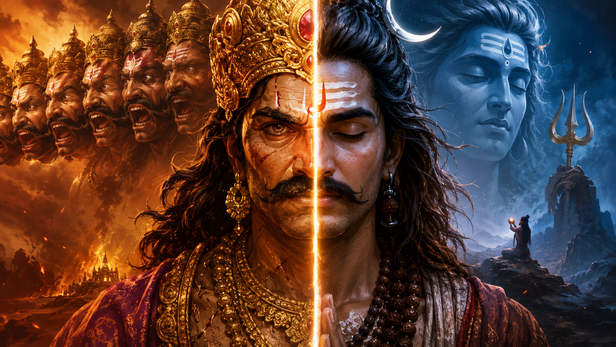
The character of Ravana from the Hindu epic Ramayana is one of the most debated figures in Indian mythology. For centuries, he has been remembered in two completely different ways. In most retellings, he is the powerful antagonist who abducted Sita and fought Lord Rama. At the same time, many traditions describe him as a highly learned scholar and a deeply intense devotee of Lord Shiva. This contrast has created one of the most enduring debates in Hindu storytelling: was Ravana purely a villain, or a misunderstood spiritual figure? The answer is not simple, because different texts, traditions, and cultural interpretations present different layers of his personality. Ravana is not a one-dimensional character, and that is exactly why his story continues to attract attention even today.
1. Ravana as the Villain in the Ramayana Narrative
In the traditional structure of the Ramayana, Ravana is clearly positioned as the antagonist. He is the king of Lanka who abducts Sita, an act that directly leads to the war between him and Lord Rama. In this narrative, Ravana represents adharma, or actions that go against moral and cosmic order, while Rama represents dharma, or righteousness. This moral contrast is central to the epic’s storytelling structure, making Ravana’s defeat a symbolic restoration of balance. He is described as extremely powerful, intelligent, and capable, but his actions are driven by ego, desire, and pride. This is why he is remembered in mainstream tradition as the “villain” of the Ramayana.
2. Ravana as a Devotee of Lord Shiva in Tradition
At the same time, many Hindu traditions and later retellings present Ravana as a devotee of Lord Shiva. He is said to have performed intense penance to gain divine boons and spiritual power. One of the most well-known stories describes Ravana attempting to lift Mount Kailash, the abode of Shiva. In that moment, Shiva is believed to have subdued him, after which Ravana is said to have expressed deep devotion and composed hymns in praise of Shiva. This includes associations with the famous Shiva Tandava Stotra in devotional tradition.
Because of such stories, Ravana is often described as a powerful Shiva bhakt, or devotee, in cultural memory. Some interpretations also highlight his scholarly knowledge, musical talent, and command over spiritual practices. However, it is important to note that not all textual traditions agree on the extent of this devotion. Some scholars and interpretations suggest that references to Ravana’s devotion are more prominent in later traditions rather than strictly in the earliest layers of the epic.
3. The Scholar, King, and Complex Personality
Beyond the debate of devotion and villainy, Ravana is also consistently described as a highly intelligent ruler and scholar. Many traditions portray him as knowledgeable in Vedic learning, political strategy, music, and governance. He is often shown as a capable king of Lanka, with immense administrative and military strength. His intellectual abilities are frequently highlighted, and some accounts describe him as a master of multiple disciplines, including spiritual and worldly knowledge. This complexity is important because it shows that Ravana is not simply a negative character. He is portrayed as someone with both extraordinary qualities and serious moral failures.
4. Why the Interpretations Differ So Much
The difference in opinions about Ravana comes from the layered nature of Hindu mythology itself. Unlike a single fixed narrative, the Ramayana exists in multiple versions across regions and traditions. In one interpretation, Ravana is a clear symbol of ego and adharma, whose downfall teaches moral discipline and righteousness. In another interpretation, he is seen as a tragic figure whose downfall comes not from lack of knowledge or devotion, but from ego, desire, and misused power. Some modern retellings even describe him as a “flawed anti-hero” rather than a purely evil being. This duality is why Ravana continues to generate debate in both religious and cultural discussions.
5. The Deeper Philosophical Lesson Behind Ravana’s Story
At a deeper level, Ravana’s story is not only about good versus evil. It is also about the internal conflict between knowledge and ego. Even if he is accepted as a devotee of Shiva in many traditions, his devotion alone does not define his moral path. His attachment to power and inability to control desire ultimately lead to his downfall in the Ramayana narrative. This creates a broader philosophical message: spiritual knowledge and devotion are meaningful only when balanced with humility and ethical conduct. Without that balance, even great strength can become self-destructive.
Conclusion
So, is Ravana a villain or a great scholar and powerful devotee of Lord Shiva?
The most balanced and factually grounded answer is that Ravana is both a villain in the narrative structure of the Ramayana and a complex figure who is also described as a devotee and scholar in many traditions. He cannot be reduced to a single label. In the Ramayana, he represents adharma and is defeated by Rama. In devotional and cultural interpretations, he is also remembered as a powerful Shiva devotee with immense knowledge and strength. Ultimately, Ravana’s enduring relevance comes from this complexity. He is not just a character of the past, but a symbol of how greatness, ego, devotion, and downfall can exist within the same individual, making his story one of the most discussed and interpreted in Hindu mythology even today.
Unlock insightful tips and inspiration on personal growth, productivity, and well-being. Stay motivated and updated with the latest at My Life XP.