What Everyone Missed in the Mahabharata War
Noopur Kumari | Fri, 24 Apr 2026
In a war filled with uncertainty, one thing remained perfectly balanced food. The king of Udupi fed lakhs of soldiers every day without shortage or waste. His secret wasn’t complex calculation, but careful observation. Each night, he watched Krishna closely. A simple act eating peanuts became a powerful signal. By understanding this pattern, the king adjusted food preparation for the next day. What looked ordinary became extraordinary, turning a small habit into the key to managing one of the largest food systems during the war.

Untold War Secret Behind Zero Food Wastage
Image credit : ChatGPT(ai)
What if feeding millions was not about resources but about understanding signals? During the great war of Mahabharata, when kings were busy choosing sides, one ruler made a different choice. He chose humanity. While warriors fought on the battlefield, he took responsibility for something just as powerful ensuring no soldier slept hungry. And then comes the mystery. For 18 days, not a single grain of food was wasted. No shortage. No excess. Just perfect balance. How did he manage this in the middle of chaos? The answer lies in something so simple it almost feels unbelievable.
![The King Who Stayed Away from Battle]()
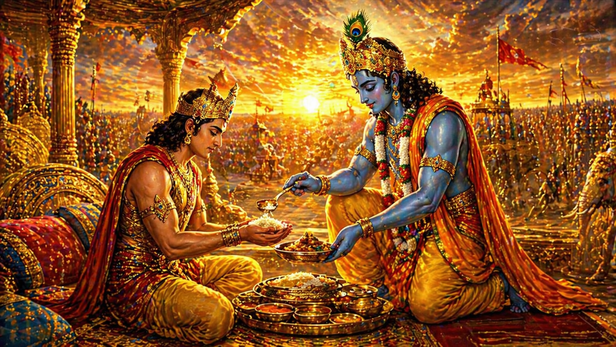
While most rulers picked sides in the war, the Udupi king chose a different path service. Instead of fighting, he took responsibility for feeding soldiers from both sides. This decision was not just strategic, it was deeply humane. In a time of destruction, he focused on sustenance. This shows that true strength is not always in battle, but in supporting life. His role may not have been on the battlefield, but it was essential for survival.
![Massive War Food Preparation]()
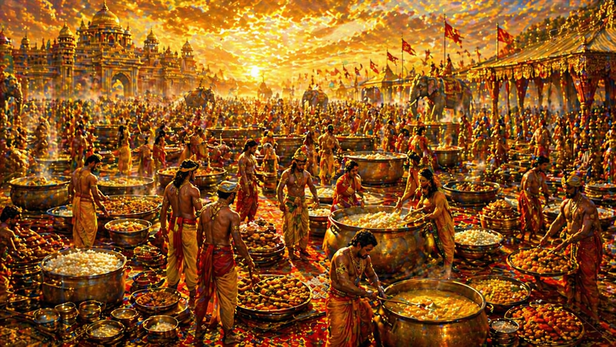
Feeding lakhs of soldiers every single day during war was not a simple task. The number of people could change daily due to casualties and movement. Overcooking meant waste, undercooking meant hunger. In such uncertainty, maintaining balance seemed impossible. Yet, for 18 days, the system worked flawlessly. No excess. No shortage. This was not luck it was a method hidden behind something very simple.
![Krishna Eating Peanuts at Night]()
Every night, the king observed Krishna eating peanuts. This small act became a signal. The number of peanuts Krishna consumed indicated how many soldiers would not return the next day. Based on this, the king reduced food preparation accordingly. It was not magic it was deep awareness and trust. By understanding this pattern, he aligned his actions perfectly with reality.
Using Krishna’s subtle signals, the king adjusted food quantities daily. If more peanuts were eaten, he prepared less food the next day. If fewer, he prepared more. This created a perfect balance. Not a single grain was wasted, and no soldier went hungry. This strategy reflects a powerful lesson when you observe carefully and act wisely, even the most complex problems can be solved with simplicity.
This story is not just about war it is about awareness, service, and responsibility. In today’s world, where food waste is a global issue, this ancient wisdom feels more relevant than ever. The king didn’t just manage food he respected it. He listened, observed, and adapted. That is what made his service extraordinary. It reminds us that solutions are often simple if we are willing to notice them.
Unlock insightful tips and inspiration on personal growth, productivity, and well-being. Stay motivated and updated with the latest at My Life XP.
1. Who was the king of Udupi in the Mahabharata story?
The king of Udupi is mentioned in regional traditions as a wise ruler who chose service over warfare during the Mahabharata. He is remembered for feeding soldiers from both sides.
2. How did he manage to feed so many soldiers?
He used observation instead of calculation. By understanding subtle signals from Krishna, he adjusted food preparation daily to match the exact need.
3. What was Krishna’s role in this story?
Krishna indirectly guided the king. His simple act of eating peanuts each night was interpreted as a signal to estimate the next day’s food requirement.
4. Why is this story not widely known?
This story comes from regional and oral traditions rather than mainstream versions of the Mahabharata, which is why it is less commonly discussed.
5. Is this story symbolic or literal?
It can be seen both ways. Symbolically, it teaches awareness, observation, and wise resource management during uncertain times.
WHEN ONE KING CHOSE HUMANITY OVER WAR
The King Who Stayed Away from Battle
Image credit : ChatGPT (ai)
While most rulers picked sides in the war, the Udupi king chose a different path service. Instead of fighting, he took responsibility for feeding soldiers from both sides. This decision was not just strategic, it was deeply humane. In a time of destruction, he focused on sustenance. This shows that true strength is not always in battle, but in supporting life. His role may not have been on the battlefield, but it was essential for survival.
THE CHALLENGE OF FEEDING MILLIONS
Massive War Food Preparation
Image credit : ChatGPT (ai)
Feeding lakhs of soldiers every single day during war was not a simple task. The number of people could change daily due to casualties and movement. Overcooking meant waste, undercooking meant hunger. In such uncertainty, maintaining balance seemed impossible. Yet, for 18 days, the system worked flawlessly. No excess. No shortage. This was not luck it was a method hidden behind something very simple.
KRISHNA’S SIMPLE BUT POWERFUL SIGNAL

Krishna Eating Peanuts at Night
Image credit : ChatGPT(ai)
Every night, the king observed Krishna eating peanuts. This small act became a signal. The number of peanuts Krishna consumed indicated how many soldiers would not return the next day. Based on this, the king reduced food preparation accordingly. It was not magic it was deep awareness and trust. By understanding this pattern, he aligned his actions perfectly with reality.
THE STRATEGY THAT PREVENTED WASTE
A LESSON BEYOND THE BATTLEFIELD
Unlock insightful tips and inspiration on personal growth, productivity, and well-being. Stay motivated and updated with the latest at My Life XP.
Frequently Asked Questions (FAQs)
The king of Udupi is mentioned in regional traditions as a wise ruler who chose service over warfare during the Mahabharata. He is remembered for feeding soldiers from both sides.
2. How did he manage to feed so many soldiers?
He used observation instead of calculation. By understanding subtle signals from Krishna, he adjusted food preparation daily to match the exact need.
3. What was Krishna’s role in this story?
Krishna indirectly guided the king. His simple act of eating peanuts each night was interpreted as a signal to estimate the next day’s food requirement.
4. Why is this story not widely known?
This story comes from regional and oral traditions rather than mainstream versions of the Mahabharata, which is why it is less commonly discussed.
5. Is this story symbolic or literal?
It can be seen both ways. Symbolically, it teaches awareness, observation, and wise resource management during uncertain times.