
What Happened After Kamadeva Was Burned? The Truth
What if one of Hindu mythology's most powerful demons was not born from evil but from a misunderstanding of desire itself? Most retellings stop at the moment when Lord Shiva opens his third eye and burns Kamadeva to ashes. The story sounds complete. Yet an extraordinary chapter is often left untold. Those ashes did not simply disappear. They became the source of a force that threatened the balance of the universe. Hidden inside this ancient narrative is a lesson about human nature, temptation, and the battle between wisdom and unchecked desire. The deeper you go, the more relevant this story becomes to modern life.
When Creation Needed Shiva and Shakti
The story begins at a crucial moment in cosmic history. The demon Tarakasura had become nearly invincible, and only the birth of Kartikeya could defeat him. For that to happen, Lord Shiva and Goddess Shakti needed to unite. However, Shiva was deeply absorbed in meditation, detached from worldly distractions. The balance of creation depended upon awakening him from this state. It was not merely a personal matter but a cosmic necessity. The fate of gods, sages, and the three worlds rested upon a single event that seemed impossible to achieve.
The Secret Role of Goddess Kamakshi
A lesser-known tradition tells us that Kamadeva did not directly approach Shiva without preparation. Before undertaking his mission, he sought the blessings of the Divine Mother. As Kamakshi, the Goddess is said to have held Kamadeva within her compassionate gaze and granted him a subtle shadow form. This detail changes the way we understand the story. It suggests that divine forces were already at work behind the scenes. The mission was not merely an act of temptation but part of a larger cosmic design that would eventually lead to both destruction and transformation.
The Moment Desire Met Absolute Awareness
When Kamadeva released his arrows toward Lord Shiva, something extraordinary happened. Shiva's third eye opened, and the force of divine consciousness reduced the shadow form to ashes. Symbolically, this moment represents what happens when pure awareness confronts attachment and illusion. The story is not condemning desire itself. Desire is essential for creation, growth, and continuity. Rather, it reveals that when desire attempts to disturb higher consciousness without balance, it cannot survive in its distorted form. The fire of wisdom burns away everything that is incomplete or false.
The Demon Born From Misguided Desire
The most fascinating part of the story begins after the burning of Kamadeva. From those ashes arose Bhandasura. Symbolically, Bhandasura represents desire stripped of its sacred purpose. When human longing is reduced only to physical pleasure, possession, and self-indulgence, it loses its creative power and becomes destructive. This is the deeper meaning behind his birth. He was not born from pure desire but from desire disconnected from wisdom. Such desire multiplies greed, anger, jealousy, and ego just as Bhandasura's vast armies multiplied across the battlefield.
The Inner Battle We All Face
The story becomes truly powerful when viewed as an inner journey. Bhandasura is not merely a mythological figure; he symbolizes the chaos that emerges when desires take control of our lives. Obsession with status, pleasure, validation, and material gain can slowly create inner conflict. One unchecked desire often leads to another, forming an army of distractions. The result is anxiety, dissatisfaction, and spiritual emptiness. Ancient sages understood that the greatest battles are not fought outside but within. The story invites us to identify and confront the forces that disturb our inner harmony.
Why Lalita Tripura Sundari Appeared
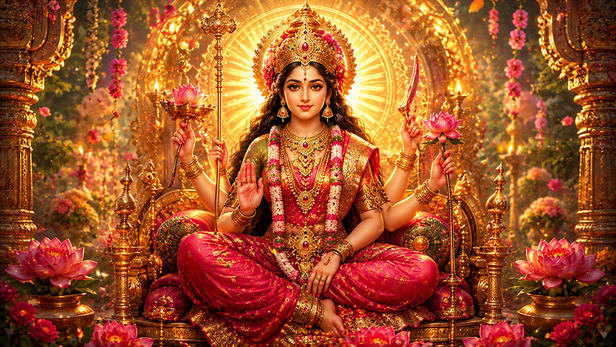
When the gods found themselves unable to defeat Bhandasura, a higher force emerged. Goddess Lalita Tripura Sundari appeared as the embodiment of supreme wisdom, beauty, and divine consciousness. Her appearance carries a profound message. Darkness created by ignorance cannot be defeated through force alone. It requires knowledge, awareness, and spiritual awakening. Lalita does not merely destroy a demon; she dissolves the illusion that gave birth to him. Her victory symbolizes the triumph of higher understanding over confusion, attachment, and uncontrolled desire.
The Lesson Hidden in the Myth
The deepest teaching of this story is not about suppressing desire but transforming it. Desire itself is neither good nor bad. It becomes dangerous only when disconnected from purpose, wisdom, and self-awareness. When guided by higher values, desire fuels creativity, relationships, growth, and service. When left unchecked, it creates inner turmoil. The journey from Kamadeva to Bhandasura and finally to Lalita Tripura Sundari reflects the path every person must walk from instinct to awareness, from attachment to understanding, and from confusion to clarity.
Unlock insightful tips and inspiration on personal growth, productivity, and well-being. Stay motivated and updated with the latest at My Life XP.
Frequently Asked Questions (FAQs)
1. Who was Kamadeva in Hindu mythology?
Kamadeva is the Hindu god of love, attraction, and desire. He is often depicted carrying a sugarcane bow and flower-tipped arrows that awaken affection and creative energy in living beings.
2. Why did Kamadeva approach Lord Shiva?
According to Hindu traditions, the gods needed Lord Shiva and Goddess Parvati to unite so that their son, Kartikeya, could be born and defeat the powerful demon Tarakasura. Kamadeva was sent to awaken Shiva from deep meditation.
3. Why did Lord Shiva burn Kamadeva?
When Kamadeva attempted to disturb Shiva's meditation, Lord Shiva opened his third eye. The intense fire of divine consciousness reduced Kamadeva's manifested form to ashes, symbolizing the power of spiritual awareness over distraction and attachment.
4. Who was Bhandasura?
Bhandasura was a powerful demon said to have emerged from the ashes associated with Kamadeva's destruction. In spiritual interpretations, he represents distorted desire, ego, and uncontrolled worldly attachments.
5. What does Bhandasura symbolize?
Bhandasura symbolizes desires that have lost their higher purpose and become driven solely by ego, greed, and material obsession. His story serves as a warning about the consequences of allowing unchecked desires to control one's life.