
What Happens After Death? The Mahabharata’s Answer
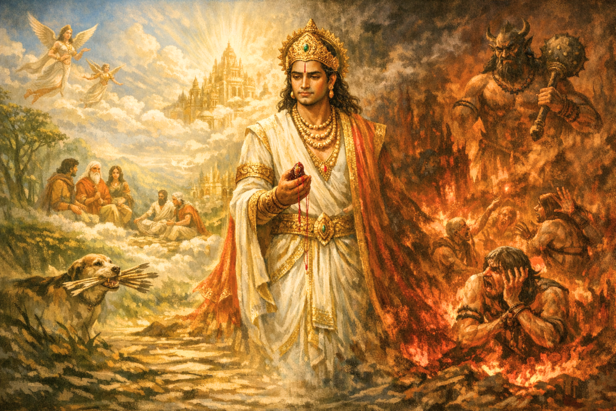
Death is one of the few certainties in human life- and yet, it remains the greatest mystery. Across civilisations, religions and philosophies, people have asked the same question in countless ways: What happens when everything ends? The Mahabharata, one of the most profound and complex texts ever written, does not offer a simple answer. Instead, it offers something far more unsettling, far more layered- a vision of life after death that is not an ending, but a continuation. And in that continuation lies a truth that is both comforting and deeply uncomfortable.
Death Is Not the End- It Is a Transition
In the world of the Mahabharata, death is never treated as a final moment of disappearance. It is described as a passage- a shift from one state of existence to another. The body falls, but something essential continues. This idea is not presented as abstract philosophy alone; it is woven directly into the lives and fates of its characters. Warriors die on the battlefield, kings fall from power, loved ones are lost- but none of them simply vanish. They move forward into another realm shaped not by chance, but by their actions. Because in the Mahabharata, what follows death is not random. It is earned.
Heaven and Hell Are Not What You Think
One of the most striking revelations in the Mahabharata is its portrayal of heaven and hell- not as permanent destinations, but as temporary experiences shaped by karma. The story of Yudhishthira’s final journey reveals this with unsettling clarity. After renouncing his kingdom and walking toward the Himalayas, he becomes the only one among the Pandavas to reach heaven in his mortal form. But what he sees there is not what he expects.
Duryodhana- the very man responsible for immense suffering- is seated in glory. And those he loved- his brothers, Draupadi- are nowhere to be found. Disturbed and unwilling to accept this, Yudhishthira demands answers. He is then taken on a journey that feels like a descent into hell, where he hears the voices of his loved ones suffering. It is only later revealed that this experience is a test. A revelation. A truth about the nature of the afterlife itself.
Karma Decides Everything- But Not Forever
The Mahabharata suggests that after death, the soul experiences the results of its actions- good and bad- but not in a permanent, eternal sense. Even the most virtuous are not entirely free from error, and even the flawed are not entirely devoid of goodness. As a result, souls may experience both heaven and hell, depending on the balance of their deeds. Yudhishthira himself, known for his righteousness, is briefly shown hell because of a single moral compromise- the moment he deceived Dronacharya during the war.
This is where the Mahabharata becomes deeply philosophical. It suggests that no action disappears. Every choice leaves a trace. And after death, those traces shape what comes next.
Rebirth: The Journey Continues
Perhaps the most profound idea the Mahabharata presents is that even heaven is not the final destination. After the rewards of good deeds are exhausted, the soul does not remain there forever. It returns. It is reborn. Life, death, afterlife, and rebirth form a cycle- a continuous movement rather than a straight line.
This means that existence does not end with a single lifetime. It evolves. And what you carry forward is not your wealth, your status, or your identity. It is your actions.
Dharma: The Only Thing That Follows You
In one of its most powerful teachings, the Mahabharata emphasises that everything external is left behind at death. Relationships, possessions, achievements- all fade. Only one thing remains. Dharma. Righteousness. The way you lived your life.
It is said that while everything else abandons a person at the moment of death, their actions remain as their only companion into the next world. This idea transforms the question of death into something far more immediate. Because it suggests that what happens after death is not decided at the moment of dying. It is decided every day while living.
The Most Unsettling Truth
What makes the Mahabharata’s vision of the afterlife so powerful is that it does not divide the world into simple categories of good and evil. Instead, it presents a more complex, more human reality. The same person can be capable of greatness and failure. Of virtue and mistake. And the afterlife reflects that complexity. Yudhishthira sees heaven and hell not as fixed places, but as experiences that reveal the full weight of one’s life- not just its highlights, but its shadows.
The Final Thought
So what happens after death, according to the Mahabharata? You do not disappear. You continue. You experience what you have created through your actions. You move through realms shaped by your own life. And eventually, you return. Not as the same person- but carrying the invisible imprint of everything you once were. And perhaps that is the most haunting answer of all: Death does not end the story. It simply reveals what the story has become.
Unlock insightful tips and inspiration on personal growth, productivity, and well-being. Stay motivated and updated with the latest at My Life XP.